Skip to content

Posts from the ‘Interlocutors’ Category

New Successes for Teri Klassen’s Work in Quilt Studies

Teri Klassen has recently completed her doctoral qualifying exams in folklore here at Indiana University in preparation for a doctoral dissertation focused on the social life of quilts in the United States. She has also now received grant funding for a phase of her project titled “Quilt Styles of West Tennessee Sharecroppers and Tenant Farmers of the Early to Mid 1900s.” Her award is the 2008-2009 Lucy Hilty Research Fund Grant  given by the American Quilt Study Group.

Earlier this year, she curated the exhibition “Family Patterns of Tradition” for Bloomington Restorations Inc. It is an exhibit of 32 quilts made from about 1930 to 2000 by Erdine Brown and two of her daughters, Betty Cates and Faye Doolin, of western Kentucky. The exhibit will be open to the public one more time, from 1-4 p.m., Saturday, May 31, at BRI headquarters, 2920 E. Tenth Street, Bloomington IN 47408. For more information, call BRI (812) 336-0909.

Two More Great Museum Posts: Hertz and Ingalsbe

Following up on news of Jim Seaver’s summer position at the National Gallery of Art, I am pleased to report on two more IU students (and Curatorship course alumni) headed to great paid graduate internships for the summer. Carrie Hertz, a doctoral student in the Department of Folklore and Ethnomusicology, will be headed to Stratford Hall (birthplace of Robert E. Lee), for a position in its Textile Collection, while Suzanne Godby Ingalsbe, also a doctoral student in folklore, will be headed to the Metropolitan Museum of Art where she will also work with textiles in its Antonio Ratti Textile Center. These are wonderful summer museum jobs going to excellent students. Congratulations!

Grant Recipient Michael P. Jordan

Congratulations go to Michael P. Jordan, Ph.D. student in the Department of Anthropology at the University of Oklahoma, upon his reciept of two significant grant awards in support of his upcoming doctoral research in Southwestern Oklahoma. Mike has been awarded a Jacobs Fund Grant from the Whatcom Museum Society and a Morris and Lucille Opler Research Award from the OU Department of Anthropology. Mike has a significant track record of research work in the ethnography and ethnohistory of the Southern Plains and is a museum anthropologist with a number of projects to his credit. He is also involved in the work of publishing Museum Anthropology Review. Well done.

MAR 2(1) Now Published

We are very pleased that the next issue of Museum Anthropology Review (volume 2, number 1) has just been published. Find it here. The issue contains some fine reviews as well as two peer-reviewed articles. These articles are the first peer-reviewed works to appear in the journal. Find more information on the new issue here.

Cultural Analysis

I am happy to have recently accepted an invitation to join the editorial board for Cultural Analysis, an excellent open access journal whose virtues I have celebrated on several occasions (such as here, here, and here). As its editors describe it:

Cultural Analysis is an interdisciplinary, peer-reviewed journal dedicated to investigating expressive and everyday culture. The journal features analytical research articles, but also includes notes, reviews, and cross-disciplinary responses. Cultural Analysis is global in scope, with an international editorial board.

Best wishes to the journal and to everyone involved in its work. Keep its free, easy to access offerings in mind in your teaching and research and consider sending them your most complelling manuscripts.

James Seaver at the National Gallery of Art

Congratulations go to IU Department of History doctoral student James Seaver, who has just been awarded a nine-week summer internship in the Curatorial Records and Files Division of the National Gallery of Art in Washington, DC. Along with sophisticated general training and experience in museum work, Jim will have an opportunity to focus on World War II provenance issues in a museum context. This theme relates to his wider interesta in the circulation of material culture in times of war and in the contemporary significance of World War II associated objects.  A Ph.D. minor in Folklore and Ethnomusicology, Jim participated during 2007 in the Curatorship and Theories of Material Culture graduate seminars.

Four Great Material Culture Papers

Today, on the first day of the Central States Anthropological Association meetings in Indianapolis, Indiana, four members of the IU Department of Folklore and Ethnomusicology gave outstanding papers reflecting their broader work in the study of material culture.  Panel organizer Teri Klassen gave a fine museum-based, collections-study paper looking at a collection of Eastern Cherokee dolls in the collections of the Mathers Museum.  Gabrielle A. Berlinger presented her current thesis research on commonalities and variation in the meaning of Sukkah building in the Jewish community of Bloomington, Indiana.  Carrie Hertz presented her work on “inalienable clutter” in the lives and closets of middle class twenty-somethings and Liora Sarfati explored the role of commercially produced and distributed material culture in the practice of contemporary Korean shamanism. Liora’s paper was a first public glimpse of recently completed doctoral fieldwork undertaken last year in Seoul, South Korea.  All four papers were first rate works, combing closely studied detail and smart analysis. The audience was large (as these things go) and attentive.  The panel followed on a fine group of museum studies presentations by a team of Butler University undergraduates, making it a great day for museum and material culture studies at CSAS.

A Bronx Botánica Opens its Doors in Bloomington, Indiana

By Gabrielle Berlinger

With the arrival of the vernal equinox, “Botánica: A Pharmacy for the Soul” opened its doors to the public this past Friday at the Mathers Museum of World Cultures in Bloomington, Indiana. This exhibition, the Masters Project of doctoral student in folklore Selina Morales, is the culmination of her years of her research into different dimensions of space, constructions of identity, cultural materials, and systems of belief that are produced in the botánica, a store that sells items necessary for practicing a variety of Afro-Caribbean religions. In the gallery at the back of the Museum’s first floor, Selina recreated the botánica that her Puerto Rican grandmother, Jerusalén Morales-Díaz, owned and ran in New York City from 1985 to 1991. Selina draws on memories, family stories, and her ethnographic fieldwork in New York, New Jersey, and Puerto Rico to contextualize and communicate the experience of Jerusalén as proprietor of the botánica.
pegboard.jpg
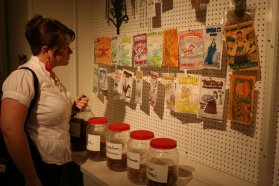
1. A visitor examines the baños, or baths, that hang on the pegboard display.

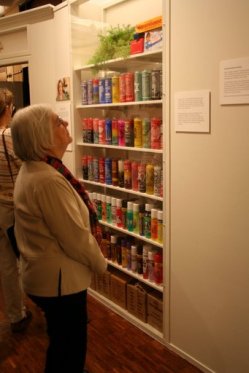
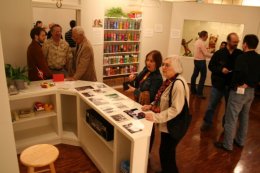
During the two-hour opening, over 250 people entered the exhibition and stepped into a botánica, guided by the Morales family’s memories. The front door of the store, flanked by recreated city brick walls tagged with graffiti, opens into a main room where photographs of Jerusalén’s family and clients in the botánica are displayed behind and on top of the proprietor’s counter. The walls of the room alternately display cases with altars to deities of the Afro-Caribbean religions, and objects sold for ritual practice. Colorful candles line one wall from floor to ceiling, while another is covered in pegboard from which pouches of bath salt, beaded necklaces, and other religious materials hang. The items’ vibrant colors set against the store’s white walls jump out and draw visitors in to read the contextualizing labels that quote Jerusalén, Selina, and other family members explaining the meaning of these objects and this space. A semi-enclosed room behind the counter area recreates the private area in which Jerusalén would consult clients who visited her botánica for healing and advice.
candles.jpg
2. A visitor examines the wall of candles.

This opening day was a momentous event for many people. It celebrated Selina’s long-term research, material collection, and exhibition curation, and introduced a rich case study of Afro-Caribbean religious belief, material culture, and practice that the Bloomington public may now engage in mind and body, through memory, sight, sound, smell, and touch.

Both of Selina’s grandmothers and one grandfather, her aunt, and her brother were all in attendance for the opening. A steady stream of family, friends, and new visitors toured the exhibition, spooned clean large platters of hot Puerto Rican food (Pernil [roast pork], arroz con gandules [rice with pigeon peas], yucca con mojo [yucca with garlic-olive oil sauce], and crackers with guava paste and white cheese), and enjoyed the music of Sancocho, an Afro-Caribbean drum group, that entertained in the adjoining room.
counter.jpg
3. A view of the main room from behind the proprietor’s counter.

Selina deserves great congratulations on the opening of such an impressive exhibition that has created a space in which the community may consider notions of healing, family, love, creativity, and spirituality. Her beautiful creation makes all of us – her family, friends, and colleagues – proud to share in her life’s work and in the work of folklore.

For more on the exhibition, see Selina Morales’ blog:
www.botanica-jardines.blogspot.com

Thanks to Gabi Berlinger for this great guest post. Selina’s exhibition is wonderful and the lively, crowded, fun opening was Bloomington’s museum event of the year. Congratulations to Selina and to the Mathers Museum staff on a job well done–Jason.

Hertz on Barthes on Fashion

Congratulations to Carrie Hertz on the publication of a fine review of The Language of Fashion, a posthumous collection of works by Roland Barthes. Carrie’s review has appeared in Journal of Folklore Research Reviews. Find it here.

IU Symposium on Dress and Adornment: Call for Papers

IU Symposium on Dress and Adornment
Saturday, April 19, 2008
Call for Papers

Dress and adornment in 19th-century women’s fashion will be explored in an exhibit at the Wylie House Museum during the months of April and May.  Wylie family letters, fashion publications of the time, photographs, and later scholarship are used to put garments and accessories from the Sage Collection and the Wylie House Museum into context.  Wylie House visitors can explore timeless topics such as gendered roles, body image, trend transmission, and technology’s effects on fashion in this exhibit installed throughout the rooms of this historic house museum.

In conjunction with the exhibit at the Wylie House, The Department of Folklore and Ethnomusicology presents the IU Symposium on Dress and Adornment to be held on Friday, April 18 and Saturday, April 19.  On Friday at 3 p.m., participants are invited to the Wylie House for a curator’s discussion of the exhibit to kick off the symposium.  On Saturday from 10 a.m. to 5 p.m., faculty and students will present papers on the topics of dress and adornment. These presentations will take place at the Indiana University Memorial Union.

We invite paper abstracts on any topic of dress and adornment. Please submit a 250-word abstract that characterizes the twenty-minute oral presentation you propose to give at the symposium on April 19. Abstracts should accompany a short personal statement about you and your interests. Please email abstracts and personal statements as Word or Rich Text attachments to Suzanne Ingalsbe at sgodby@indiana.edu by February 29, 2008.

We hope to see you all at the Wylie House on Friday and at the symposium on Saturday.

Jason Jackson, Suzanne Ingalsbe, and Pravina Shukla, Symposium Organizers