Skip to content

Posts from the ‘Good News’ Category

Gabrielle Berlinger Defends M.A. Thesis

Congratulations to Gabrielle Berlinger who completed her M.A. in Folklore in the Department of Folklore and Ethnomusicology at Indiana University today with a very successful oral exam covering her studies in general and her thesis project “Ritual Interpretation: The Sukkah as Jewish Vernacular Architecture” in particular. Her well recieved thesis is an ethnography of Sukkot observance in Bloomington, Indiana, with an emphasis of the physical structures built and used by families and community organizations here. A significant contribution to research on Jewish material culture and to the study of Jewish life in the smaller communities of North America, the study is also a pilot project for future examinations of the topic in other communities elsewhere in the world. Her committee was uniformly pleased with her efforts and I am very proud to have served as her chair. Well done.

On The Grace of Four Moons

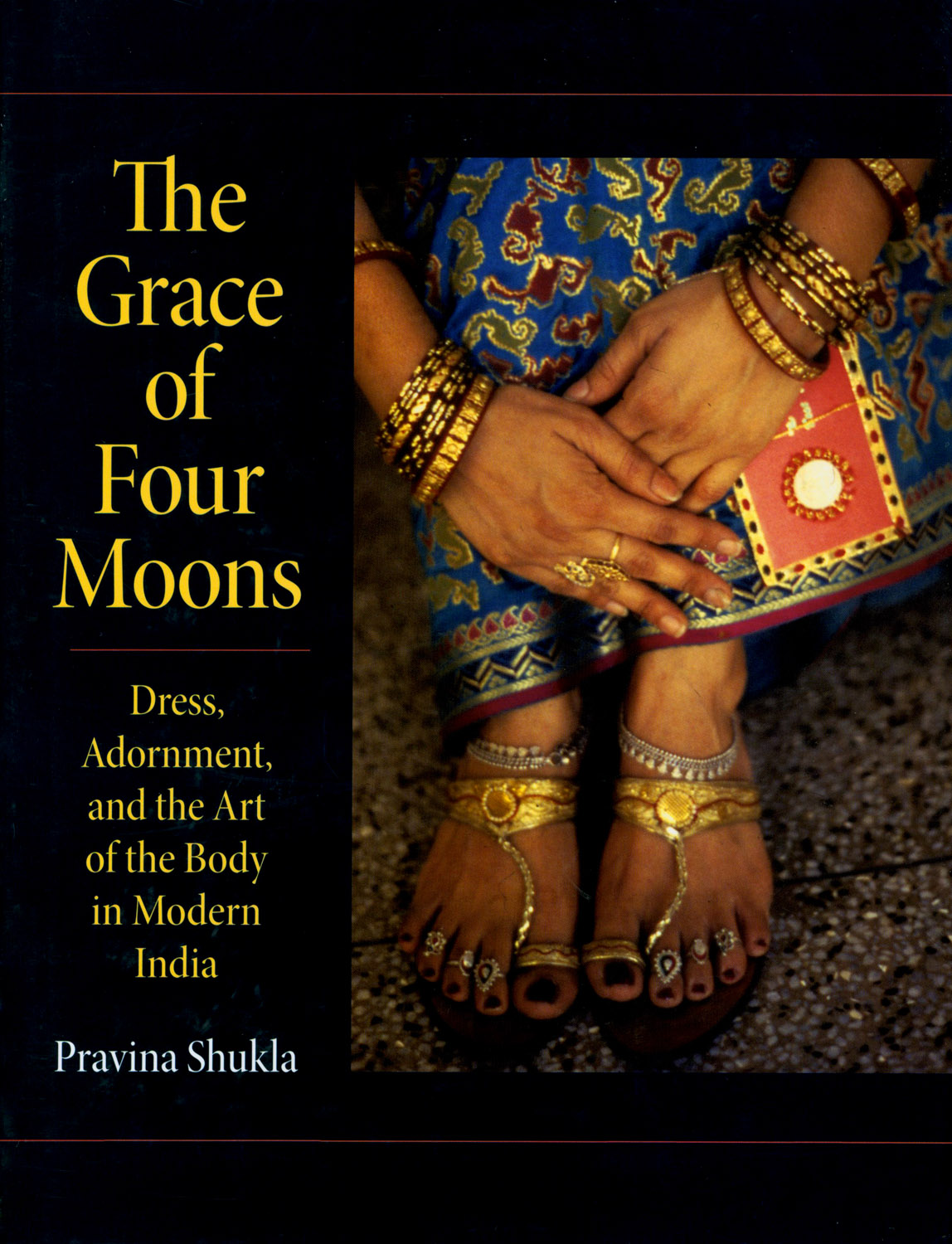
IU media relations has distributed a press release profiling my colleague Pravina Shukla’s fine ethnography of dress and adornment in India, The Grace of Four Moons, recently published by Indiana University Press. Find the release online here. (Image: Courtesy of Indiana University.)

The Grace of Four Moons (cover)

The Grace of Four Moons (cover)

Museum Anthropology 32(1)

mua32_1

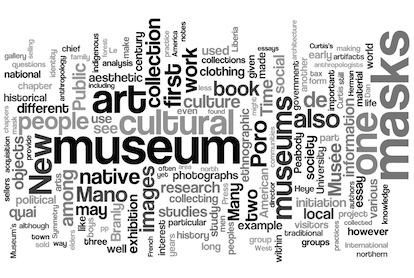
Editorial work on Musueum Anthropology volume 32, number 1 is almost complete. The issue will soon go to the publisher. As a preview, here is a Wordle of the issue’s contents.

Find the full-size version online here. Thanks http://www.wordle.net/ Thanks as well to the authors and peer-reviewers whose work will be showcased in this, the Spring 2009, issue.

Religion among the Folk in Egypt

Heartfelt congratulations to my colleague Hasan M. El-Shamy on the publication of his brand new book Religion Among the Folk in Egypt.

Suzanne Ingalsbe Earns M.A. with Thesis Exhibition and Paper on Indiana Instrument Builders

Continuing with a theme… Congratulations to Suzanne Ingalsbe on the completion of her M.A. in the Department of Folklore and Ethnomusicology at Indiana University. Suzanne’s thesis project centered on the building of a gallery exhibition exploring the work and works of a large number of Indiana makers of musical instruments. This exhibition, which was staged last spring at the John Waldron Arts Center, was an extension of a long term research and interpretation project pursued by Traditional Arts Indiana. (Learn more about the broader project here.) The exhibition was attractive, lively, well-researched, and well-received. In her accompanying paper, Suzanne documented the behind the scenes work that went into the exhibition and set it within the larger contexts of scholarship related to the history of artistic and ethnographic museum display and conceptual debates within folklore studies. Great job Suzanne.

Jody Perkins Earns M.A. with Thesis Project on the Hinkle-Garton Farmstead

Congratulations to Jody Perkins on the completion of her M.A. in the Department of Folklore and Ethnomusicology at Indiana University. Jody’s thesis project focused on collecting, processing and archiving oral history interviews related to the The Hinkle-Garton Farmstead, which is now maintained as a museum by Bloomington Restorations, Inc., “a private not-for-profit organization dedicated to the preservation of Bloomington and Monroe County’s historic architecture and old neighborhoods.” In addition to the original farmstead-related research that she and her collaborators complled, Jody presented and defended a thesis placing this work within the context of the scholarly literatures on oral history, folk and open air museums, and historic preservation practice. Well done!

Congratulations to Amber Ridington and Kate Hennessy on Winning the SVA’s Jean Rouch Award

Two excellent people were recently awarded the Society for Visual Anthropology’s Jean Rouch Award. Amber Ridington and Kate Hennessy were recognized for Dane Wajich: Dane-zaa Stories and Songs – Dreamers and the Land, an outstanding Vrtual Museum of Canada sponsored website project on the culture of the Doig River First Nation in Northern British Columbia. Get all the details here. I am sorry that I did not get more of a chance to chat with Amber and Kate at the AAA meetings (or to see Amber at all at the AFS meetings). Congratulations to them and to their many collaborators among the Dane-zaa.

The Anthropologist as Hero: Claude Lévi-Strauss on his 100th Birthday

A brief note to celebrate the life and work of Claude Lévi-Strauss on the occassion of his 100th birthday. Lévi-Strauss was born on November 28, 1908. As a graduate student I had the good fortune to have excellent teachers–especially Joelle Bahloul, Henry Glassie and Ray DeMallie–who encouraged me to engage with Lévi-Strauss in a serious way and I wound up reading a great deal of his work during the time of my training. In my fieldwork I have had the honor of living among peoples who practice forms of dual organization and Lévi-Strauss’ work on this theme was exceptionally useful to me in a very grounded ethnographic sense. (I sometimes think that some of the difficulty experienced by readers of Lévi-Strauss who came of age in the post-structuralist era is attributable to the fact that few among them have first-hand experiences in societies like those that figure so centrally to his work.) Among my earliest published works is an article that explores dual organization in Southeastern Native North America. A high point in my career is the kind note that Lévi-Strauss wrote to me expressing satisfaction that my account supported his position. This paper appeared not long after the English translation of The Story of Lynx, in which Lévi-Strauss returned to the problems of dualism and dual organization in Native America. The book remains one of my favorite works in anthropology. I continue to draw upon the full range of Lévi-Strauss’ writings regularly in my own research.

In the teaching of anthropology and folklore graduate students in North America, I fear that Lévi-Strauss’ work has moved into the precarious liminal zone that my colleague Richard Bauman and I have come to refer to as “theories of the middle age” (a play on Robert K. Merton’s theories of the middle range). In the teaching of “core” theory courses in these disciplines (and this must surely be true in sociology and other fields as well), historical courses start with, and work forward from, classic social theory of the 19th century (or earlier), which means careful attention to Marx, Weber, Durkheim, the Grimms, Herder, Freud, etc. These courses seemingly always seem to run out of time and/or steam before attending to the post-World War II era. If such classes must come to the present, they skip the middle 20th century and take up, often in rushed fashion, the contemporary scene.  In classes that are not historical in frame, this same post-World War II era work is also often neglected. It is frequently only glimpsed through its impact on more recent scholars. This dynamic is regretable to me and is something that I have tried to address in my own work as a teacher of graduate students.

With respect to Lévi-Strauss’ work, I often teach The Way of the Masks in my Theories of Material Culture course and The Story of Lynx in my Native American Folklore and Folk Music course. I have taught the later book in a general folklore theory course as well, combing it with key essays from Structural Anthropology I and Structural Anthropology II. If I were teaching a different set of courses, I could easily see teaching The Savage Mind and Triste Tropiques. A discussion of the Elementary Structures of Kinship would remain, for me, essential to a class on kinship and social organization. These are all works that I hope that the students withwhom I work will become acquainted.

To reach 100 is a heroic accomplishment for any human being. In this spirit, I drew, in my post title, upon the subtitle of a collection of essays–well known in its day–dealing with the work of Lévi-Strauss–Claude Lévi-Strauss: The Anthropologist as Hero. May we all live as long and as productive lives as Claude Lévi-Strauss. Happy birthday Professor.

AFS Presents Lifetime Achievement Award to IU Professor Richard Bauman

The following is the IU Bloomington press release sharing news of my colleague Dick Bauman’s AFS Lifetime Achievement Award, which was presented at the recent Society meetings in Louisville. Congratulations to Dick on an honor well deserved.

Honor culminates more than 40 years of scholarly research

bauman

BLOOMINGTON, Ind. — Indiana University folklore professor Richard Bauman has studied the acts of speaking and of silence as communicative modes among 16th century Quakers and Medieval Icelanders. He’s also taken a keen ear to coon dog traders in East Texas and researching practical jokesters.

“There’s a kind of widespread notion that coon hunters lie about their dogs,” noted Bauman, an IU faculty member since 1986, whose 1981 article about them was titled, “Any Man Who Keeps More’n One Hound ‘ll Lie to You.”

“My work centered around a trade day in Canton, Texas,” he recalled. “On the Friday-Saturday-Sunday preceding the first Monday of the month, you had these guys gathering with their dogs. For the sociability of it, for visiting with other coon hunters, they’d go out and hunt, shoot dice, get drunk, but tell a lot of stories about dogs.

“The stories,” he observed, “offered me a wonderful vantage point on the tension between truth and lying in everyday life and the role of stories in calibrating and recalibrating that tension.”

Bauman, Distinguished professor emeritus of folklore and ethnomusicology at IU, recently was presented with the Lifetime Scholarly Achievement Award by the American Folklore Society. This is the highest honor that the society bestows and it is bestowed upon a living senior scholar in recognition of outstanding scholarly achievement over the course of a career.

He is the fourth person to receive the honor and the first of his generation so recognized. Linda Dégh, also a Distinguished professor emeritus of folklore at IU, was a recipient of the award, which is presented every two years.

“There were some major paradigm shifts that went on with my generation,” Bauman explained. “The previous winners were transitional in a sense. They were trained in an older approach to folklore that was very item-oriented and very historical in its focus. I had a hand in introducing perspectives that were much more anthropological, much more linguistic and much more ethnographic.”

He is describing a revolution that the field of folklore went through during the 1960s. As an example, instead of looking at the comparative, textual history of individual folk tales or folk songs, Bauman and his folklore colleagues began to branch out and study the social context of such tunes, proverbs and riddles. He has observed how “these things have currency in their communities,” he said.
Read more
Cultural Analysis and the Savage Minds OA Awards

The winners of the Savage Minds OA Anthropology Awards have just been announced in the run up to tomorrow night’s award’s ceremony in the SF Hilton Lobby at 6 pm. Cultural Analysis, a fine OA folklore journal on whose editorial board I serve has taken the runner up spot in an excellent field. The journal Anthropology Matters has won the first place spot. Learn about all the nominees on Savage Minds here and who the winners in all three categories are here. Congratulations to the winners and thanks to those who voted.