Skip to content

Posts from the ‘Folklore Studies’ Category

Value, Ownership, and Cultural Goods: Regina F. Bendix to Deliver 2016 Richard M. Dorson Memorial Lecture

This is the season’s big lecture. With many heritage studies projects underway, it is a perfect time to welcome Regina back to Bloomington. Here are the details:

2016 Richard M. Dorson Memorial Folklore Lecture
Join us for the 6th Annual Richard M. Dorson Memorial Folklore Lecture.

“Value, Ownership, and Cultural Goods”

Regina F. Bendix, University of Gottingen, Germany

Monday, March 21, 2016
6:00-8:00 pm
800 N Indiana Ave

A reception will follow the lecture.

Abstract:

Since the mid-1990s, scholarship on heritage has blossomed – some might say boomed – and brought forth a plethora of new journals and studies in many languages, not least due to the vigorous work and impact of UNESCO’s heritage programs. UNESCO’s work on behalf of “cultural goods” reaches back roughly sixty years and has yielded many policy suggestions, conventions and programs. UNESCO’s activities in turn mobilized other international agencies concerned less with safeguarding valuables and more with ownership and group rights. They point toward ways in which different groups of actors harness the notions of tradition, folklore, culture or heritage to improve their lot on this earth. In their efforts, such groups are likely assisted more by experts in international law and economics than by students of culture.

For scholars in folklore and related fields, at least two tasks present themselves. One entails a continuation of a by now “traditional” task: understanding how excerpts from cultural scholarship, in their transfer and implementation in the public sphere transform, the practices, people and places we tend to study. A second task builds on this first one: we need to find avenues to communicate better with disciplines and practitioners engaged in establishing the legal norms and the economic projections concerning the fate of culture turned resource.

CFP: Unfinished Stories: Folklife and Folk Narrative at the Gateway to the Future

Unfinished Stories: Folklife and Folk Narrative at the Gateway to the Future

The 2016 Joint Meeting of the American Folklore Society and the International Society for Folk Narrative Research

October 19-22, 2016

Hyatt Regency Miami, Miami, Florida, USA

The joint meeting of the American Folklore Society (AFS) and the International Society for Folk Narrative Research (ISFNR) will bring together more than 800 US and international specialists in folklore and folklife, folk narrative, popular literature, and related fields to exchange work and ideas and to create and strengthen friendships and working relationships.

The meeting will feature a number of plenary lectures as well as panel and forum presentations of work by folklorists and their allies in 14-17 concurrent sessions for four days. In addition, participants may register for workshops and tours that will offer an introduction to some of Miami’s cultures and communities.

Prospective participants may submit proposals for papers, panels, forums, films, and diamond presentations or propose new presentation formats. Proposal submission begins February 1 and ends March 31. Presentations on the theme are encouraged but not required.

Proposals will be reviewed by a committee of ISFNR members and of folklorists who live in the region hosting the meeting. AFS will send notification of acceptance or rejection for the meeting program in early June and post an online preliminary program schedule by July 1.

You can find more information about the meeting, including instructions for submitting proposals, beginning February 1, 2016, at http://www.afsnet.org/?2016AM.

Theme: Unfinished Stories: Folklife and Folk Narrative at the Gateway to the Future

Throughout its history, Florida has served as a sustained point of cultural convergence and exchange. Its tropical climate, burgeoning economy, and geographic proximity to the Caribbean and Latin America have influenced its cultural identity. South Florida was shaped by early migration from the United States and Caribbean Islands, as well as influxes of political refugees during the second half of the 20th century. Miami, known as the “Gateway of the Americas,” is now perceived as one of the largest and most significant Latin American and Caribbean cities. As Miami continues to evolve through cultural synthesis, it serves as a leader in terms of its transnational identity and experiences.

In addition to being termed a “Gateway,” Miami has also been described as a “City of the Future.” As such, it offers inspiration for multiple perspectives on the future development of folk narrative and folklife, both within the region and in larger contexts. Relevant topics include transnational communities, cultural synthesis and creolization, the impact of the digital revolution on folk culture, narratives about land and place, traditional responses to climate change, and much more. Conference participants may reflect on these unfinished stories as they appeared in the past and also consider the future of our fields, including emergent theories, methodologies, and ethics.

The organizing committee invites participants to explore the narrative dimensions of their work, regardless of topic.

Contact info:

Lorraine Walsh Cashman
American Folklore Society
Eigenmann Hall, Indiana University
1900 East Tenth Street
Bloomington, IN 47406
812-856-2422; fax: 812-856-2483
www.afsnet.org
lcashman@indiana.edu

Joanna Ella
Secretary
International Society for Folk Narrative Research
www.isfnr.org
jella@gwdg.de

Instruments of Prayer: Musical Instruments in the Expressive Cultures of the Native American Church

Flyer promoting a lecture by Daniel Swan at the Mathers Museum of World Cultures.

Time to Apply to the Summer Institute in Museum Anthropology

simaposter_medIts application season again for the Summer Institute in Museum Anthropology.

As noted recently on the American Folklore Society website:

“The Summer Institute in Museum Anthropology (SIMA), supported by the Smithsonian Institution and the National Science Foundation, is accepting applications for its 2015 program in Washington, DC to be held June 22-July 17. SIMA is an intensive museum research methods training program for graduate students, offered in residence at the Department of Anthropology in the Smithsonian Institution’s National Museum of Natural History. Graduate students at the masters or doctoral level who are preparing for research careers and are interested in using museum collections as a data source should apply. Although primarily oriented to cultural anthropology, students in related programs (Indigenous Studies, Folklore, etc.) are welcome to apply if the proposed project is anthropological in nature.”

Learn a lot more about SIMA on the program website: http://anthropology.si.edu/summerinstitute/

I am excited to be returning to SIMA 2015 as a visiting faculty member.

Thanks to the National Science Foundation and the Smithsonian Institution for its great support of the Institute.

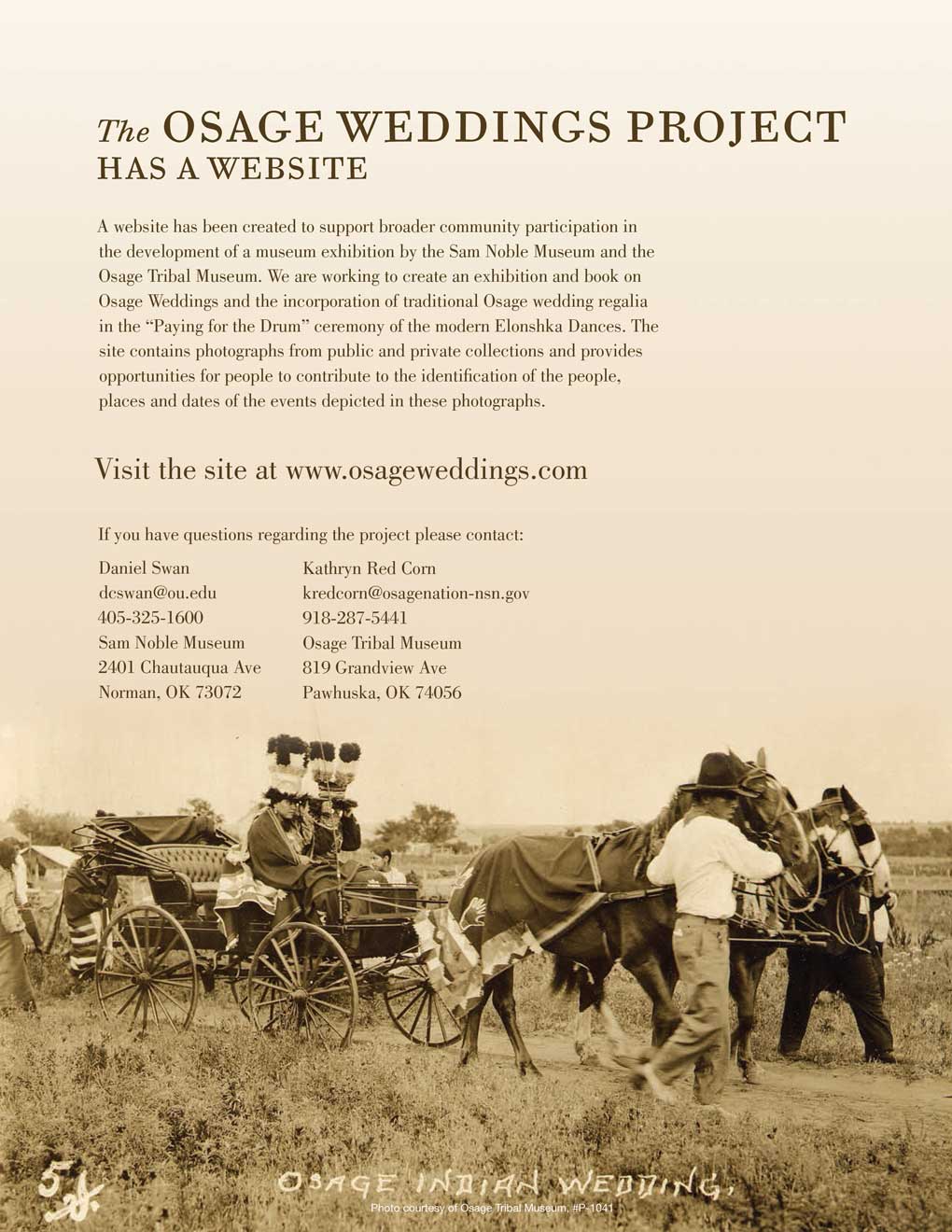
Osage Weddings Project Website Launched

EDU15_OsageFlierhttp://osageweddings.com/

Update: Archived here: https://web.archive.org/web/20181125013857/https://osageweddings.com/

AFS “Folklore and Museums Section” Founded, AFS Members (and Non-Members too) are Welcome to Join

I am happy to note here that the Executive Board of the American Folklore Society has endorsed a proposal put forward by the Folklore and Museum Policy and Practice Working Group to establish a Folklore and Museums section within the society. The section came into existence as of the Executive Board’s November 2014 meeting in Santa Fe. I am very pleased to serve as the new section’s first convener and to invite everyone with an interest in the intersection of museum practice and folklore (/folklife/ethnology) to join the new section.

As noted in the call for members on the AFS website:

the Folklore and Museums Section exists to foster communication and cooperation among museum-oriented folklorists, to advance the contribution of folklore studies scholarship and practice in museum settings, and to articulate museum-oriented folklorists with other colleagues, institutions, and organizations in the museum sector. The section aims, whenever possible, to cooperate with other sections of the American Folklore Society and with peer-organizations in the field.

The public web home for the new section can be found online here: http://www.afsnet.org/?page=MuseumSection and the member’s group space is accessible to members who are logged into the AFS website.

While I am very eager for all interested colleagues to join AFS, I want to note that the AFS has a free “Section Only” membership category by which non-AFS members can sign-up with sections such as the new Folklore and Museums section. This might be of particular value to non-folklorists who wish to keep up with the section’s work. Information on the Sections Only “membership” is available on the Membership Categories page of the AFS website. There is no cost to join the Folklore and Museums section.

The Santa Fe meetings were a great gathering for museum-minded folklorists. I am optimistic that the new section can help make the 2015 meetings even richer for our corner of the field. Thanks to all who have contributed to the momentum behind the new section and to the growth of folklore and museums work.

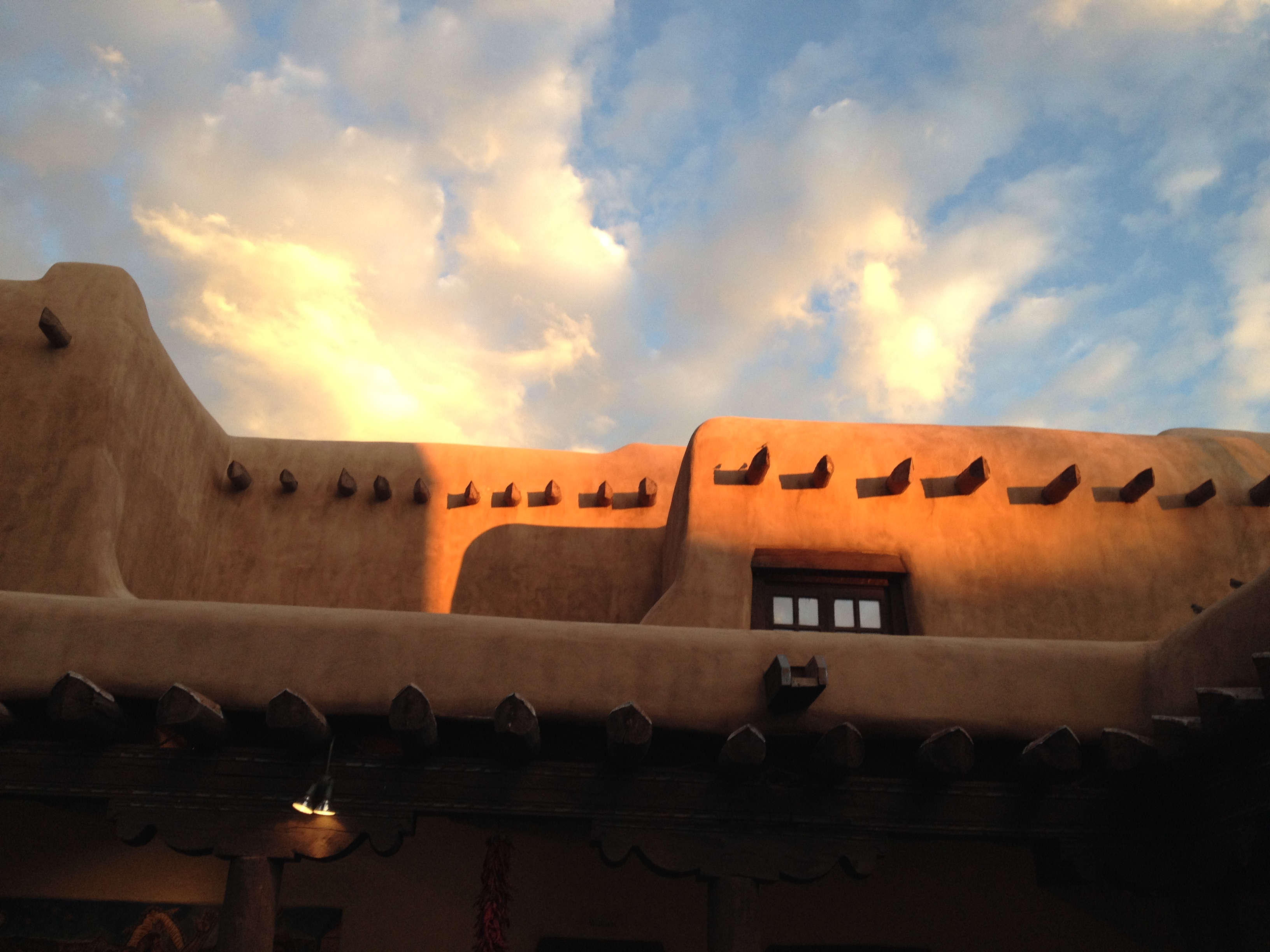
Sky Above New Mexico Museum of Art

Sky Above New Mexico Museum of Art, November 2014

On the Digital Practices in History and Ethnography Interest Group: An Invitation

CALL FOR PARTICIPATION

New members are invited to join the Digital Practices in History and Ethnography Interest Group (DPHE-IG) in the Research Data Alliance (RDA), an international initiative to facilitate the development of effective data practices, standards, and infrastructure in particular research areas, and across research areas–aiming to enhance capacity to archive, preserve, analyze, and share data, and for collaboration both within and across research communities.

RDA’s DPHE-IG works to advance data standards, practices and infrastructure for historical and ethnographic research, contributing to broader efforts in the digital humanities and social sciences.  Bi-weekly calls move the work of the group forward.  Many meetings are “project shares” during which someone leading a digital project describes their efforts and challenges. Some calls are with other RDA groups (such as the Provenance Interest Group), aiming to draw their expertise into our work in history and ethnography.

Our call-in meetings are on Tuesdays, 1:00 p.m. EST; see our schedule through May 2015, and let us know if you would like to share a project. Also see our annual report of activities, including a list of project shares thus far.

RDA holds two plenary meetings each year at which interests group can meet, and interact with other interest groups.  The next plenary is in San Diego, California and will be held on March 9-11, 2015.

Please join the group (just below the calendar here) [its free] and pass on this information to others who may be interested.  We would especially appreciate help reaching people outside Europe and North America.

Jason Baird Jackson (Indiana University), Mike Fortun (Rensselaer Polytechnic Institute), Kim Fortun (Rensselaer Polytechnic Institute), co-chairs

(Contact me if I can answer any questions that you might have about DPHE–Jason)

Open Post in Folklore and Mythology at Harvard University

From a call for applicants being circulated by the Committee on Degrees in Folklore and Mythology, Harvard University…

The Undergraduate Degree Program in Folklore and Mythology is seeking applications for a College Fellow to teach three undergraduate courses in the field during the 2014-15 academic year.  The remaining 25% of the appointment will be reserved for the Fellow’s research program.  The Fellow may also be asked to advise one senior thesis and to evaluate senior theses.  Applicants must have a doctorate  in hand by the start of academic year 2014-15.  The appointment is for one year, with the possibility of renewal for a second year.  Please submit a cover letter and curriculum vitae, along with a list of proposed courses, by March 15, 2014.  We encourage applications from candidates in Departments including but not limited to Folklore and Anthropology, as well as in Departments of Languages and Literatures, and in Area Studies.

Harvard is an Equal Opportunity/Affirmative Action employer.  Applications from women and minorities are strongly encouraged.

Instructions on how to apply may be found here:

http://isites.harvard.edu/icb/icb.do?keyword=k15149&tabgroupid=icb.tabgroup153721

[The letter in which I first saw this opening explained that the due date had changed to the March 15, 2014 date shown above. Applicants will wish to get to the bottom of the question of due date.]

Some Folklore Jobs

“The Department of Folklore and Ethnomusicology at Indiana University invites applications for two one year positions as Visiting Lecturers to begin Fall 2014. We seek candidates with graduate training in folklore as well as experience in the teaching of introductory folklore classes and readiness to teach in one or more of the fields of narrative, belief, folklore of the United States, material culture and ethnographic methods.” Find more detail on the AFS website.

“Staten Island Arts, an arts service organization and presenter, seeks a Staff Folklorist to run a year-round Folk & Traditional Arts Program. Reporting to the Executive Director, Staten Island Folklife works directly with traditional artists and their communities to present, document, and safeguard the traditional cultural resources found throughout the borough. Over the past four years, Staten Island Arts Folklife has been under the direction of a single folklorist, and has established itself as a source of innovation, in the field of public sector folklore.” Find more details on the AFS website.

On the New Volume of Museum Anthropology Review

Museum Anthropology Review (MAR) has just published a new double issue—its first themed collection. Volume 7, number 1-2 of MAR collects papers originally presented at a January 2012 workshop titled “After the Return: Digital Repatriation and the Circulation of Indigenous Knowledge.” Hosted by the National Museum of Natural History, Smithsonian Institution and funded by the (U.S.) National Science Foundation and the Understanding the American Experience and World Cultures Consortia of the Smithsonian Institution, the workshop was organized by Kimberly Christen (Washington State University), Joshua Bell (Smithsonian Institution), and Mark Turin (Yale University). The workshop brought together scholars from indigenous communities, cultural anthropology, folklore studies, ethnomusicology, linguistics, and collecting institutions to document best practices and case studies of digital repatriation in order to theorize the broad impacts of such processes in relation to: linguistic revitalization of endangered languages, cultural revitalization of traditional practices, and the creation of new knowledge stemming from the return of digitized material culture. Like the workshop itself, the peer-reviewed and revised papers collected in MAR ask how, and if, marginalized communities can reinvigorate their local knowledge practices, languages, and cultural products through the reuse of digitally repatriated materials and distributed technologies. The authors of the collected papers all have expertise in applied digital repatriation projects and share theoretical concerns that locate knowledge creation within both culturally specific dynamics and technological applications.

Find this special issue of MAR online at: http://scholarworks.iu.edu/journals/index.php/mar/issue/view/233

As it has always been, MAR is an open access, peer-reviewed journal free to all readers. With volume 8, to be published in 2014, MAR is becoming the journal of the Mathers Museum of World Cultures. It will continue to be published in partnership with the Indiana University Libraries with assistance from the IU Department of Folklore and Ethnomusicology and other partners.

2014 will bring new enhancements to MAR. To keep up with the journal, please sign up as a reader, follow it on Twitter @museanthrev, and/or like it on Facebook.