Skip to content

Posts from the ‘Florida’ Category

Hurricanes, Fires, and Scholarly Societies Now

A satellite image of hurricane Milton via PBS https://www.pbs.org/newshour/nation/live-map-track-the-path-of-hurricane-milton

My parents raised me to worry about hurricanes and hurricane season. I grew up on the coasts of Florida, as did my parents themselves. Floridians, but not of the Florida Man variety, hurricane season was for them about making plans and preparations. This involved learning about, and mitigating risks, making plans, getting supplies, having shutters, marking storm locations on maps printed in daily papers, watching the weather news and much more. These kinds of preparation were not abstract, as my family weathered numerous actual storms of greater or lesser impact. While our home was never severely impacted, we had access to plenty of examples of how devastating tropical storms could be, both pictured on the local news and in family oral tradition.

As if the job of leading a scholarly society is not challenging enough now on other fronts, society leaders have—like my parents when I was growing up—to think about such things as hurricane seasons, fire seasons, and the practical implications of anthropogenic climate change. Leaders of the American Anthropological Association (AAA), for instance, know this because many of them experienced their own 2018 annual conference in San Jose, California. Here is how then first-time attendee Ian Pollock described it afterwards in December 2018

Darkening the sky, hanging in the rafters of the convention center, and stinging the throats and eyes of everyone who came, the smoke of the major fires ravaging California was an inescapable presence. The AAA president, in his opening remarks, acknowledged the forensic anthropologists from Cal State Chico who were at that moment assisting in the recovery and identification of bodies from towns destroyed by the fire. Zoe Todd was among many who commented on the smoke, calling it a kind of message: the land itself telling us about the violence of the settler colonial structures on which California is built.

I was reminded of Kim Fortun’s recent interview on The Familiar Strange podcast, in which she talked about living in toxic times. She argued that anthropologists can respond as a disaster unfolds, and not just in the aftermath. I also thought of a recent workshop at Deakin University in Melbourne, called “Writing Slow Disaster in the Anthropocene.” As the organizers wrote in their call for participants:

[Block quote in block quote] ‘Slow disaster describes the long process of environmental and infrastructural degradation produced by inadequate risk assessments, industrial regulations, and the political narratives that shape design decisions of human-environment relations. The longer temporal perspective provided by slow disaster can help index political, infrastructural, and social dynamics in relation to the new terrains and atmosphere emerging in the Anthropocene. Writing slow disaster draws attention to, and works through, the entanglements of climate crises, structural violence, and the legacies of industrialism.’

San Jose, after all, is basically an adjunct to Silicon Valley, home of techno-utopians and their confidence that every problem can be solved with a technological solution, and a concentration of wealth like the world has never seen before. The fires that sent up the smoke choking San Jose were distant still, but creeping ever closer. No blue-sky thinking could dispel the haze.

Beyond the structural lessons of such episodes, there are also just the practical realities. Sometimes the show, or the annual meeting, just must go on, but it goes on in such a way that falls far short of its organizer’s hopes for reasons not within their immediate control. One can have, for instance, a bad meeting where everyone is talking about bad air or a meeting that loses money and thereby impedes other work.

Or, sometimes scholarly meetings have to be cancelled. COVID led to this dynamic on a vast scale and I was involved as an organizer for the 2020 American Folklore Society (AFS) meeting that eventually was realized in Tulsa in 2022. Hotel contracts and meeting plans loom as the most mission critical, financially significant, and ultimately risky undertakings that scholarly societies pursue. They are where the largest amount of staff and volunteer labor, and member activity and expenditure, resides for most of the societies in the American Council of Learned Societies (ACLS). Natural disasters, pandemic diseases, and, strikes and labor actions (three real world matters that are linked at a deeper level) are all threats that scholarly society leaders wind up needing to understand and manage to the best of their ability, but they cannot directly prevent or control them. The best that they can do is to seek to mitigate risk and impact.

It has been a long time since I first started tracking these issues. Meeting locations, meeting contracts (which are complex and involve varied actors), the implications of locations and contracts for both society members and local people, including local scholarly and cultural organizations, as well as local workers are, and have long been, matters of great concern within and beyond scholarly societies. But today, they are weighted with many additional concerns. The AAA has witnessed some of those additional concerns and their impacts as AAA members have passionately debated the pros and cons of holding its meeting this year in Tampa, Florida (and the pros and cons of attending). I bracket out those for now and just focus on the newest facts known to me on the morning of October 8.

I hope that Hurricane Milton, presently a major storm spinning over the superheated Gulf of Mexico and headed towards a coastline centered on Tampa Bay petters out quickly and causes no damage or harm to anyone or anything, but Florida (and Georgia and North Carolina and Tennessee) has not yet recovered from the devastation of recent Hurricane Helene. The work of Helene recovery makes Milton even more dangerous as the Tampa area is piled high with debris ready to be blown or washed away, aggravating further any damage that Milton might otherwise cause if/when it makes landfall. This matters for the AAA leaders because the 2024 annual meeting of the AAA, which was already under great stress for sociopolitical reasons, is only 43 days away and set for Tampa. I want Milton to produce no injuries, no destruction of infrastructure, no negative impacts of any kind. As an expected attendee at the upcoming meeting, I want only good things for my fellow AAA members and the people of my home state. As a member of the Council for Museum of Anthropology (CMA) board and thus a minor AAA elected leader, I am worried not only about the “regular” human risks, but also about the risks to the AAA as a society. A whole generation of vexing and difficult annual meetings (not just San Jose in 2018) have already impacted AAA membership and AAA finances. Like so many institutions, scholarly societies have been being ground down by a range of contemporary processes and dynamics. Massive fires are a climate change part of this that we can discuss from experience, but there are scholarly societies right now, on the day that I write this, who are cancelling their annual meetings specifically due to Hurricane Milton (Google it for evidence and for Helene cancelations as well). I hope to be in Tampa for a great AAA meeting, but it is only prudent, as with my parent’s yearly preparations and close attention to the weather, to be cognizant that Hurricane Milton could impact the AAA meeting set for November 20-24, 2024. And the Tampa meeting has already faced challenges increasingly typical of the current gestalt.

In the series of posts that this one joins, I am trying to think out loud about the newer challenges that leaders of scholarly societies generally, and of my scholarly societies particularly, are facing, and that they have no choice but to face. Severe weather and natural disasters are not new, of course. And scholarly societies have weathered such things before and will do so in the future. But the political, economic, social, and organizational environments are worsening, and anthropogenic climate change is making the weather more variable and, in the case of massive fires and powerful storms, more dangerous. It would be a significant thing if this were the only change to which scholarly society leaders needed to help their organization adapt, but it is just one on a long and growing list.

I wish for only good things for the people of Florida and I appreciate all that the elected and professional leaders of the AAA and AFS are doing to keep these societies mission-focused and effective in vexing time. That work is not easy.

Remembered Visits to Seminole and Miccosukee Country

Some readers of Shreds and Patches know that I just lost my father KBJ (1935-2020). Others know that I am presently returning to my studies of craft from the Native South after the conclusion of my Directorship (2013-2019) of the Mathers Museum of World Cultures. With my father on my mind and in a time in which my family has been spending a lot of time looking at old family photographs, my father’s life and influence on me can be linked to my renewed studies.

While I was still in grade school (6th grade maybe?), my father brought me to the section of the Miccosukee Reservation on the Tamiami Trail west of Miami. We went at the time of the event presently called the Miccosukee Indian Arts and Crafts Festival. I recall watching a visiting Kevin Locke (Lakota) hoop dancing and seeing a lot of patchwork and other Seminole/Miccosukee crafts. In those days a would-be patchwork jacket buyer could sort through hundreds of off-the-rack examples. I recall eating sofkee for the first time–out of a paper cup from a food stand.

I do not know if he began collecting Seminole dolls on that visit or not, but in the years since that period, his collection grew and grew. After his collection was damaged in a house fire, he started again. A part of his second collection is shown below.

2016-02-01 Ken Jackson Seminole Dolls

Seminole Dolls from My Father’s Collection.

In taking me to Seminole/Miccosukee country, my dad was repeating an experience of his own youth. As shown in the other picture I share below, my dad was taken to a Seminole tourist camp when he was little. I do not know specifically where he was taken (by my step grandmother?), but this would have been in the Musa Isle era.

When I think about the path that my own life has taken, I think about how my father played a major role in leading me to the trailhead from which I departed. His own journey was remarkable and I am grateful beyond measure for the life course that he set me upon.

Kendall's First Visit to a Seminole Village Miami Fl Nov 14 1939

My father as a very small boy visits a Seminole tourist village near Miami.


Coconut Rattles in Florida and Oklahoma

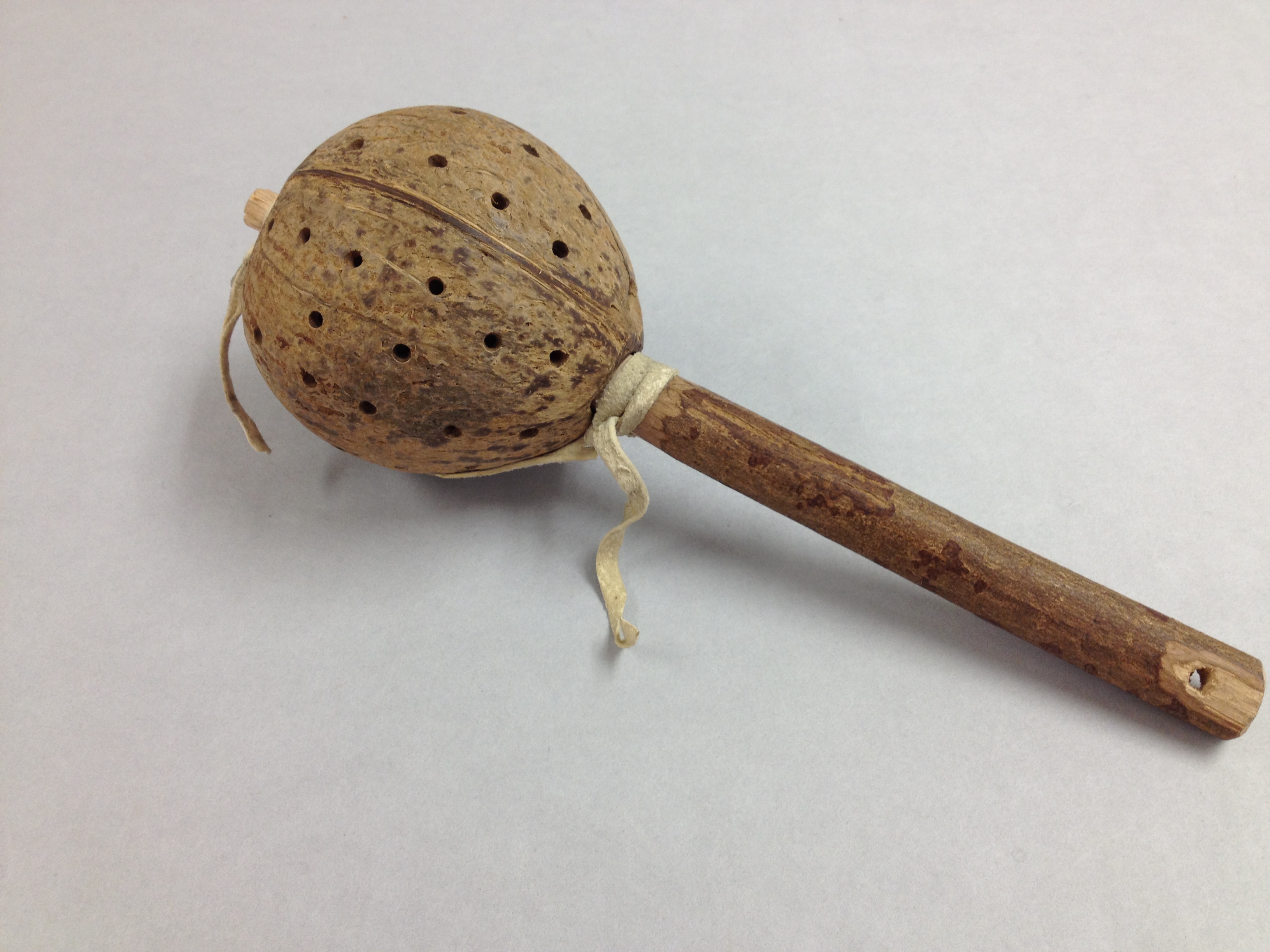
The diversity of materials used by Native peoples in the Americas to make hand rattles is pretty staggering. Among the farming peoples of the Southwest, Plains, Northeast and Southeast, gourds are one important material used for this purpose. Having the same basic form as gourd rattles, but unique to some Southeastern Indian peoples, are rattles, such as this Florida Seminole example, made from coconuts. William C. Sturtevant provided the coconut used here to Jack Motlow, from whom he commissioned it for $2.00 in 1951. This Florida Seminole example is made exactly like those used among the Southeastern peoples in Oklahoma, including among the Yuchi. (I commissioned Yuchi examples for the Gilcrease Museum in Tulsa during the later 1990s.) Such rattles are called “gourds” in English in Oklahoma and are particularly suited to the outdoor dances of the region. Such rattles are loud and thus sound great when used, as they most often are, outside, in open spaces. (The holes drilled in the coconut amplify the rattle’s sound.)

This example is #301 in the William C. Sturtevant Collection, Department of Anthropology, National Museum of Natural History, Smithsonian Institution.

(The Seminole Tribune has published biographical profiles of two of Jack and Lena Motlow’s daughters. These profiles are of Louise Motlow and Mary Motlow Sanchez and are online.)

Pot Holders, Or William C. Sturtevant Collections Research, Day 1

I am in Washington at the start of a period of research studying the collection of objects gathered over much of the career of Smithsonian anthropologist William C. Sturtevant (1927-2007). (For background on W.C.S., see this biographical sketch that I posted to the Museum Anthropology weblog and this Washington Post obituary by WP staff writer Louie Estrada.)

While Dr. Sturtevant was long associated with the Smithsonian, his individual research collection grew and grew over the course of his career and was not accessioned into the holdings of the National Museum of Natural History until after his death in 2007. My work with the objects is an extension of the Southeastern Native American Collections Project (SNACP), but it also aims to assist the museum in the work of organizing and cataloging the Sturtevant Collection.

Today was mainly a get organized day, but I can share a glimpse of the objects that was looking at.

Dr. Sturteveant worked throughout his career on issues in Florida Seminole ethnography, linguistics, ethnology, and ethnohistory. He was always particularly interested in material culture and he went to considerable lengths to document the rich visual and material culture of the Seminole people living in my home state. (I first met Dr. Sturtevant while still an undergraduate when he attended a conference on Seminole folk art not far from my family home.)

It will take a very long time to sort out the details, but I began (metaphorically) unraveling the threads of his collection and its history with initial study of eight relatively simple objects–patchwork decorated pot holders made for sale to non-Seminole tourists by Seminole women during in the 1980s. In addition to their aesthetic richness and visual interest, such objects speak to the complex ways that the Seminole people have adapted to life in one of the most complex corners of North America. The Seminole engagement with tourism began in the early 20th century, it continued through the period represented by these pot holders, and it continues up to the present-era, in which the Seminole Tribe of Florida is the force behind a myriad of tourist destinations, including the global Hard Rock cafe and casino enterprise.

For four of the eight pot holders that I looked at today, I already know the name of the artist. A few of the as-yet artist-unidentified objects are pictured below. All objects are from the collections of the Department of Anthropology, National Museum of Natural History. I especially thank the department’s staff for hosting my research visit. Photographs shown here are my own quick and simple iPhone snapshots. (Better photographs can come later.)

Sturtevant Collection T162

Patchwork Pot Holder, Florida Seminole

(Above) Patchwork Pot Holder, Florida Seminole, Sturtevant Collection T162, Department of Anthropology, National Musuem of Natural History, Smithsonian Institution. Photograph by Jason Baird Jackson

Patchwork Pot Holder, Florida Seminole

Patchwork Pot Holder, Florida Seminole

(Above) Patchwork Pot Holder, Florida Seminole, Sturtevant Collection T111A, Department of Anthropology, National Musuem of Natural History, Smithsonian Institution. Photograph by Jason Baird Jackson

Patchwork Pot Holder, Florida Seminole

Patchwork Pot Holder, Florida Seminole

(Above) Patchwork Pot Holder, Florida Seminole, Sturtevant Collection T111B, Department of Anthropology, National Musuem of Natural History, Smithsonian Institution. Photograph by Jason Baird Jackson

Patchwork Pot Holder, Florida Seminole

Patchwork Pot Holder, Florida Seminole

(Above) Patchwork Pot Holder, Florida Seminole, Sturtevant Collection T111C, Department of Anthropology, National Musuem of Natural History, Smithsonian Institution. Photograph by Jason Baird Jackson

I have a lot of data management work to accomplish before tomorrow, but I could not resist sharing this glimpse.

Florida Folklorist Stetson Kennedy (1916-2011)

I wish to note the passing of fellow Floridian and folklorist Stetson Kennedy. I did not know him, but I admire his work and his remarkable career. As the detailed obituary published Tuesday in the New York Times will suggest, he is very much a person worth knowing about. To have hung out with Woody Guthrie and Zora Neale Hurston, married seven times, and crippled the Ku Klux Klan via a Superman radio show and lived to 94–that’s a life. Rest in Peace.

Anthropologist Robert Reeves Solenberger (1916-2006)

In a paper that I published in 2002, I drew upon unpublished ethnographic notes compiled in 1940-1941 by then University of Pennsylvania graduate student Robert R. Solenberger. Solenberger was a student of Frank G. Speck and others on the faculty at Penn. The notes that I drew upon in my paper are part of the Speck Papers at the American Philosophical Society. I have today been working on a new paper that draws upon the same unpublished manuscript by Solenberger. In 2000, when I was working on the paper mentioned above, I was able to track down Professor Solenberger in retirement in Tuscon, AZ and to speak with him on the phone about his graduate studies and the materials that I was then drawing upon.

Taking up work on a new project based on his notes, I went online tonight to see what more I could learn about Solenberger’s career. I learned that he passed away (in his 90s) a few years ago. I found various bits of information on his life, work, and history, but did not find a professional obituary. Based on the information that I pieced together tonight, I offer the following brief sketch.

Robert R. Solenberger (1916-2006) earned a M.A. in anthropology from the University of Pennsylvania in 1940 with a thesis on “An Interpretation of Material on the Anthropology of East Africa Based upon Mediaeval Arabic Writers.” and was on the faculty of the Department of Sociology and Anthropology at Bloomsburg State College (now Bloomsburg University). He published a prominent series of articles focused on the Marianas Islands, where he worked in the 1950s. (These appeared in Human Organization, Anthropological Linguistics, and Oceania, among other outlets.) During his graduate training, he participated in archaeological research at Clovis, New Mexico in 1937 (under the direction of John L. Cotter). He was a Quaker and a conscientious objector during World War II.

My sources include published works discoverable via Google Scholar and the Internet Archive, as well as the following Google discoveries:

http://www.biblerecords.com/solenberger.html
http://www.fum.org/QL/issues/0709/passages.htm
http://www.upenn.edu/gazette/0302/0302notes.html
http://www.upenn.edu/gazette/0707/obits.html

He appears on the AAA Honor Roll of Donors in the last years of his life, but I could find no professional obituary in a AAA publication or elsewhere. A Society of Friends memorial sketch is available.

It was an honor to speak with this anthropology elder early in 2000. I record here my thanks for his kindness and his interest in my work. I also express appreciation for his work, including the six pages of Southeastern Indian ethnography that he compiled in 1940 while on a road trip with  through Virginia, North Carolina, and Florida.

Rest in Peace.

(Additions and corrections to this sketch are very welcome.)

Cattelino on Citizenship and Nation in the Everglades

My super-talented friend Jessica Cattelino has written a great piece for Anthropology News on the social dimensions of Everglades restoration in my home territory of South Florida. (Unfortunately it is toll access and thus not easily accessible to non-AAA members.)

A (cc) liscenced image of the Everglades from Flickr. How cool is that?