Skip to content

Posts from the ‘Exhibitions’ Category

Exciting New Presentation Formats for #AFS2011

Work on the 2011 American Folklore Society Meetings is now in high gear. The AFS meetings next fall will be held on my home campus at Indiana University Bloomington. As we get ready to host the meetings, I have been particularly involved in getting ready to introduce a new quick format presentation format and to re-boot the poster format along museum exhibition lines.  These new possibilities are described in the document circulated today by the Society. I hope that a large and diverse group of scholars takes an interest in attending the meetings and that these two new presentation formats appeal to scholars of all levels of seniority and to those working across the full breadth of folklore studies and its congeners. I want to personally express thanks to those senior scholars who have agreed to attend and host the poster exhibitions opening event and to my colleagues participating in the trial run for what are now (in AFS-speak) being called “Diamond” presentations at the 2010 meetings in Nashville. Here are the details from the home office:

<><><><><><><><><><><><><><><><>

Dear Colleagues,

In the next few weeks we will post online the Invitation for Participation for the American Folklore Society’s 2011 annual meeting, set for October 12-15 at the Biddle Hotel and Conference Center in the Indiana Memorial Union complex on the campus of Indiana University in Bloomington. We encourage participation by folklorists throughout the world in our gathering.

This will be AFS’s first meeting on a university campus since our last meeting in Bloomington in 1968. Our hosts will be the Indiana University Department of Folklore and Ethnomusicology, and the theme of the meeting, on which presentations are encouraged but not required, is “Peace, War, Folklore.”

All proposals for the annual meeting program will be due by March 31. The entire process includes registration for the meeting, payment of the registration fee, and submission of your proposal.

We’re sending you this message to bring you up to date on two new developments within our annual meeting. The first has to do with an improvement in the proposal submission process, and the second involves the introduction of two new presentation formats.

But first, here is a link to a video documenting the Bloomington annual meeting committee’s musical “Invitation to Bloomington 2011” performed at our annual business meeting in Nashville last October.

Now to the news:

1. No More Long Abstracts Required from Individual Presenters in Pre-Organized Sessions

Beginning with the 2011 annual meeting, people who will be making presentations in pre-organized paper and Diamond sessions (for more information on Diamond sessions, see below) no longer have to submit long (500-word abstracts) for their presentation, just short (100-word) ones.

As in the past, individuals participating in organized paper and Diamond sessions will provide their short abstracts to their session chair in advance of the March 31 deadline. Session chairs will submit long and short abstracts for the session as a whole, and short abstracts for all presentations, as part of the session proposal.

2. Two New Presentation Formats at AFS 2011

While our meeting will feature the presentation of papers, discussion forums, media works, and professional development workshops as it has done for many years, in 2011 we are giving special emphasis to two new forms of presentation.

Re-Imagining the Research Poster in Folklore Studies: AFS Research Poster Exhibitions

The 2011 Annual Meeting Program Committee and the Society are making a special effort to capitalize on the research poster’s special virtues for folklorists. AFS Executive Board member and Indiana University Associate Professor of Folklore Jason Jackson will curate the 2011 Research Poster Exhibitions.

Posters, a vital means of scholarly communication in many fields, allow for the integration of graphic and textual information. They share the strengths characteristic of the informal settings in which folklorists often learn, teach, and study. Many folklorists are deeply involved in studying topics that lend themselves to the poster exhibition framework.

The current digital moment has created new opportunities to extend the power of this genre. Posters can stand alone as documents of scholarly research in folklore studies, and can also be augmented through informal oral presentation or the use of multimedia enhancements. They can also be repurposed after a conference into gallery and web-based exhibitions. Like conference papers, posters can also serve as a foundation for other genres of scholarly communication, including articles and book chapters. Posters themselves have begun to be peer-reviewed, revised, and published in scholarly journals.

This year, in lieu of poster panels organized by the membership, we are soliciting individual proposals for poster presentations on one of four broad topics: Peace, War, Folklore (the 2011 annual meeting theme), Folklore and Folklorists Making a Difference, Folklore Studies and the Digital Humanities, and Musical Cultures.

Poster presentations selected for each grouping will be brought together to comprise one of four formal exhibitions, which will be initially presented at an opening reception on Thursday morning. At that time, a distinguished scholar with special knowledge of the exhibition theme will host each exhibition, and will make public remarks about the exhibition’s posters.

Steve Zeitlin from City Lore will host Peace, War, Folklore

Marsha MacDowell from the Michigan State University Museum will host Folklore and Folklorists Making a Difference

Kimberly Christen from Washington State University will host Folklore Studies and the Digital Humanities

Jeff Todd Titon of Brown University will host Musical Cultures

The reception will also provide time for presenters to dialogue informally with each other, with interested conference attendees, with the hosts, and with other special guests. The posters will remain on exhibition throughout the conference.

Post-conference publication of selected posters is a possibility. We have invited a number of journal editors to attend the poster exhibition opening as special guests. Editors so far agreeing to attend include Regina Bendix (co-editor of Ethnologia Europaea), Kristina Downs (co-editor of Folklore Forum, which is interested in receiving submissions from participating poster exhibitors), Rob Howard (editor of Western Folklore), Jason Baird Jackson (editor of Museum Anthropology Review), and Tok Thompson (co-editor of Cultural Analysis).

AFS Diamond Presentations: An Invitation

On the basis of their increasing popularity among scholars and with the inspiration of a successful experiment undertaken at the 2010 Annual Meeting in Nashville, the American Folklore Society invites individual and organized session proposals in what we are calling the Diamond format, a formalized presentation genre structured by time and images:

Individual Diamond presentations are seven minutes long and are organized around 21 slides that are set to advance automatically every 20 seconds.

Audience response to such presentations have been very enthusiastic, and the format offers a number of specific advantages:

· As with the highly structured expressive genres that folklorists have often studied, this format calls upon presenters to be creative and selective in organizing their presentations.

· Focused presentations and images aid and engage audiences, even those unfamiliar with the topic or those whose first language differs from that of the presenter.

· This format is valuable not only for presenting image-based topics (such as studies of material culture or cultural performance), but also for all presenters concerned with visual communication and those who wish to experiment with visual techniques to enhance communication.

· This format is an easy starting point for the creation of audio slidecasts and small digital exhibitions—more durable modes of scholarly communication valuable to diverse online audiences—as well as in such settings as media kiosks in gallery exhibitions.

· The brevity of the format allows extra time for discussion.

· Brief but structured, the format supports multidimensional, open-ended presentations, making it very appropriate for the presentation of new projects or works-in-progress.

You may submit proposals for individual Diamond presentations, which the Program Committee will group into sessions, or organized Diamond sessions of six to ten presentations. All Diamond sessions will be constructed with an initial seven minutes allotted for preparation and introduction of the session as a whole, seven minutes for each Diamond presentation, and the balance of the available time dedicated to discussion of the full set of presentations. At the discretion of the session chair, the discussion time may be used for response by a formal discussant, open “full room” questions and answers, break-out time in which presenters can confer with interested audience members, or a combination of these discussion formats.

For those who would like to know more about the sources of inspiration for this format, there is much discussion around the web of a variety of similar (but not identical) formats, including the format known as Pecha-Kucha, developed in the design fields in Japan. Some of these are associated with formally trademarked brands of presentation events. Also available online are videos and slidecasts of presentations made in these related formats:

A YouTube version of Jason Jackson’s AFS 2010 Diamond presentation on the Open Folklore project: http://www.youtube.com/watch?v=zBUfYuVlBZE

A Pecha-Kucha presentation on YouTube: http://www.youtube.com/watch?v=9NZOt6BkhUg

“Hate Long, Rambling Speeches? Try Pecha-Kucha” by Lucy Craft [NPR on Pecha-Kucha]: http://www.npr.org/templates/story/story.php?storyId=130698873

A discussion of Pecha-Kucha in anthropology with links to examples and information: http://www.antropologi.info/blog/anthropology/2010/pecha-kucha

The Pecha-Kucha Organization: http://www.pecha-kucha.org/

On Lightning Talks: http://perl.plover.com/lightning-talks.html

On the Ignite Format and Events: http://ignite.oreilly.com/

Search also “Pecha Kucha” in YouTube, “Death by PowerPoint,” “Ignite,” “Lightning Talks,” and Wikipedia.

——

Please feel free to circulate this email to your non-AFS-member colleagues who may not have received it directly. We look forward to seeing you in Bloomington this October. Thank you for your support of our field and Society.
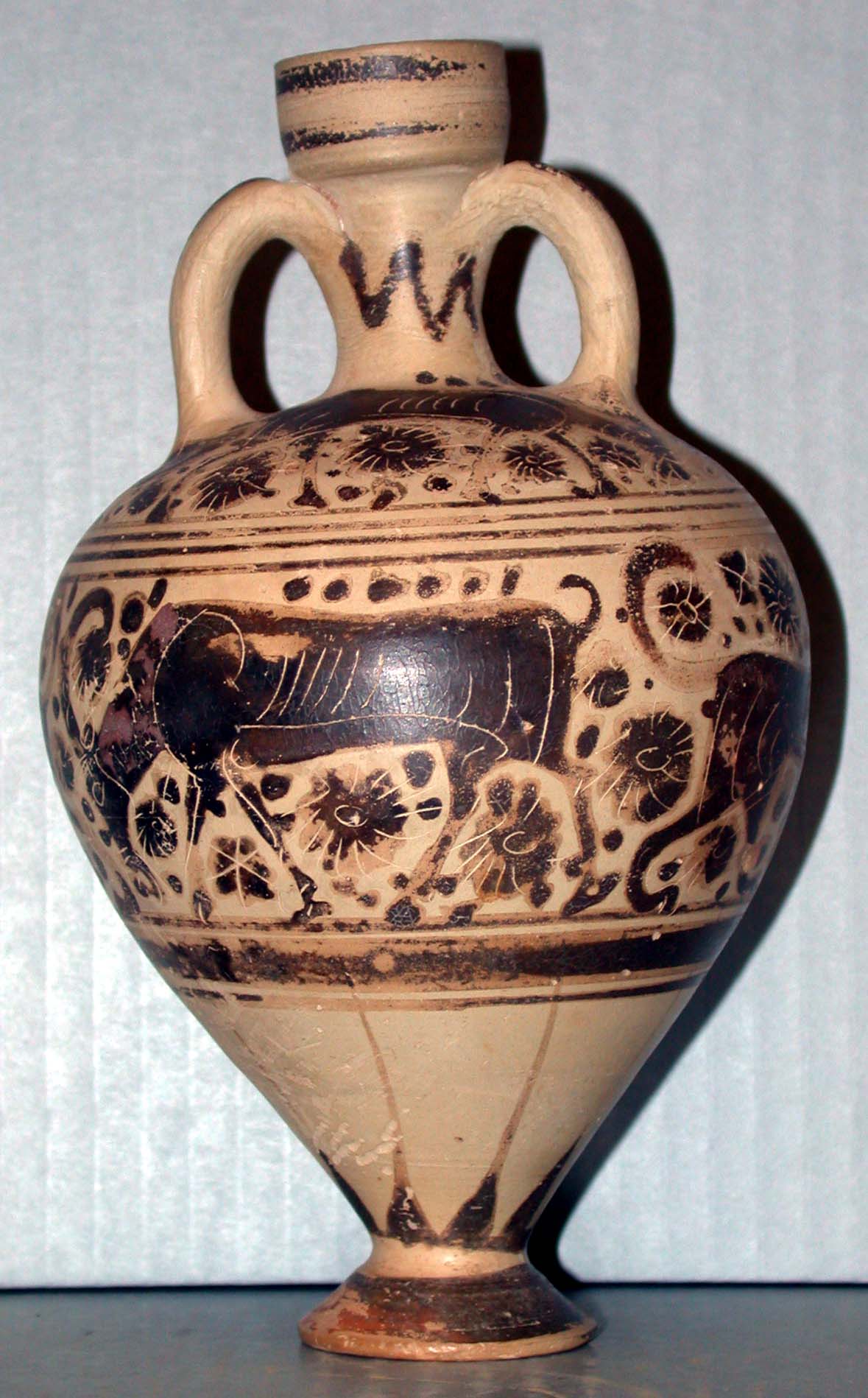
Mediterranean Treasures: Selections from the Classics Collection [at SNOMNH]

I am excited to share news of an upcoming exhibition at the Sam Noble Oklahoma Museum of Natural History. Opening October 2 and continuing through January 2, 2011 is Mediterranean Treasures: Selections from the Classics Collection.  At SNOMNH, the museum’s significant Classical Archaeology collections are steward by the Division of Ethnology (led by my friend and collaborator Daniel C. Swan). This new show has been curated by the division’s talented collections manager (and old world archaeology specialist) Kathryn Barr. Describing the exhibition’s orienting framework, the exhibition release quotes her noting:

“In developing this exhibit we faced a challenge on how to incorporate a number of different cultures and time periods,” explained Kathryn Barr, exhibit curator and manager of the ethnology collection at the museum. “Ultimately we decided that rather than focusing on the differences between these groups we would highlight their shared technologies. The Mediterranean Sea provided the perfect stage for this exhibit, as it was truly a focal point for the cultures we wanted to highlight. For centuries the region surrounding this body of water has been an area of great diversity, but it has also been an important melting pot as well. Many of the great civilizations of Africa, Asia, Europe and the Middle East developed along its shores and each one influenced the others.”

As discussed in the full release (available here), this will be the museum’s most ambitious exhibition from the Classics Collection and the first major exhibition of the collection staged in the museum’s impressive new facility.

While we are thinking about the SNOMNH Classics collections, I can also note the small digital exhibition that then-graduate assistant Rhonda S. Fair built during my time as SNOMNH Assistant Curator of Ethnology. Found here, it presents the museum’s Mark Allen Everett Collection of Ancient Greek, Etruscan, and Roman Pottery.

SNOMNH C-2001-1-7

100 Summers Exhibition Opens at SNOMNH

I am pleased to note the openning of the “One Hundred Summers: A Kiowa Calendar Record” exhibition at the Sam Noble Oklahoma Museum of Natural History in Norman. I have not yet heard how the openning events have gone, but I look forward to seeing the exhibition myself this summer.  Learn more about the show here.  Find the associated book, authored by Candace Greene and published by Nebraska, here.

New Exhibits!

I am late posting on them, but I want to celebrate two new exhibitions at the Mathers Museum that were curated by IU doctoral students, both of whom are minoring in Folklore. Jim Seaver (an alum of my Curatorship and Theories of Material Culture courses and a history doctoral student) curated “A World of His Own: The Uncommon Artisty of Chester Cornett.” The exhibition looks at the work of a Kentucky chairmaker whose life and art were originaly documented in the dissertation and later books produced by folklorist Michael Owen Jones. The Mathers staff really outdid itself in helping Jim realize his vision. The exhibition includes a number of innovate custom display elements, incuding a shotgun house with a front poarch on which to display Cornett’s chairs.

The second new exhibition is “Clothes, Collections and Culture… What is a Curator? Undertaken by Lori Hall-Araujo, a doctoral student in the Department of Communication and Cuture, the exhibition utilizes the Royce Collection of Isthmus Zapotec Textiles and Clothing to examine the behind the scenes work of museum curators.

Both exhibitions are visiually and intellectually compelling and both were vigorously celebrated at a joint exhibition openning last Friday evening. Congratulations to Lori and to Jim and to the entire Mathers Museum staff. Wonderful!  Learn more here and here.

One Hundred Summers

I am pleased to note that One Hundred Summers: A Kiowa Calendar Record, a book by my friend Candace S. Greene, has just been released by the University of Nebraska Press. Candace’s study is an important outcome of a project that I initiated while serving as Assistant Curator of Ethnology at the Sam Noble Oklahoma Museum of Natural History. Through text and color images, the book presents and interprets a remarkable pictoral calendar by the Kiowa artist Silver Horn.  Covering 100 years of Kiowa tribal history, the calendar was donated to the museum during my tenure at SNOMNH. With IMLS funding, teaching materials have been prepared to faciliate use of the calendar in K-12 contexts. In addition, my friend Daniel Swan, the current SNOMNH curator of ethnology is preparing an exhibition focused on the calendar. In the period since the project began, the fragile calendar has been completely conserved and stabilized with funding provided by the Save America’s Treasures program. My friend Victoria Book, SNOMNH’s conservator supervised this effort working with paper conservation specialist Ellen Livesay-Holligan.

The University of Nebraska Press has done an exceptional job in designing the book. It is really beautiful. Check it out and help spread the word.

100_summers

Suzanne Ingalsbe Earns M.A. with Thesis Exhibition and Paper on Indiana Instrument Builders

Continuing with a theme… Congratulations to Suzanne Ingalsbe on the completion of her M.A. in the Department of Folklore and Ethnomusicology at Indiana University. Suzanne’s thesis project centered on the building of a gallery exhibition exploring the work and works of a large number of Indiana makers of musical instruments. This exhibition, which was staged last spring at the John Waldron Arts Center, was an extension of a long term research and interpretation project pursued by Traditional Arts Indiana. (Learn more about the broader project here.) The exhibition was attractive, lively, well-researched, and well-received. In her accompanying paper, Suzanne documented the behind the scenes work that went into the exhibition and set it within the larger contexts of scholarship related to the history of artistic and ethnographic museum display and conceptual debates within folklore studies. Great job Suzanne.

New Successes for Teri Klassen’s Work in Quilt Studies

Teri Klassen has recently completed her doctoral qualifying exams in folklore here at Indiana University in preparation for a doctoral dissertation focused on the social life of quilts in the United States. She has also now received grant funding for a phase of her project titled “Quilt Styles of West Tennessee Sharecroppers and Tenant Farmers of the Early to Mid 1900s.” Her award is the 2008-2009 Lucy Hilty Research Fund Grant  given by the American Quilt Study Group.

Earlier this year, she curated the exhibition “Family Patterns of Tradition” for Bloomington Restorations Inc. It is an exhibit of 32 quilts made from about 1930 to 2000 by Erdine Brown and two of her daughters, Betty Cates and Faye Doolin, of western Kentucky. The exhibit will be open to the public one more time, from 1-4 p.m., Saturday, May 31, at BRI headquarters, 2920 E. Tenth Street, Bloomington IN 47408. For more information, call BRI (812) 336-0909.

A Bronx Botánica Opens its Doors in Bloomington, Indiana

By Gabrielle Berlinger

With the arrival of the vernal equinox, “Botánica: A Pharmacy for the Soul” opened its doors to the public this past Friday at the Mathers Museum of World Cultures in Bloomington, Indiana. This exhibition, the Masters Project of doctoral student in folklore Selina Morales, is the culmination of her years of her research into different dimensions of space, constructions of identity, cultural materials, and systems of belief that are produced in the botánica, a store that sells items necessary for practicing a variety of Afro-Caribbean religions. In the gallery at the back of the Museum’s first floor, Selina recreated the botánica that her Puerto Rican grandmother, Jerusalén Morales-Díaz, owned and ran in New York City from 1985 to 1991. Selina draws on memories, family stories, and her ethnographic fieldwork in New York, New Jersey, and Puerto Rico to contextualize and communicate the experience of Jerusalén as proprietor of the botánica.

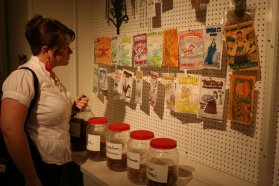
pegboard.jpg
1. A visitor examines the baños, or baths, that hang on the pegboard display.

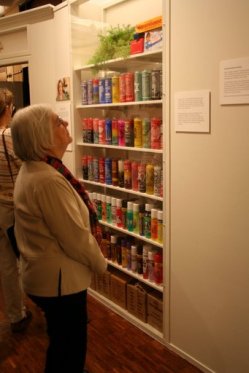
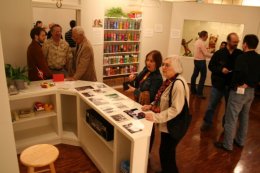
During the two-hour opening, over 250 people entered the exhibition and stepped into a botánica, guided by the Morales family’s memories. The front door of the store, flanked by recreated city brick walls tagged with graffiti, opens into a main room where photographs of Jerusalén’s family and clients in the botánica are displayed behind and on top of the proprietor’s counter. The walls of the room alternately display cases with altars to deities of the Afro-Caribbean religions, and objects sold for ritual practice. Colorful candles line one wall from floor to ceiling, while another is covered in pegboard from which pouches of bath salt, beaded necklaces, and other religious materials hang. The items’ vibrant colors set against the store’s white walls jump out and draw visitors in to read the contextualizing labels that quote Jerusalén, Selina, and other family members explaining the meaning of these objects and this space. A semi-enclosed room behind the counter area recreates the private area in which Jerusalén would consult clients who visited her botánica for healing and advice.

candles.jpg
2. A visitor examines the wall of candles.

This opening day was a momentous event for many people. It celebrated Selina’s long-term research, material collection, and exhibition curation, and introduced a rich case study of Afro-Caribbean religious belief, material culture, and practice that the Bloomington public may now engage in mind and body, through memory, sight, sound, smell, and touch.

Both of Selina’s grandmothers and one grandfather, her aunt, and her brother were all in attendance for the opening. A steady stream of family, friends, and new visitors toured the exhibition, spooned clean large platters of hot Puerto Rican food (Pernil [roast pork], arroz con gandules [rice with pigeon peas], yucca con mojo [yucca with garlic-olive oil sauce], and crackers with guava paste and white cheese), and enjoyed the music of Sancocho, an Afro-Caribbean drum group, that entertained in the adjoining room.

counter.jpg
3. A view of the main room from behind the proprietor’s counter.

Selina deserves great congratulations on the opening of such an impressive exhibition that has created a space in which the community may consider notions of healing, family, love, creativity, and spirituality. Her beautiful creation makes all of us – her family, friends, and colleagues – proud to share in her life’s work and in the work of folklore.

For more on the exhibition, see Selina Morales’ blog:
www.botanica-jardines.blogspot.com

Thanks to Gabi Berlinger for this great guest post. Selina’s exhibition is wonderful and the lively, crowded, fun opening was Bloomington’s museum event of the year. Congratulations to Selina and to the Mathers Museum staff on a job well done–Jason.