Skip to content

Posts from the ‘Ethnology’ Category

Put a Bird On It

I have been offline and not able to post on the Smithsonian work over the past few days. Today I need to get back to work, so here is a quick picture post. Shown above is a pine needle basket made by Rosa J. Pierite. In the artist’s information tag that accompanies the basket, she (?) identifies her tribal background as Choctaw-Tunica. Elsewhere (as in this Louisiana Folklife Center artist profile of Mrs. Pierite’s daughter, also a basketweaver), her tribal heritage has been noted as Choctaw-Biloxi.

Such pine needle baskets in the shape of a variety of animals–turkeys, alligators, etc.–are a remarkable basketry innovation from the Native peoples of Louisiana, but they are poorly represented in museum collections because earlier collectors and curators often ignored them as tourist arts. It is great that this example, along with three other pine needle baskets by Mrs. Pierite (not animal shaped) will be joining the collections of the Department of Anthropology, National Museum of Natural History, Smithsonian Institution. This example is currently accounted as number T-006.

Please forgive the pop culture reference in my post title.

People Make Collections: Anthropologist Michael Davis (1942-2012)

Museum collections are made by people who gather together the things that other people make. Earlier this week I was looking at a group of objects in the William C. Sturtevant Collection that were gathered together and documented by then-University of Oklahoma doctoral student Michael Davis. This is an exceptional collection of German silver jewelry made in the 1960s by an impressive number of Native American artists working on the Southern Plains.

After his OU studies, Michael Davis went on to become a Professor of Anthropology at Truman State University in Kirksville, Missouri. I wanted to congratulate him on the quality of the collection that he made and the exceptional way in which he documented it. Thinking about getting in touch, I discovered sadly that he passed away a few months ago. An obituary appears in the Kirksville Daily Express and is available online.

One reason that we make museum collections is to preserve something of the past for the sake of the future. I hope that Professor Davis, as well as the artists whom he documented, would be pleased to know that their work is being appreciated by those who have come along after them.

A German silver roach spreader by Pawnee smith Julius Ceasar (1910-1982) collected for the National Museum of Natural History by Michael Davis (1942-2012) and found as part of the William C. Sturtevant Collection, Department of Anthropology, National Museum of Natural History.

Yesterday was a Patchwork Day

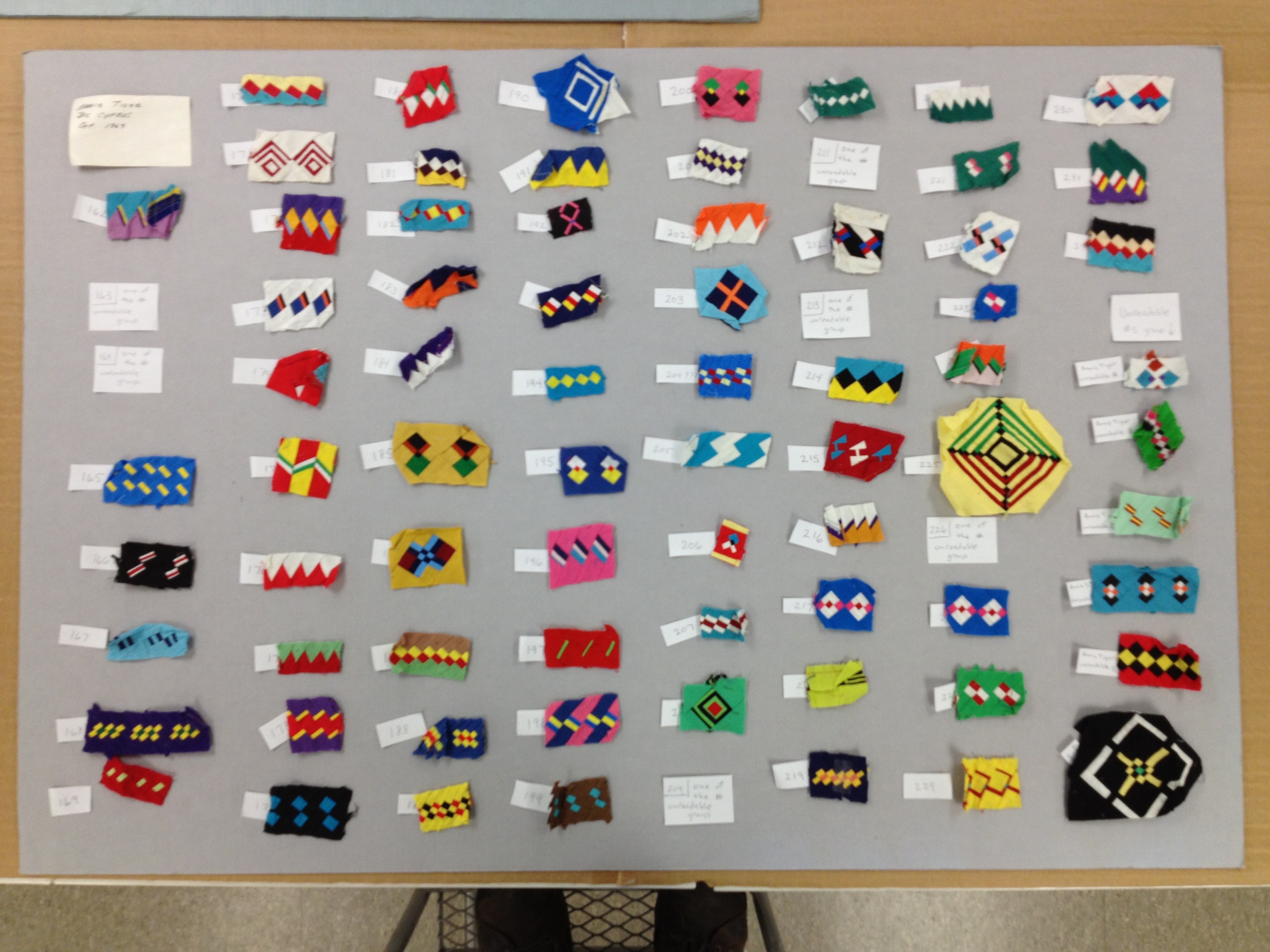
I was not able to put together a post last night, so here is just one of the couple hundred pictures I shot yesterday. This one is another array of Florida Seminole patchwork samples. These were all collected in 1969 and are by the same seamstress. As with the other objects that I am looking at, they are destined for the collections of the Department of Anthropology, National Museum of Natural History, Smithsonian Institution.

On the Study of Shreds and Patches

Yesterday my work with the William C. Sturtevant collection focused on the material culture side of his efforts to document the history, practice, and significance of the unique Florida Seminole art form known as “patchwork.” Basically, I organized and quickly looked at a couple of hundred patchwork samples such as those arrayed in the image presented here.

I have done little work yet with documents, but a large folder of notes associated with Dr. Sturtevant’s patchwork studies were handy and I took a quick peak. There is a lot there. I hold off on talking about that and describe a single note that is very relevant to this website.

For its early years, this website was just associated with my name. A while back though, it started to seem clear (to me, at least) that it needed a more blog-like name. The name the I chose was Shreds and Patches. I should have explained the source of this name at the time, but didn’t. It was a soft re-launch, I guess. Anyway, the first thing that my eye fell on when peaking into Dr. Sturtevant’s patchwork notes folder was a single slip of paper that explains the source of my name.

It is a medium sized slip of paper in his own hand and it is a quotation–the very quotation from which the title of this blog comes. The source is a famous, oft debated passage from the conclusion of a book by Robert Lowie. I have not gone back to the source to check Sturtevant’s note, but here it is as he has it.

“Nor are the facts of culture history without bearing on the judgement of our own future. To that planless hodgepodge, that thing of shreds and patches called civilization, its historian can no longer yield superstitious reverence. He will realize better than others the obstacles to infusing design into the amorphous product; but in thought at least he will not grovel before it in fatalistic acquiescence but dream of a rational scheme to supplant the chaotic jumble.”–p 441 (concluding paragraph of Lowie’s Primitive Society (1947, N.Y., Liveright; 1st ed. 1920; on pp ix-x of the new preface to the ’47 ed, RHL [Lowie] complains that this famous passage has been misinterpreted)

Lowie was one of Bill Sturtevant’s undergraduate teachers at Berkeley. I can talk some other time about the significance and history of this passage from Lowie. Here it is interesting to think what it is doing in Bill’s patchwork notes. Two possibilities have occurred to me.

If he meant it to be there, it was clever because it suggested that he was going to draw upon anthropology’s most famous theoretical discussion of “patches” in his empirical project on patches (of the Seminole sort). Alternatively, and amusingly, it could have been filed in this place by someone else because a quick scan of the text could suggest that because it is about patches it needed to go with the patchwork notes. I’ll get to the bottom of it someday, perhaps. In any case, it provides the answer to the question of why I named the blog as I did. (Lowie was not the original source of the phrase Shreds and Patches, just the one who gave it anthropological resonance in theorizing the nature of culture and so-called “civilization.”

Note.  The patchwork samples shown above are not yet numbered, but they are part of the William C. Sturtevant Collection at the National Museum of Natural History, Smithsonian Institution.

Another World is Possible: Open Folklore as Library-Scholarly Society Partnership

Preface

In the wake of the SOPA/PIPA protests, debate over the Research Works Act, the growing boycott of Elsevier by scholars in many fields, and more local discussions of the ways that various scholarly societies in my own fields of interest (anthropology, folklore studies) responded to the recent call by the [U.S.] White House Office of Science and Technology Policy for comment on public access to federally funded research, there is a great deal of additional attention being given to the changing nature of the scholarly communications (publishing) system and our hopes for its future.

One key issue centers on scholarly society publishing programs and how they can best be advanced in the present and into the future. At the 2011 American Anthropological Association meetings I spoke in two different contexts about these issues. I have shared here previously my remarks to the “Future of AAA Publishing” event (Jackson 2011b; for context, see Nichols and Schmid 2011 and Brown 2011). That presentation was on “Green Open Access Practices.”

I also spoke in the Digital Anthropologies: Projects and Projections panel organized by Mike and Kim Fortun and sponsored by the Society for Cultural Anthropology. In that event (which has been well documented by Daniel Lende (2011), my goal was to describe the Open Folklore project as both a broader community effort and as a specific digital platform, so as to illustrate a more general point about the fruitful possibilities that can come from direct partnerships between libraries and the library community and scholarly societies.

Libraries and scholarly societies now have a customer-to-business relationship and it is one that is growing ever more strained as commercial publishers become central partners in many scholarly society publishing programs. I evoked the alter-globalization motto Another World is Possible in my title because I wanted to suggest that the course that we are on is not the only one available to us. I believe, on the basis of a lot of time spent over the past five years with university librarians around the Midwestern U.S., that the research library community would much rather work with scholarly societies collaboratively in the shared real and digital spaces in which scholars and librarians (and students) already labor together rather than engage antagonistically in a neoliberal marketplace that has been shaped by the business practices pioneered by firms such as Elsevier, Springer and (yes) Wiley-Blackwell. Open Folklore is just one of many university-scholarly society partnerships that are exploring how to make this alternative framework real.

I should have just shared my presentation at the time of the AAA meetings, but I had hope that I could quickly work on it some more before getting it into wider circulation. Time has not been available for that work, but the current interest in these issues suggests that I might now have an interested audience and a second chance to share it below in the form that I presented it in Montreal.

My remarks below should not be taken as an official statement of the Open Folklore project team, the Indiana University Libraries, or the American Folklore Society. They reflect my own experience with these issues, although they of course also draw upon the rich experiences that I have had partnering with talented, committed colleagues working toward the goal of achieving Open Folklore’s aspirations. The paper below has been edited lightly just to recontextualize the language for a reader not at the original panel (meaning simple removal of language like, “so and so will probably speak later this morning about…”). I wish to take this opportunity to especially thank Mike and Kim Fortun for their remarkable service to the field as editors of Cultural Anthropology and as organizers of the Digital Anthropology event.


Another World is Possible: Open Folklore as Library-Scholarly Society Partnership

Jason Baird Jackson

Indiana University

Building upon shared values, facing common problems, and recognizing new opportunities, partnerships linking scholars, scholarly societies, and research libraries are a particularly hopeful development in the changing scholarly communication system. In my remarks, and as an example of current possibilities, I will quickly describe the Open Folklore project and situate it in the context of the serials crisis, the corporate enclosure of society journal programs, the erosion of the university press system, the development of open source software for scholarly communication, and the rise of the open access movement as a progressive response to these changes. For those wanting basic information on using Open Folklore associated resources in your research and teaching, I urge you to visit the Open Folklore Portal site online and to consult the instructional screencasts that my collaborators and I have shared there, and on YouTube.

By way of introduction, I can note that OF is a joint project of the American Folklore Society and the Indiana University Bloomington (IUB) Libraries. The two lead partners share as desire to make more reliable folklore scholarship—in many genres—discoverable and freely available online.  The Open Folklore team is doing this work but so are many colleagues in many places. Consulting the Open Folklore website, which I will come to in a moment, provides an eye-opening and encouraging sense of the OA work that a wide and deep network of folklorists have already been pursuing. Launched in 2010, the project has grown rapidly and made significant progress in its efforts to foster and encourage the development of an interconnected and interoperable, but also distributed and low-cost, system of open access projects and resources.

The Open Folklore project is more than its associated portal site. The project is pursuing educational projects aimed at educating scholars about open access issues. Importantly, it is also working with rights holders and publishing partners to encourage the pursuit of sustainable open access projects that comply with the basic technical standards already extant in the broader scholarly communications community. Read more

On the Harvesting of Low Hanging Fruit #oaweek

In disciplinary contexts, community discussions of open access and related issues in scholarly communications often get bogged down and then stall out. The reasons for this seem to me to be many. For example, participants rooted in their own particular discipline often guess about the meanings attached to key terms rather than finding, and then working from, common definitions established outside their own fields. Similarly, they often approach the various issues as if their subject area was the first, or only, field confronting these issues. In this spirit, considerable effort is then devoted to reinventing the wheel. Beyond the simple fact that the issues are really complicated and can be approached from a large number of perspectives, another problem stems from an all or nothing sensibility. The largest or most intractable problem is often quickly put on the table for consideration and proceeds to becomes a conversation stopper.

Its this last dynamic that I would like to briefly address. Put simply, we do not have to solve the most difficult problems first. Instead, we can search out and harvest the low hanging fruit. Low hanging fruit is easy and inexpensive to gather. Gathering it, we learn and gain experiences (and buy time) that will allow us, eventually, to tackle bigger challenges on the basis of experience gained and lessons learned. When we spend little or no time/money pursuing the smaller, easier prospects, we put less at risk and we can afford to learn from our mistakes. A single fall out of the top of a tree can be catastrophic. Standing on the ground, we can usually stumble and fall countless times without doing ourselves any great harm.

It is in the spirit of making progress in the harvesting of low hanging fruit–wherein significant good can be done in an easy and inexpensive way–that I recently suggested a way in which the conference programs and abstracts of the American Anthropological Association could be made freely available online to all interested users as part of the HathiTrust Digital Library. My recent suggestion of this strategy was offered as small part of an important discussion of the future of the AAA publishing program that was begun on the AAA weblog. It can be found there attached to the first of two posts by Michael F. Brown. The first (on which I commented) can be found here and a second post, dealing with the expense picture for the total AAA publishing program, is here.

Starting with the easier and less risky tasks is also the strategy underpinning the American Folklore Society/Indiana University Bloomington Libraries’ joint project called Open Folklore. Now entering its second year, most of the progress that the project has made so far could be understood as gathering low hanging fruit. What is exciting is that if enough such modest efforts are pursued concurrently, they add up to results that are definitely not a small matter.

Readers interested in looking at the basket into which a large amount of low hanging fruit has been gathered, can consult the project reports of the Open Folklore project. Over the course of three narrative accounts–the first offered at launch, the second offered at the six month mark, and the most recent at the twelve month point–a large diversity of open access accomplishments are described. In and of themselves, each represents a relatively modest resource and a readily accomplished task. Taken together, they represent significant progress towards the goal of making folklore studies a more accessible discipline. No make-or-break revenue streams were harmed in the making of the Open Folklore portal and the work that has been accomplished is as robustly and professionally preserved as is possible in the year 2011.

Like all scholarly societies confronting these questions, the AFS faces giant uncertainties in the years and decades ahead. There are many questions that will eventually need to be faced. For instance, will it ever be possible to make The Journal of American Folklore accessible in a gold OA fashion? Probably, but the pathway to getting there is hardly clear and, for the present, solving the riddles of revenue, expense and organizational sustainability in that context is too big a task. My argument is that there are other ways to make steady progress that do not require us to take on excessive risk or to immediately untie the tightest, most complicated knots.

I encourage interested anthropologists to join the conversation that Michael F. Brown is hosting at the AAA weblog. Folklorists with thoughts on the future of scholarly communications in our field are invited to comment here or to write to me privately.

This post reflects my own thinking on the questions that it addresses and should not be read as an official statement by any of the organizations or projects with which I am associated.

Why Michael Wesch’s “Blogging” Should Count

In his essay “Blogging for Promotion: An Immodest Proposal” anthropologist Greg Downey outlines a clear set of actionable proposals for reform at the intersection of scholarly communications practices and academic tenure and promotion practices. I commend his essay, which was published today (10/20/11) on Neuroanthropology, a compelling and influential PLoS (Public Library of Science) weblog that he runs with Daniel Linde. Rather than discussing this important contribution here in depth, I am going to try enacting one of its proposals. (For reference, see especially the discussion that follows Downey’s section heading “An immodest proposal (not an indecent proposition)”.)

First the set up. I am working extensively right now preparing a new course for spring 2011. This course was devised as part of my participation in a two year think-tank funded by the Teagle Foundation (a funder supporting projects designed to foster innovation in undergraduate teaching and learning) and organized by the American Folklore Society. The AFS project was built around the theme “What is the relationship between lay and expert knowledge in a complex society?” Colleagues teaching in a range of institutions, from community colleges and private liberal arts colleges to large research institutions gathered to explore the frontiers of research-based teaching, changing curriculum practices, and the wider contexts of our work in a small border discipline bridging the humanities and the social sciences, as well as the academy and the public sphere. As part of our work, we developed plans for new courses and teaching resources. Part of my work focused on working out plans for the course that I will initially teach next spring (it opens for enrollment today).

I have mentioned the course here previously. In a nutshell it uses the toolkit of folkloristics (and by extension my other field–cultural anthropology) to consider human responses–including aesthetic, expressive, customary, and communal responses–to a range of recently emergent and highly contested human social problems. Called “The New Social Problems: Communal and Expressive Responses” the new problem domains to be considered include such things as the digital divide, genetic engineering, intellectual property contests, and nanotechnologies. I am sure that I will be discussing the course further as it moves forward. The important point in this context is noting the influence that one colleague–whom I do not know and whom I have not yet met–has had on the shaping of my plans for this experimental course.

Michael Wesch, on his website/weblog Digital Ethnography (which is a key node in the digital infrastructure of his undergraduate-based research group), has regularly and effectively documented the pedagogical experiments and research work that he has been pursuing (over many years) with many successive groups of Kansas State University students. Wesch has been appropriately recognized and celebrated for the innovative work that he and his students have been doing. What I want to highlight here is that the manner in which he has documented and explained this work has made it richly available for the wider scholarly community. Because he has used http://mediatedcultures.net as a venue for reporting on his work, his strategies and experiences are openly and immediately accessible to me (and to my students) as well as to everyone else able to surmount the digital divide. Essays like “Our Class on How We Run Our Class” in which Wesch and his students describe (and enact) the technical and intellectual strategies through which a standard U.S. undergraduate course is turned into a deeply meaningful research collaboratory for social scientific investigation are just not available in the conventional published literature in our field. It is on the basis of the inspiration provided and the information conveyed by Wesch and his students that I am able to imagine a very different kind of course to pursue with my own students in January.

Michael Wesch’s Digital Ethnography efforts represent the kinds of “blogging” work that deserves to count as a substantive scholarly contribution (bridging teaching, research, and service) in such areas as annual review and tenure and promotion considerations.

On Making Conference Programs and Reports Back to 1889 Freely Accessible Online

Earlier I posted about the recent news from the Open Folklore project. One piece of the larger story was the news that the American Folklore Society, in partnership with the IU Bloomington Libraries, has made a nearly complete set of AFS conference programs and conference reports available for free online. These documents provide information on the annual meetings of the AFS going back to the society’s founding.  There are still a few missing items to be found and added to the collection, but its almost all there and this is an important accomplishment. These documents are can be found via Open Folklore search and browsed in IUScholarWorks Repository.

Most importantly, these documents are a valuable resource to scholars. They are key historical documents, but they are also invaluable to those who need to know who studied what when?

Beyond their documentary value, the folklorists and ethnologists involved in the AFS should be proud of this accomplishment. Through collaborative partnerships and the deployment of some elbow grease, another worthy open access milestone has been met. Such efforts require labor and in-kind support, but they do not require a major grant, custom digital infrastructures, and outsourced service providers.


New Open Access Tools, Resources, Partnerships, and Content Announced @openfolklore

I am happy to report that real and significant progress in the Open Folklore project continues to be made. A year ago (October 13, to be exact) the American Folklore Society and the Indiana University Bloomington Libraries launched the Open Folklore project and its associated web portal. Open Folklore is about promoting open access in the field of folklore studies (/ethnology) and about fostering partnerships among those working towards the goals of open access in the field. On behalf of the OF project team, I was the author of a news release/project report on the most recent accomplishments of the project and the most recent content additions accessible via the portal site. This was published this morning and is available from the Open Folklore portal.

As readers of the news release will discover, highlights over the past six months include making programs and reports related to the annual meetings of the American Folklore Society (going back to 1889) freely accessible, the launch of the AFS Ethnographic Thesaurus, and the continued growth in the number of AFS section journals being made freely accessible in digital form. The big picture is that the community is continuing to come together to advance the goal of making folklore scholarship and resources more discoverable and accessible to community members, students, tradition bearers, and scholars worldwide. As was recognized this summer when OF was recognized with the Outstanding Collaboration Award by the Association for Library Collections and Technical Services (ALCTS) during the American Library Association meetings, folklorists have a lot to be proud of. We are pioneering in many parts of the scholarly communications world, from the development of open access journals, books, repositories and archives to developing generalizable collaboration strategies for organizational partnership, especially between libraries, non-commercial publishers, and scholarly societies.

I encourage everyone to get caught up with what OF has been up to over the past six months and to continue to spread the word about the project while putting the tools and resources available at http://openfolklore.org to use in your work.

“Ritual and Oratory Revisited” in Annual Review of Anthropology

The final, stable 2011 edition of the Annual Review of Anthropology (a vital, not-for-profit undertaking co-edited by Don Brenneis and Peter T. Ellison) is now available (toll access). Because the topic is of great interest to me, I was pleased to see Rupert Stasch‘s review essay on “Ritual and Oratory Revisited: The Semiotics of Effective Action.” Looking more closely, it was a welcome and nice surprise to see that he knew about my work in this realm and found a generous way to weave it into his general narrative. My writings are sometimes high in area studies interest and, conversely, less immediately engaging for scholars working elsewhere in the world, thus it is always nice when it is clear that they have been discovered by, and made sense to, a colleague working in a different context. This essay will be an invaluable resources as I take up new work on the topic. Thanks!