Skip to content

Posts from the ‘Ethnology’ Category

Excellent Symposium Concludes 2013 Summer Institute in Museum Anthropology

Many things have been happening lately–so many that keeping up with them here has been difficult. Many good things have gone unreported and some bad current events (global and national, not personal) have gone un-commented upon. I am pleased though to celebrate the conclusion of the 2013 Summer Institute in Museum Anthropology. I was invited to join the institute for its last week and a half and to participate in its concluding symposium at the National Museum of Natural History (NMNH) on the Mall in Washington. In the symposium, SIMA’s twelve graduate student participants presented the initial findings of their four-week research projects utilizing the (amazing) collections–both objects and archival materials–of the NMNH Department of Anthropology. The students came to SIMA from many different graduate programs and backgrounds and possessed a diversity of historical, ethnographic, topical, and theoretical interests. They did wonderful work and I learned a lot from their studies and from their careful and compelling reporting. While they have further to go, of course, with their projects, I think that it is pretty exciting to hear the results of four intensive weeks of research as the concluding act of that same four week process. Quite remarkable.

I am very appreciative of my continued association with this wonderful program. I am glad that I have been able to help it continue moving along so well.

SIMA will happen again next summer. Details will be posted here on the SIMA website in the months ahead.

Review: A Companion to Folklore

Today the Journal of Folklore Research Reviews (JFRR) published my review of A Companion to Folklore edited by Regina F. Bendix and Galit Hasan-Rokem. (Wiley-Blackwell, 2012). It was an honor to be asked to review such a key volume in the field. Find the  review online here: http://indiana.edu/~jofr/review.php?id=1416

New Beginnings: Mathers Museum of World Cultures

Today I had the privilege of beginning work as Director of the Mathers Museum of World Cultures. I will surely write about the work of the museum extensively in the months ahead. Here I just want to thank the museum’s staff for welcoming me and thank the Indiana University administration for giving me this exceptional opportunity to do the  work that I love.

I could single out countless museum objects, collections, colleagues, goals, or aspirations to write about here, but I will use this post to acknowledge the long and important service of my predecessor Geoffrey W. Conrad. The Mathers Museum celebrates its 50th anniversary this year, and Geoff led the museum for nearly 30 of those years. The museum accomplished a tremendous amount over those three decades and it is exciting to have a chance to collaborate in building upon the solid foundation that Geoff and the staff built over the span of his long and distinguished career leading the museum.

New Beginnings: Journal of Folklore Research

During 2013, I will have the honor of editing the Journal of Folklore Research. I will be serving for a year as Interim Editor, bridging Moria Marsh’s editorship and the anticipated service  of an outstanding departmental colleague who will be away from campus next year. The opportunity is a valuable one and the time is most auspicious, as 2013 will see the publication of the journal’s 50th volume.

With roots that go back to 1942 and a number of earlier publications, the journal that we now know as JFR was founded in 1964 as the Journal of the Folklore Institute. The journal’s name was changed to its current form in 1983. Long published by Indiana University’s Folklore Institute (which would later become the Department of Folklore and Ethnomusicology), the journal has been published in its current period in a partnership between the Department and the Indiana University Press. Today the journal is prominently included and heavily used in key services such as JSTOR and Project Muse. It has long maintained a distinctive and international voice in folklore studies and ethnology and has benefitted from a global community of supporters, led by its team of corresponding editors. In keeping with the mandate of its departmental home, the journal has welcomed work by ethnomusicologists throughout its history.

I have learned much shadowing the journal’s able staff throughout the fall and, while Moria begins enjoying life after editing, I will enjoy continuing, in the year ahead, alongside Managing Editor Danille Christensen and Editorial Assistant Miriam Woods. In my preliminary work, I have already learned a tremendous amount about the fields in which JFR publishes. I look forward to the work, and the year, ahead.

Thanks to everyone who has made JFR a success over the past five decades.

A First Rate Podcast: Artisan Ancestors Visits the Summer Institute in Museum Anthropology

A perfect example of how scholarly research in folklore and anthropology can be made accessible and interesting for a wider audience is the Artisan Ancestors podcast produced and hosted by my friend and colleague Jon Kay. (Jon is, among other roles, the Director of Traditional Arts Indiana.) If you have not yet encountered the Artisan Ancestors show, I urge you to check it out. As Jon describes it, the focus of the show is on strategies for “researching creative lives and handmade things.” Jon does interviews with people involved in such work with the goals of encouraging and guiding newcomers to such studies and of expanding the horizons of those already deeply involved. Long adept in the skills of the public folklorist, Jon has mastered the podcast genre. He is a great interviewer and he knows how to do in interview with the needs of his audience and the requirements of the medium in mind. The production values are high but it is clear that he has worked out a system that gets good results without endless, expensive work.

In his newest episode (#26) Jon interviews Dr. Candace Greene, another friend and the Director of the Summer Institute in Museum Anthropology (SIMA). The interview explores the purposes and goals of SIMA in a way that not only introduces this training program (for which I was a faculty member this past summer) but also encourages deeper understanding of the broader value of museum collections for research in social and cultural history. It is a great interview and listening to it will illustrate not only the value of the SIMA effort but also suggest the value of podcasting initiatives such as Artisan Ancestors. Kudos to Jon and Candace for their great job with this episode.

A Very Small Pot by Maude Welch, Eastern Cherokee Potter

A very small “wedding jug” by Eastern Cherokee potter Maude Welch (1894-1953). William C. Sturtevant collected this piece from Ms. Welch on September 15, 1951, about two years before her death. Drawing upon her experience visiting Catawba potters, Mrs. Welch was central to the revitalization of pottery making among the Eastern Cherokee.  A rich profile of her and her work is available online from the Western Carolina University library. It was authored by M. Anna Fariello.

This piece (which is only about 2″ in all dimensions) is in the William C. Sturtevant Collection, Department of Anthropology, National Museum of Natural History, Smithsonian Institution. For those who are interested in such things, Sturtevant paid Mrs. Welch’s asking price of 50 cents. (Fifty cents is about $4.00 today, if adjusted for inflation.)

A Sea Island Basket by National Heritage Fellow Mary Jane Manigault

The William C. Sturtevant collection includes a nice group of coiled, sea grass baskets created by the African American weavers of the Sea Island region near Charleston, South Carolina. The better documented of these were collected by William C. Sturtevant in 1959. In this group is the basket shown above. It was made by Mary Jane Manigault (1913-2010), a basket maker who would go on (25 years later) to be awarded a National Heritage Fellowship from the National Endowment for the Arts in 1984.

There is a rich literature about the Sea Island basketry tradition. A recent work is the exhibition catalog Grass Roots: The African Origins of an American Art. The volume was edited by Dale Rosengarten, Theodore Rosengarten, and Enid Schildkrout and published by the Museum of African Art in 2008. The associated exhibition led to free online resources on the subject being made available through the Museum of African Art, the National Museum of African Art, and the McKissick Museum at the University of South Carolina.

Interestingly, one of William Sturtevant’s photographs from his 1959 visit to the Sea Island region was featured in the Grass Roots exhibition’s online presence. It is an image of Pearl Dingle weaving a basket at her family’s stand in Mt. Pleasant South Carolina. You can see it on the McKissick website.

The rich obituary for Mrs. Manigault published on the website for the documentary film Bin Yah: There is No Place Like Home is definitely worth checking out. It notes that her baskets are among those in the amazing Sea Island collection curated at the Mathers Museum (at Indiana University) where I work as a Faculty Curator. The NEA National Heritage Fellow profile for her is another great online resource.

This basket is currently identified as T331 and is from the William C. Sturtevant Collection, Department of Anthropology, National Museum of Natural History, Smithsonian Institution.

Coconut Rattles in Florida and Oklahoma

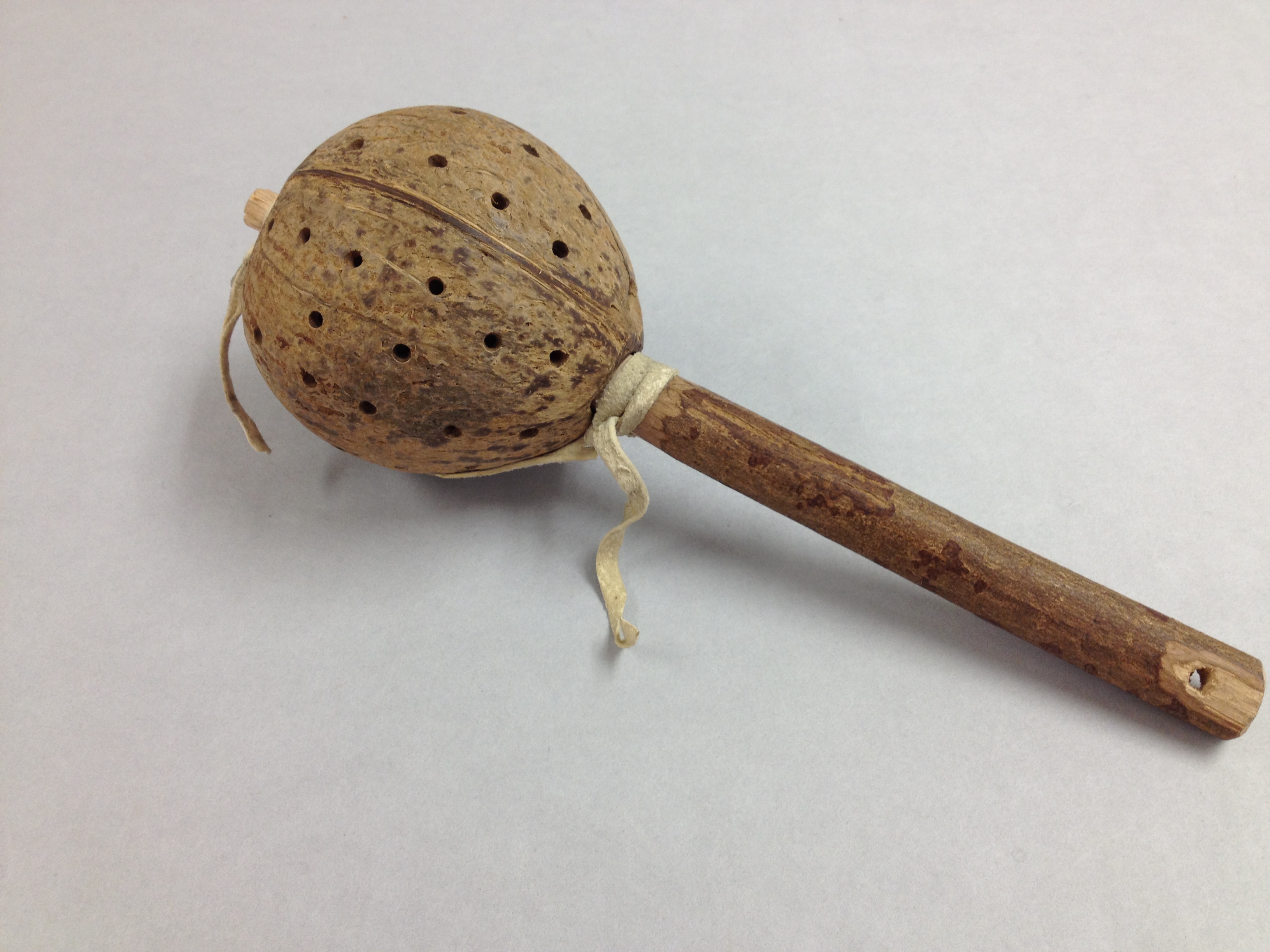
The diversity of materials used by Native peoples in the Americas to make hand rattles is pretty staggering. Among the farming peoples of the Southwest, Plains, Northeast and Southeast, gourds are one important material used for this purpose. Having the same basic form as gourd rattles, but unique to some Southeastern Indian peoples, are rattles, such as this Florida Seminole example, made from coconuts. William C. Sturtevant provided the coconut used here to Jack Motlow, from whom he commissioned it for $2.00 in 1951. This Florida Seminole example is made exactly like those used among the Southeastern peoples in Oklahoma, including among the Yuchi. (I commissioned Yuchi examples for the Gilcrease Museum in Tulsa during the later 1990s.) Such rattles are called “gourds” in English in Oklahoma and are particularly suited to the outdoor dances of the region. Such rattles are loud and thus sound great when used, as they most often are, outside, in open spaces. (The holes drilled in the coconut amplify the rattle’s sound.)

This example is #301 in the William C. Sturtevant Collection, Department of Anthropology, National Museum of Natural History, Smithsonian Institution.

(The Seminole Tribune has published biographical profiles of two of Jack and Lena Motlow’s daughters. These profiles are of Louise Motlow and Mary Motlow Sanchez and are online.)

A Chitimacha Basket

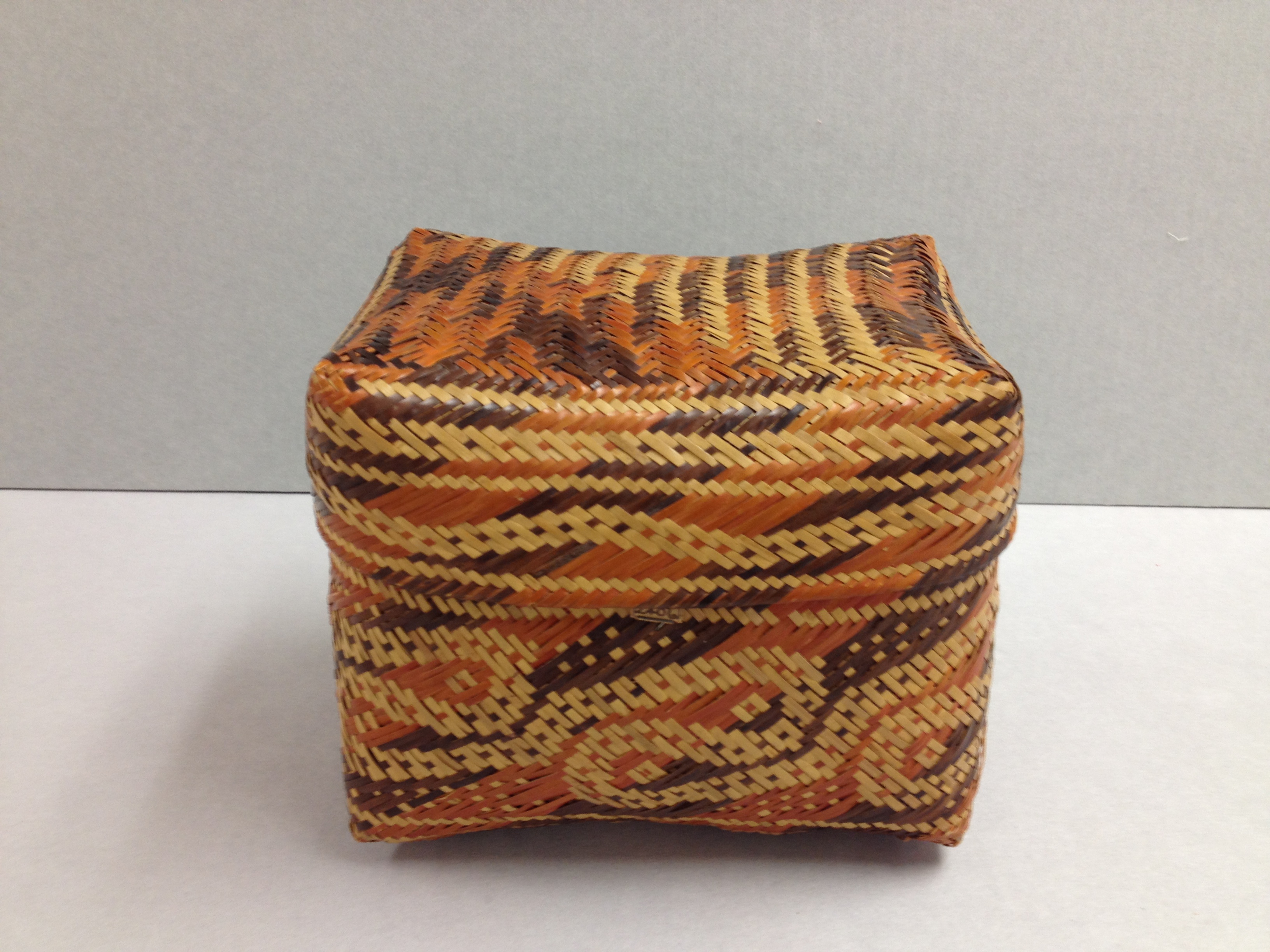
Here is an image of a double woven river cane basket with lid from the Chitimacha people of Louisiana. It was purchased at auction in 1972 by William C. Sturtevant and is now in the collections of the Department of Anthropology, National Museum of Natural History, Smithsonian Institution (T070).

People Love Tiny Baskets

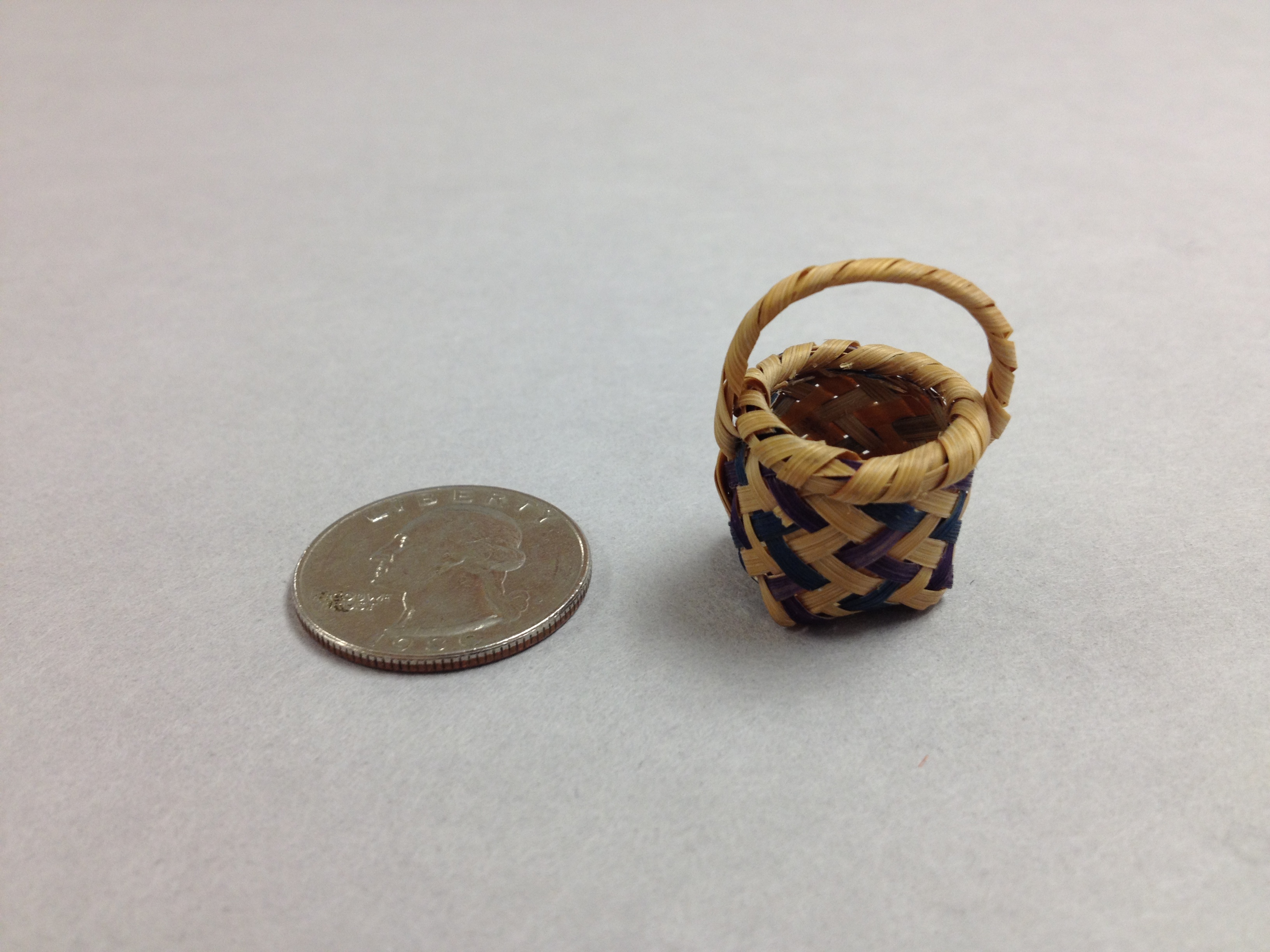
When wearing my curator hat, I have seen how ubiquitous love of tiny baskets seems to be, at least among fans of hand made objects. While I am sure that some engineer is doing nano-scale weaving already, tiny-scale seems good enough for fans of Native American basketry. The best known heroes in this area are the basket weavers of California, particularly the Pomo with their amazing feather covered baskets, but the art of the tiny basket has also been pursued in the native South. This impulse is reflected in this Choctaw basket by “Sweeny Willis” that was collected by John Mann Goggin among the Choctaw residing near Philadelphia, Mississippi. Ms. Willis’s name is spelled “Sweenie” elsewhere, such as in the records associated with pottery that she made that is in the collections of the National Museum of the American Indian.

This single weave river cane basket is currently referred to as #494 in the William C. Sturtevant Collection, Department of Anthropology, National Museum of Natural History, Smithsonian Institution.

For a bit of theorizing, look below the fold.

Read more