Skip to content

Posts from the ‘Ethnology’ Category

State Fairs: Growing American Craft: Four Questions for Exhibition Contributing Curator Jon Kay

Jon Kay with Jason Baird Jackson
Indiana University Bloomington

Jon Kay is Director of Traditional Arts Indiana and an Associate Professor of Folklore at Indiana University Bloomington. In this exchange I pose questions to him about the new Smithsonian exhibition and catalogue State Fairs: Growing American Craft. Find details about the exhibition at the end of the interview.

Jason Baird Jackson (JBJ):  Jon, you have just returned from a trip to Washington, DC for the opening of the exhibition State Fairs: Growing American Craft, which will run through September 7, 2026 at the Smithsonian American Art Museum’s Renwick Gallery. The Renwick is the part of the Smithsonian devoted to craft. Before I ask you about your role in the exhibition and the associated catalogue (Mary Savig, ed., State Fairs: Growing American Craft. Smithsonian Books, 2025), can you tell me about the opening? What did you see? What did you do? Who went with you? What was most memorable?

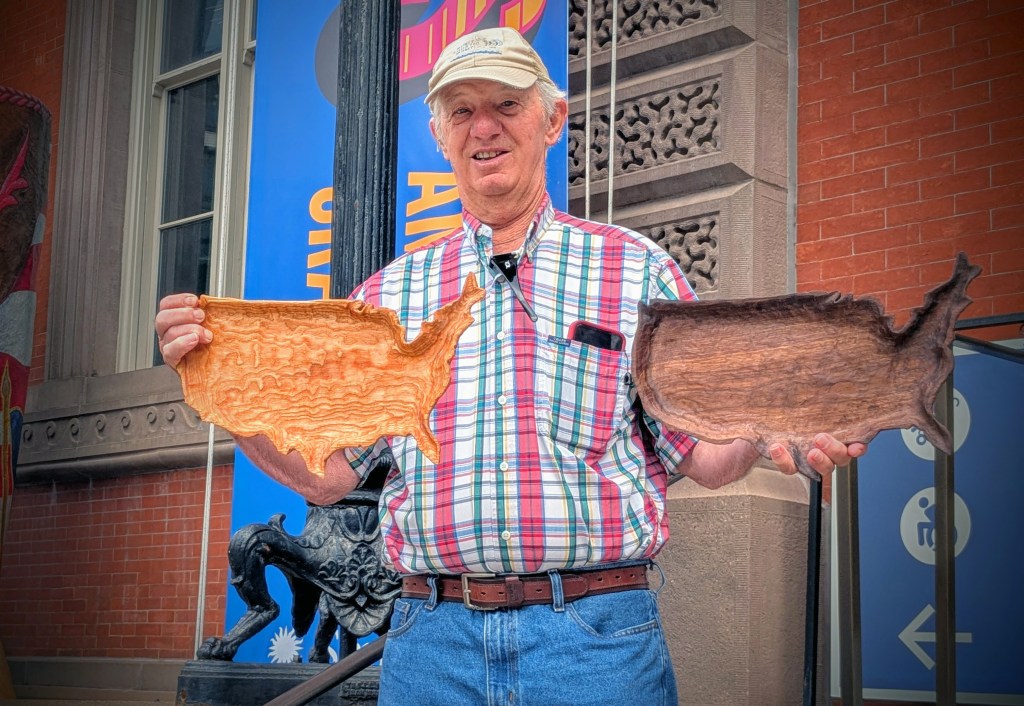
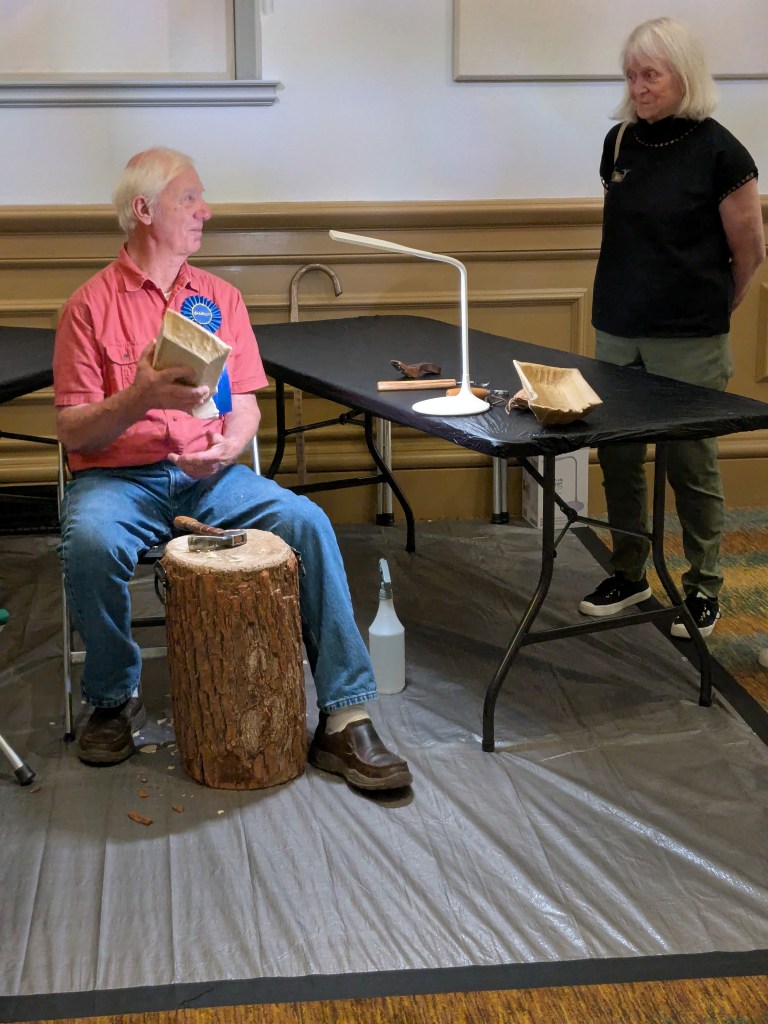
Jon Kay (JK): Thank you for the opportunity to reflect on my recent trip to Washington, DC, where I attended the Smithsonian American Art Museum (SAAM)’s after-hours celebration of the exhibition State Fairs: Growing American Craft at the Renwick Gallery. I participated in the event with Keith Ruble, a bowl hewer and longtime demonstrator in the Indiana State Fair’s Pioneer Village (Figure 1). Keith was named a State Fair Master in 2001—well before I became director of Traditional Arts Indiana (TAI)—a testament to the longstanding recognition of his work.

From 2001 to 2021, TAI partnered with the Indiana State Fair to honor its veteran participants through the State Fair Masters program. Each honoree was selected for their skill, excellence, and deep knowledge in their discipline, as well as for their commitment to passing on that knowledge within their communities. The program emerged in the years following the untimely death of Bill Day, an early Pioneer Village demonstrator and Keith Ruble’s bowl-hewing mentor. It was fitting, then, that both Keith’s and Bill’s bowls were featured in the Renwick’s exhibition (Figure 2).

Keith had been invited to demonstrate at the exhibition, but initially declined—he and his wife, Susie, don’t fly, and he didn’t feel up to driving to DC. When he told me this, I offered to take him. He agreed. So, the day before the celebration, Keith, Susie, my wife Mandy, and I made the twelve-hour trip to the Renwick.

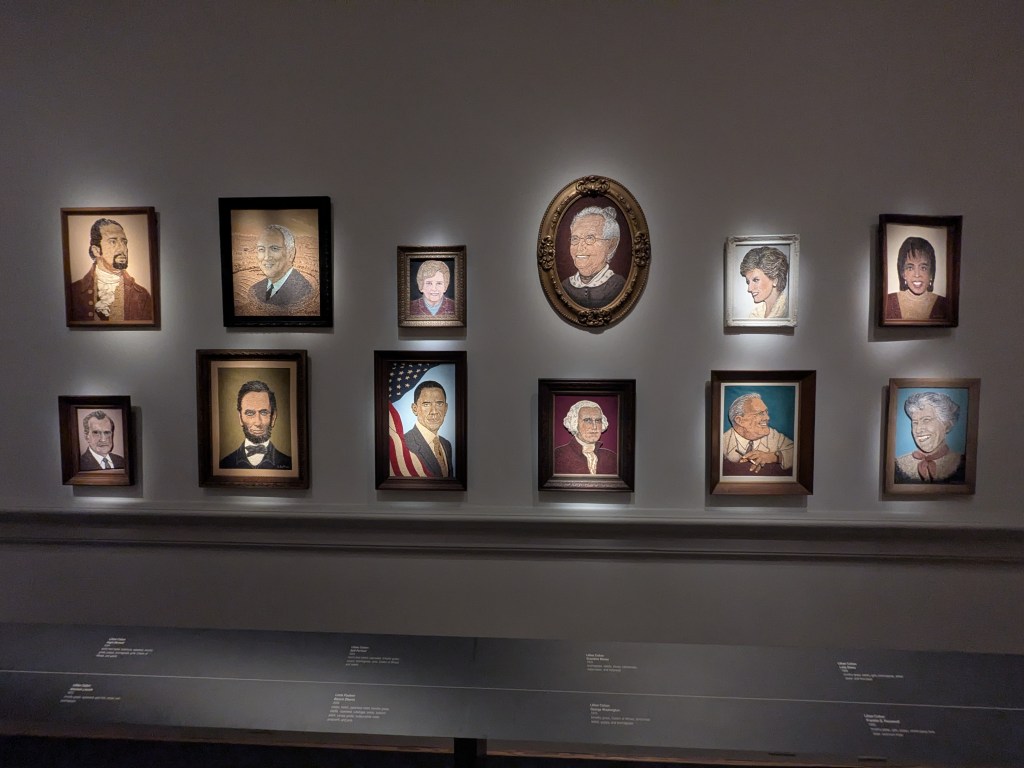
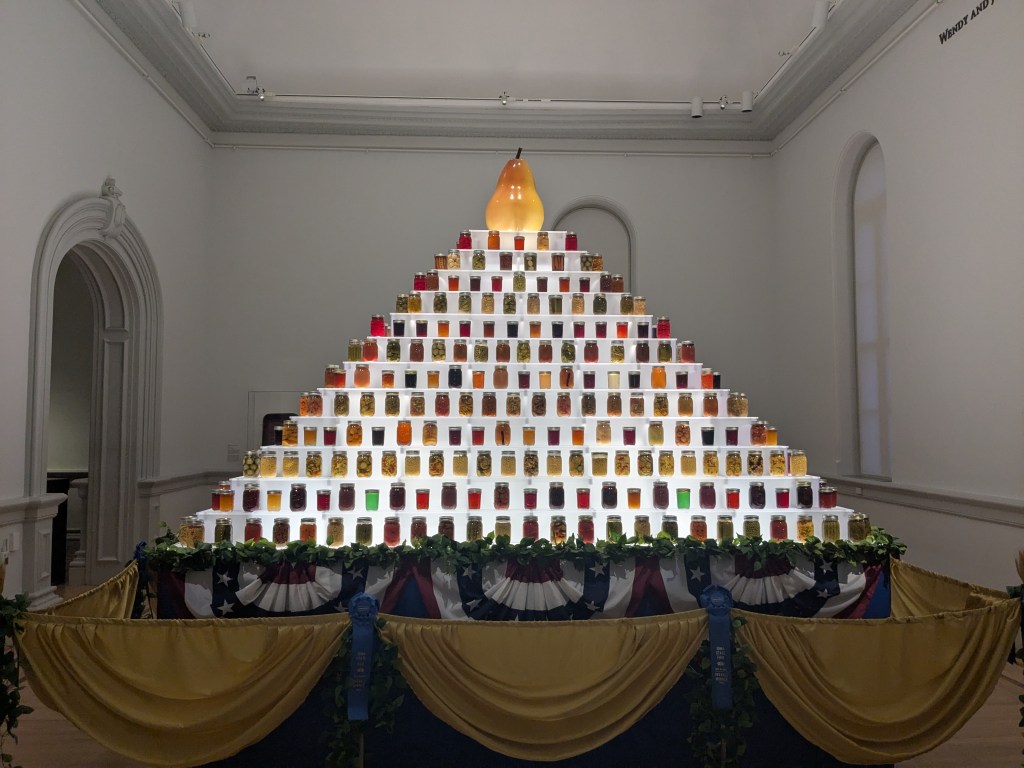
On our first morning in DC, we walked to the Renwick Gallery to view the exhibition and deliver several hand-hewn bowls that Keith had made for the museum’s gift shop (Figures 3 and 4). I imagine your future questions will explore the exhibition’s content in more detail, but for now, I’ll say it was a remarkable showcase of crafts by artists who have exhibited, competed, and demonstrated at state fairs—past and present. From pottery and crop art to canned goods and quilts, the exhibition underscored the central role of craft in state fairs since their inception in 1841 (Figures 5, 6, 7, and 8).

The celebration brought together many of the featured artists and their families, including saddle maker Bob Klenda from Kimball, Nebraska; canner Rod Zeitler from Coralville, Iowa; and basket maker Polly Adams Sutton from Seattle, Washington (Figures 9, 10, 11). While the artists enjoyed seeing their work on display, the event also created a meaningful space for state fair craftspeople from across the country to connect and share stories. The atmosphere was one of mutual appreciation. In a culinary nod to fair traditions, the Renwick served corndogs, cornbread, corn pudding, and other fair staples. It was a festive and memorable evening.

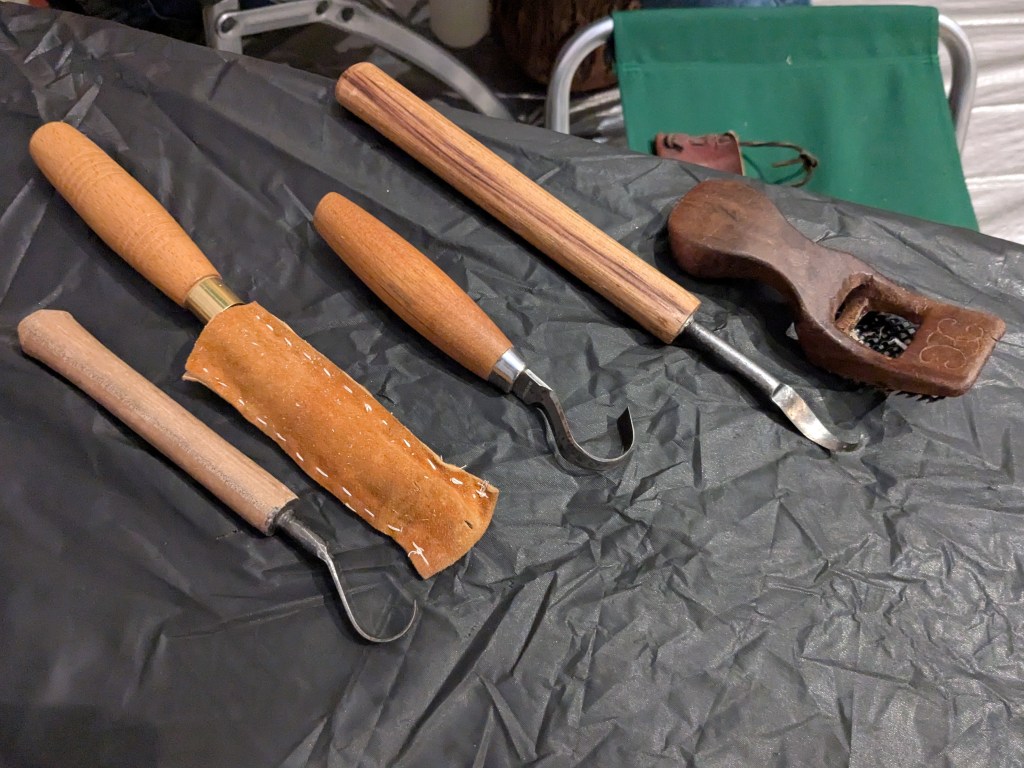
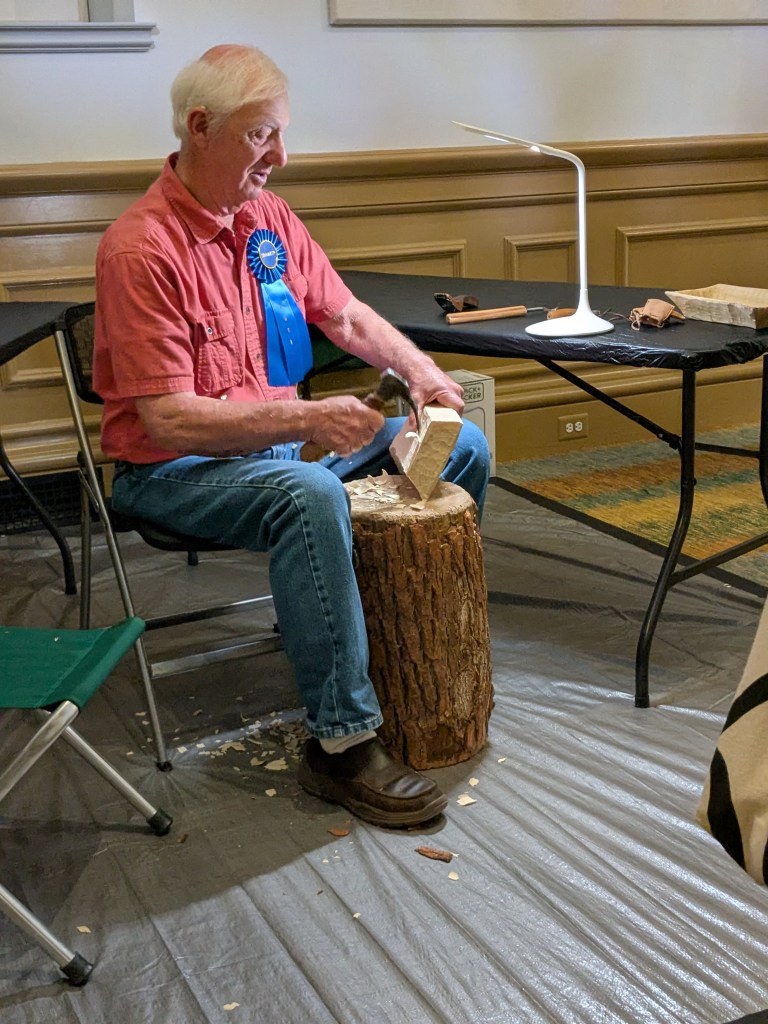
The following day, Keith demonstrated his craft at the Renwick. Concerned about wood chips, the events team taped down tarps and provided tables and chairs. Keith’s setup was minimal—just a few tools: a bowl adze fashioned from a ball-peen hammer, a bent gouge, a couple of spoon knives, and a hand-rasp scraper (Figure 12). But what really caught people’s attention was his sassafras stump with luggage handles, which he uses as a chopping block (Figure 13).

Throughout the day, Keith worked on an Indiana-shaped bowl, answered questions, and shared stories. He spoke about his mentor, Bill Day; his wife’s tolerance for him chopping in the living room; and his “mother-in-law” bowls—his name for the ones that crack (Figure 14).

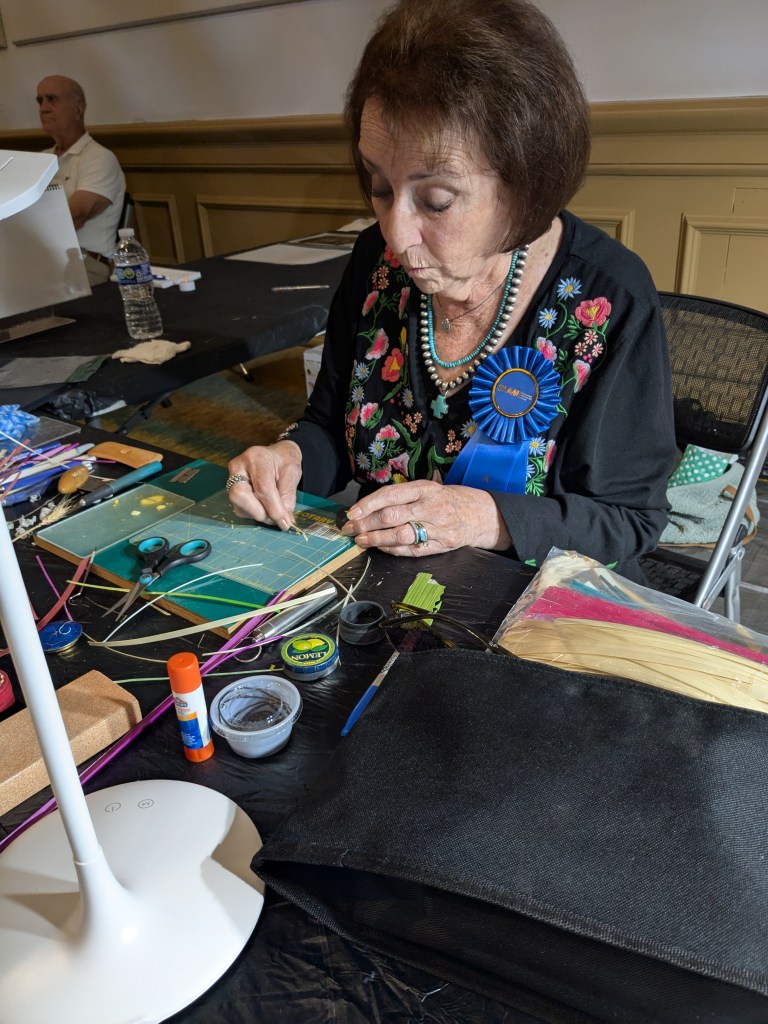
Alongside Keith were two other demonstrators: Martha Varoz Ewing from Santa Fe, New Mexico, who practices traditional straw appliqué, and Samuel Barsky from Baltimore, Maryland, known for knitting custom sweaters of his own design (Figure 15 and 16).

Soon after Keith began, the rhythmic chop, chop, chop of his adze echoed through the gallery, drawing visitors to the demonstration area. From 10 a.m. to 2 p.m., the artists worked and engaged with the public. Keith noted that he didn’t even finish the bowl he brought to work on. I assured him that the Smithsonian didn’t mind. There was a steady stream of visitors throughout the day, and the exhibition, as a whole, was very well attended.

JBJ:  I am glad that you and Mandy, Keith and Susie had a great time at the exhibition and its opening events! With the scene set now, can you tell me about your role as one of the “contributing curators” working with lead curator Mary Savig?

JK: From 2004 to 2022, I coordinated the Indiana State Fair Masters Program as part of my work directing Traditional Arts Indiana. For this program, I conducted oral history interviews, created exhibition panels, and produced documentary films.* My friend Betty Belanus, a retired curator at the Smithsonian Institution’s Center for Folklife and Cultural Heritage and Indiana’s first state folklorist in the 1980s, was aware of my long-standing work with the Indiana State Fair. When Mary Savig, Chief Curator of the Renwick Gallery, began planning the exhibition State Fairs: Growing American Craft, Betty suggested that she reach out to me to help identify potential Indiana craftspeople to feature.

Mary and I met at the 2023 Indiana State Fair, where I gave her a tour of the fairgrounds. The State Fair Masters program, as I mentioned earlier, celebrated the work of longtime fair participants—from apple growers and hog breeders to pie bakers and weavers—highlighting the artistry embedded in fair traditions. While many of these practices have aesthetic dimensions, the Renwick is a craft gallery, so performance-based traditions, such as baton twirling, clogging, and washboard playing, were outside the scope. I joked that while I could make a case for seedstock swine breeding or miniature donkey husbandry as art forms, jars of jelly and pickles were probably as close as the exhibition would get to these more ephemeral crafts.

As we walked the fairgrounds, Mary and I discussed her vision for the exhibition and my nearly two decades of work with the Indiana State Fair. The State Fair Masters program had ended in 2023, so I was especially reflective during our visit.

Our first stop was the Indiana Arts Building, formerly known as the Home and Family Arts Building. In the basement, baked goods and canned items were exhibited; the main floor featured quilts, needlepoint, weaving, crochet, and knitting. The building also featured paintings, photographs, and other artworks that had been entered in various fair competitions. I introduced Mary to longtime building coordinator Nancy Leonard, and then we talked with Mary Schwartz, a 2013 State Fair Master who was recognized for her needlepoint artistry.

Next, we visited the Pioneer Village, located across the fairgrounds and surrounded by antique tractors and historic farm implements. The Village showcases farming practices, music, and crafts from Indiana’s Depression Era and earlier. I introduced Mary to the wheelwrights and blacksmiths, and Charlie Carson who trains oxen and makes yokes. In the Pioneer Village Building, Mary talked with quilters, weavers, and broom makers—but what truly captured her interest was the bowl hewing.

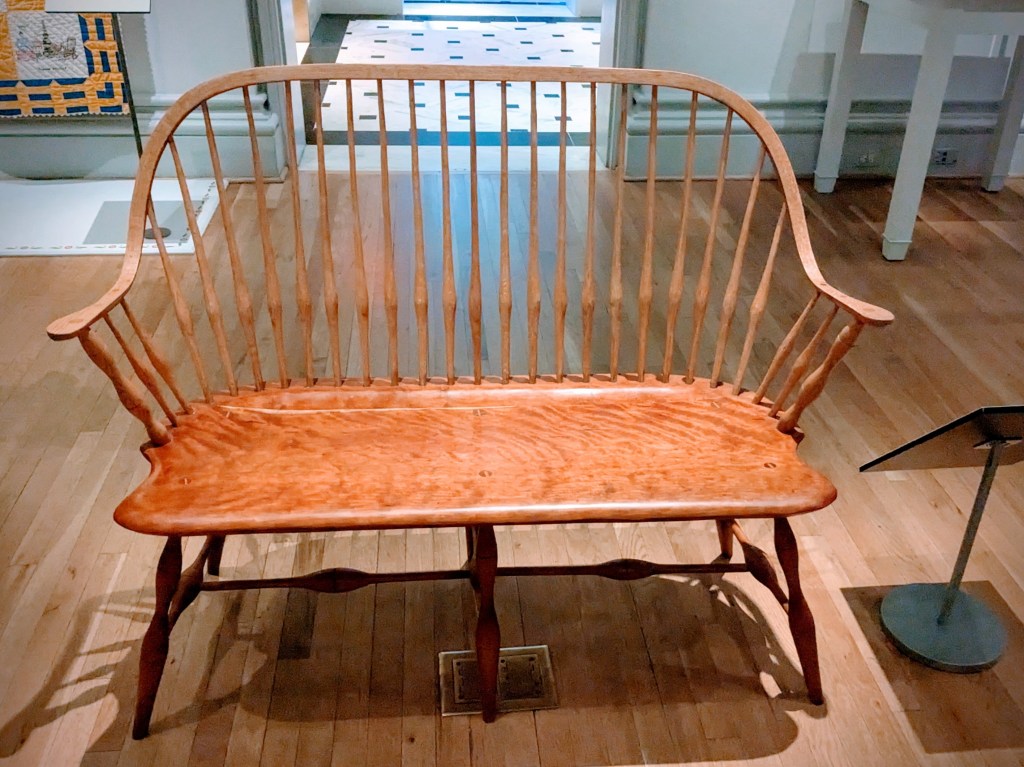
I had recently curated an exhibition at the Swope Art Museum in Terre Haute, Indiana that featured several bowl makers who demonstrated at the fair. I introduced Mary to Keith Ruble and Blaine Berry, both of whom would later be featured in the Renwick exhibition. I also secured a large sassafras bowl made by Bill Day for the exhibition. I loaned the gallery a tulip poplar bowl shaped like Indiana, which Keith had made for me for the 2016 Bicentennial of Indiana Statehood. In addition to recommending artists, I shared ideas for potential craft inclusions. Mary ultimately acquired a settee and two Windsor chairs from Blaine, which the Smithsonian purchased (Figure 17).

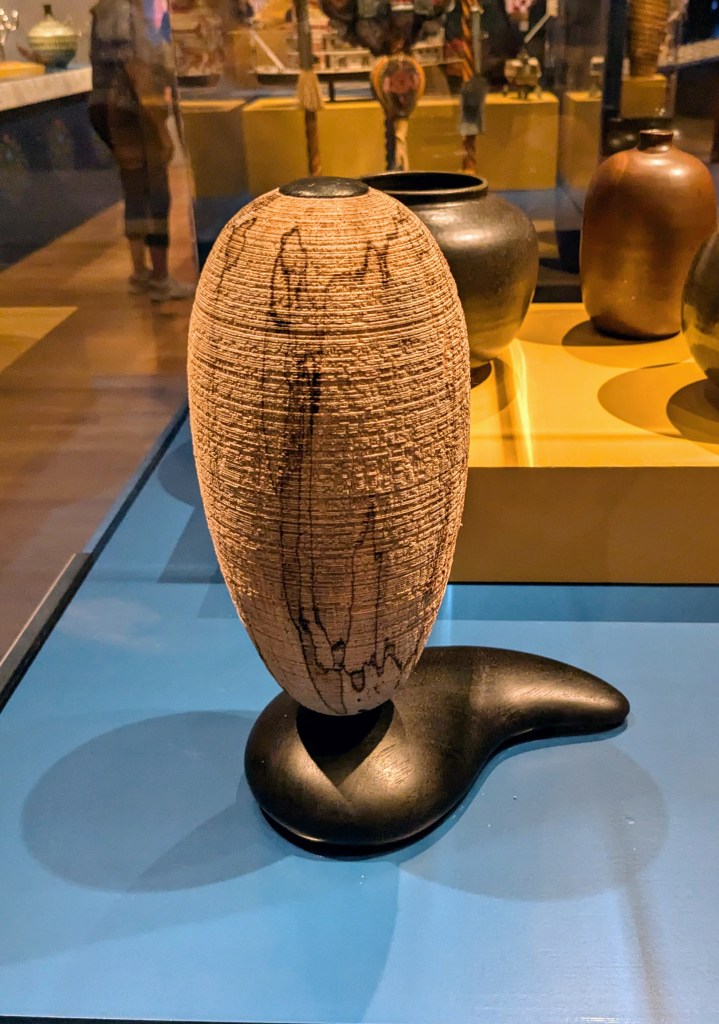
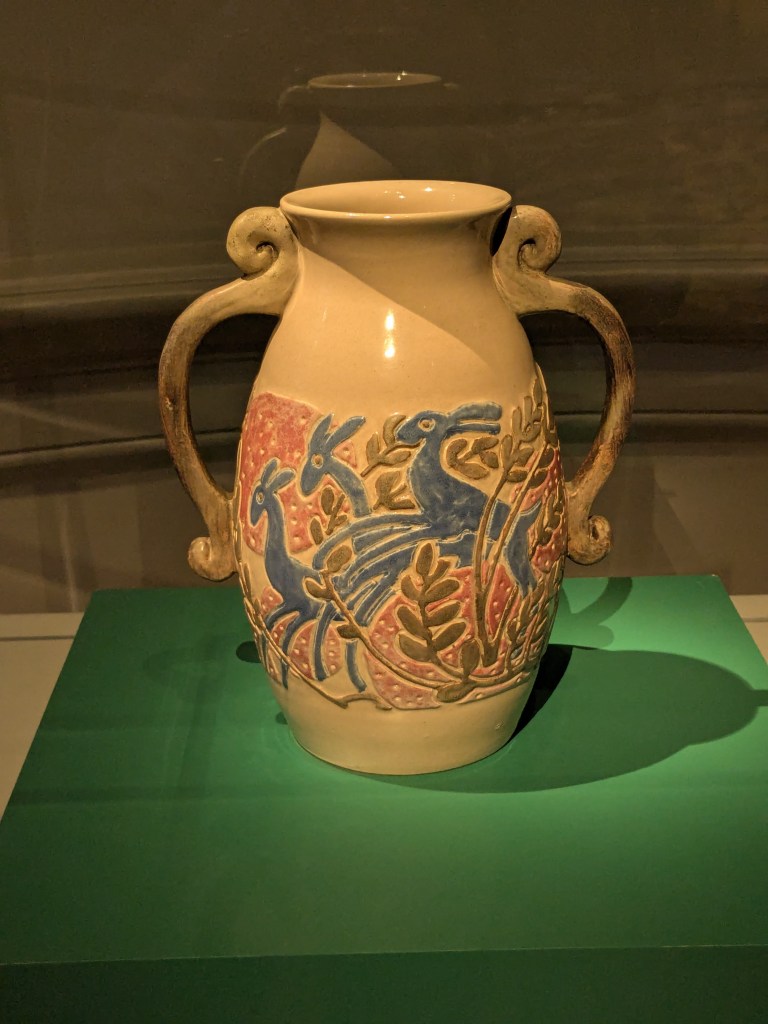
By the end of our visit, Mary had identified about ten potential Indiana artists for the exhibition. A few months later, she told me that she needed to pare down the list, because the exhibit included more craftspeople from Indiana than any other state. The final roster included bowl maker Keith Ruble, chairmaker Blaine Berry, basket weaver Viki Graber, woodturner Betty J. Scarpino, and potter Kelly Bohnenkamp, who loaned her whimsical “corndog vase” (Figures 18-20). The exhibition also included works by two historical Indiana craftspeople: a vase by Mary Overbeck (1878–1955) and the large bowl made by Bill Day (1915-1999) (Figure 21).

JBJ:  I am glad that you could help the craftspeople of Indiana gain recognition from this major exhibition at a key world museum devoted to craft. I mentioned the catalogue for the exhibition at the start. Can you tell readers what they will find in that catalogue and what your contribution to it is?

JK: The exhibition catalog, State Fairs: Growing American Crafts, is a companion book published by Smithsonian Press (Savig 2025). It connects the narrative threads of the exhibition, as outlined by editor Mary Savig in the introduction. The chapters then highlight key themes, including “4-H and Youth Participation,” “Creative Arts Competitions and Women’s Collectivity,” “Indigenous Fashion Shows,” and “Studio Craft Competitions.” My chapter ended up being more focused than the others, centering on the Pioneer Village at the Indiana State Fair.

Mary and I initially discussed framing the essay around creative aging in heritage events, but ultimately, she felt a tighter focus on the Pioneer Village would serve the book better. For my chapter, I drew on decades of interviews with participants in the Pioneer Village. In fact, I had to work hard to stay within the word count. I hadn’t realized at the time that mine would be the only chapter focused on a specific event. While the other essays explore broader themes across multiple fairs, mine is grounded in my long-term work at the Indiana State Fair—and especially in the Pioneer Village.

I feel fortunate to have served as a contributing curator for the exhibition. Much of my role involved sharing nearly two decades of research into craft traditions at the Indiana State Fair. I’ll be returning to the Renwick Gallery this winter to participate in a panel discussion, where I’ll speak about my work in arts and aging, drawing on experiences with longtime fair participants, including those in the Indiana Arts Building and across the fairgrounds.

JBJ: The new exhibition, book and public program series at the Renwick Gallery is one of scores of projects that you have pursued related to craft and craftspeople in Indiana, in the United States, and overseas. Looking ahead, what is your next big project related to craft all about?

JK: As you know, I tend to keep several projects going at once, so questions like this always make my head spin a bit. I recently submitted a manuscript for a book on Indiana basketry, which is currently under review at the press. It examines the social function of craft in everyday life and the cultural changes that have undermined it.

In addition, I co-authored a new, public-facing book, Lifelong Arts: A Creative Aging Handbook, for the Indiana Arts Commission. The Indiana Arts Commission will publish it. I wrote it with Stephanie Haines and Anna Ross, and it explores creative aging practices. The book is based on a series of public workshops and trainings that we conducted across the state in 2022-23. Lifelong Arts will be my third public-facing creative aging guide. This one is a more general guide to arts and aging. In contrast, my other two projects were regional and based on traditional arts and everyday creative practices: Memory, Art & Aging (Kay 2020) and Everyday Arts in Later Life (Kay, Jackson, and Islam 2024).

So, I am in the starting phase of two larger projects. One explores bowl hewing in Indiana, which connects to Keith Ruble, Bill Day, and the State Fair. While this tradition is deeply rooted in Indiana, I’ve also discovered that bowl hewing is part of a broader international network of green woodworkers, toolmakers, and heritage events. Many of these makers speak about how the craft supports their emotional, physical, and social well-being, which aligns with my ongoing interest in craft and wellness. The second project, which may eventually merge with the bowl hewing project, is a scholarly study on “Folklife and Creative Aging” (Figure 22).

Of course, my academic research runs in parallel with (and within) my work directing Traditional Arts Indiana at Indiana University. TAI continues to operate the TAI Apprenticeship and the Indiana Heritage Fellowships. I am also exploring the development of an online version of TAI’s Community Scholar Training. It’s a lot to think about and seeing it all laid out like this feels a bit daunting.

In closing, Jason, thanks for your ongoing interest in craft, museums, and folklore. It was great to reflect on this moment and to think about my years at the fair and the exhibition at the Renwick. I know that the exhibition has helped me approach the fair with fresh eyes and to see the many crafts and communities that the fair has helped cultivate.

JBJ: Thanks Jon for sharing these valuable reflections and thanks for all that you do for Indiana and its peoples.

Learn more about the exhibition State Fairs: Growing American Craft online at: https://americanart.si.edu/exhibitions/state-fairs 

A version of this post will be preserved in the Published Work and White Papers collection of the Material Culture and Heritage Studies Laboratory community in IUScholarWorks. [Update: See https://hdl.handle.net/2022/33755 for the archival version.]

Notes
*Twenty documentary videos profiling State Fair Masters are accessible via Indiana University’s Media Collections Online. See the “Traditional Arts Indiana’s State Fair Master Documentaries” collection via https://media.dlib.indiana.edu/.  

References Cited

Kay, Jon, ed. 2020. Memory, Art, and Aging: A Resource and Activity Guide. Traditional Arts Indiana. https://hdl.handle.net/2022/33323

Kay, Jon, Joelle Jackson, and Touhidul Islam. 2024. Everyday Arts in Later Life. Traditional Arts Indiana. https://hdl.handle.net/2022/33322

Savig, Marty, ed. 2025. State Fairs: Growing American Craft. Smithsonian Books.
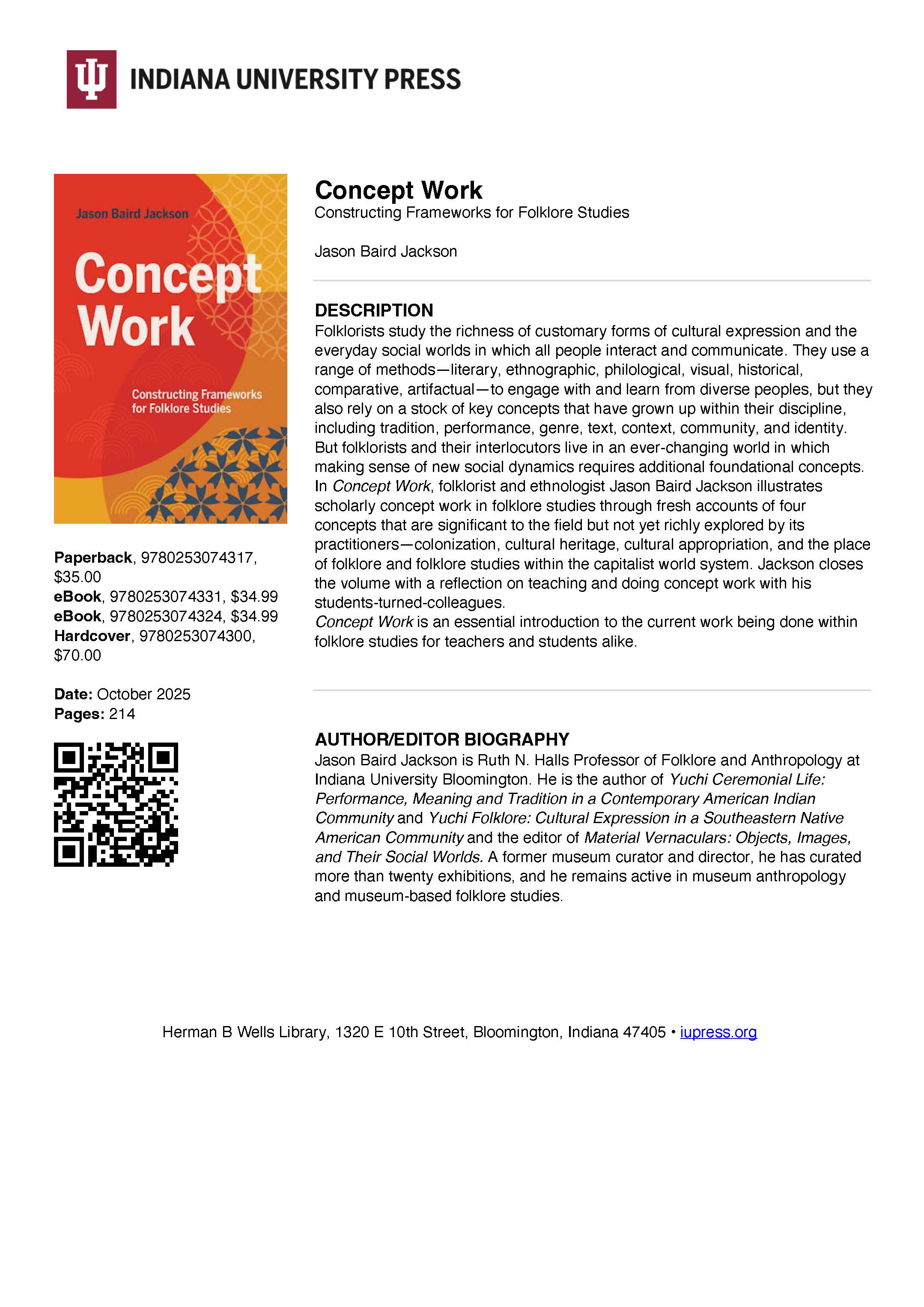

Concept Work: Constructing Frameworks for Folklore Studies Due October 2025 from IU Press.

I am happy to note that my book Concept Work: Constructing Frameworks for Folklore Studies is in press with Indiana University University. Look for it in October and learn more about it on the press website here: https://iupress.org/9780253074317/concept-work/ . The flyer is below.

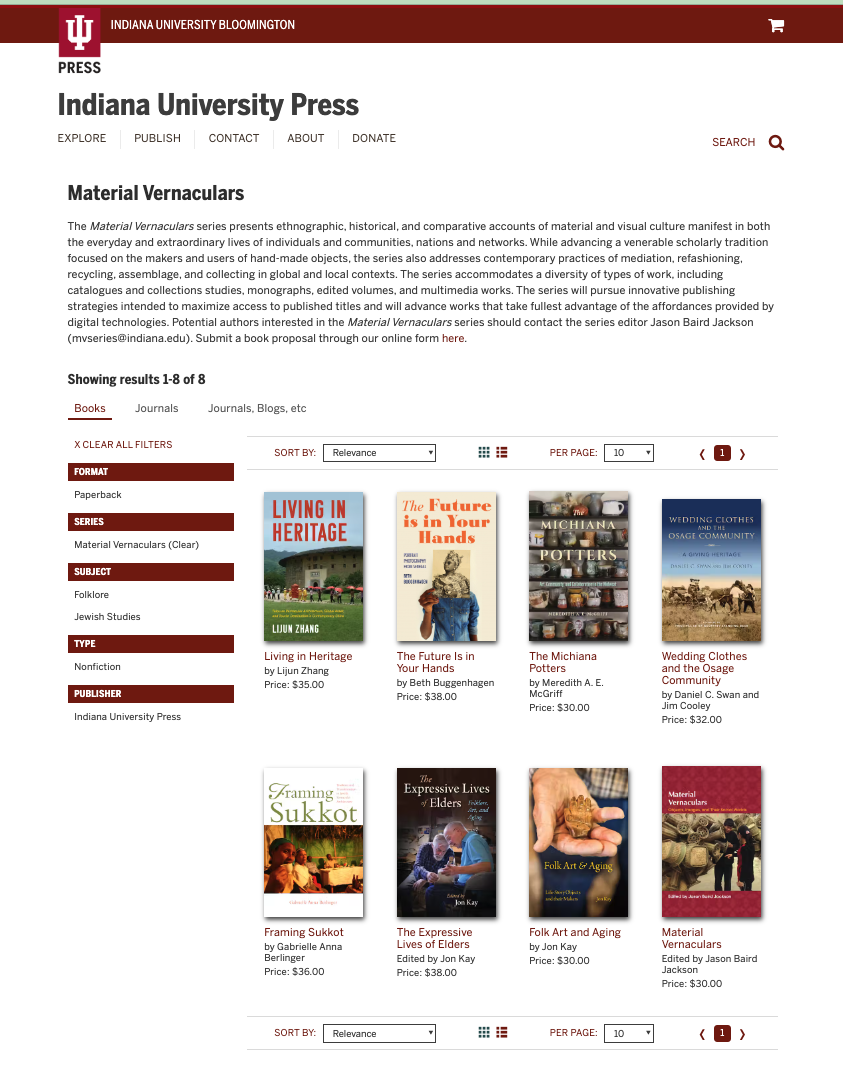
Now Published: Living in Heritage: Tulou as Vernacular Architecture, Global Asset, and Tourist Destination in Contemporary China by Lijun Zhang

Good news is scarce in my world right now, but I am really very pleased to share that Lijun Zhang’s latest book Living in Heritage: Tulou as Vernacular Architecture, Global Asset, and Tourist Destination in Contemporary China has now been published by Indiana University Press in the Material Vernaculars series. It has to be auspicious that Lijun’s important book was officially published on September 17, 2024, which this year was the Mid-Autumn Festival or Moon Festival (did you see that moon?!?). I may share more about the book later, but for today, here is the description and the link to its page at IU Press.

Yongding County in southeast China is famous for its large, multistory communal vernacular buildings known as tulou, translated “rammed earth building.” These structures were designated a UNESCO World Heritage Site in 2008. Living in Heritage introduces readers outside of China to this classic example of local Chinese architecture in the context of contemporary heritage preservation and tourism.

Focusing on the Yongding Hakka Tulou Folk Culture Village, which is part of Hongkeng Village, author Lijun Zhang examines the on-the-ground processes and effects of heritage-making, UNESCO-inspired tourism, and how locals negotiate the dramatic transformation of their daily, social, and economic lives. Within an age of cultural change beginning at the start of the 21st century, Living in Heritage explores how the tulou phenomenon as heritage has and continues to be transformed into cultural, economic, or political capital. Through her careful study, Zhang reveals how the blurring of formerly distinct domains—private and public, local and global—gives rise to a living museum that now relies on insiders and outsiders to preserve their way of life.

Living in Heritage offers an in-depth ethnographic account of the people dwelling and working within traditional tulou architecture in the 21st century.

Lijun Zhang is Assistant Professor of Folklore at George Mason University. She is author of Chinese Folk Art and Crafts and editor (with Marsha MacDowell) of Quilts of Southwest China and (with Ziying You) of Chinese Folklore Studies Today: Discourse and Practice.

Please consider purchasing a copy from IU Press here https://iupress.org/9780253070975/living-in-heritage/ (or wherever you get your books). Doing so supports not only the press in general but the free-to-readers versions of Material Vernacular titles. (More on that when the free version becomes available.)

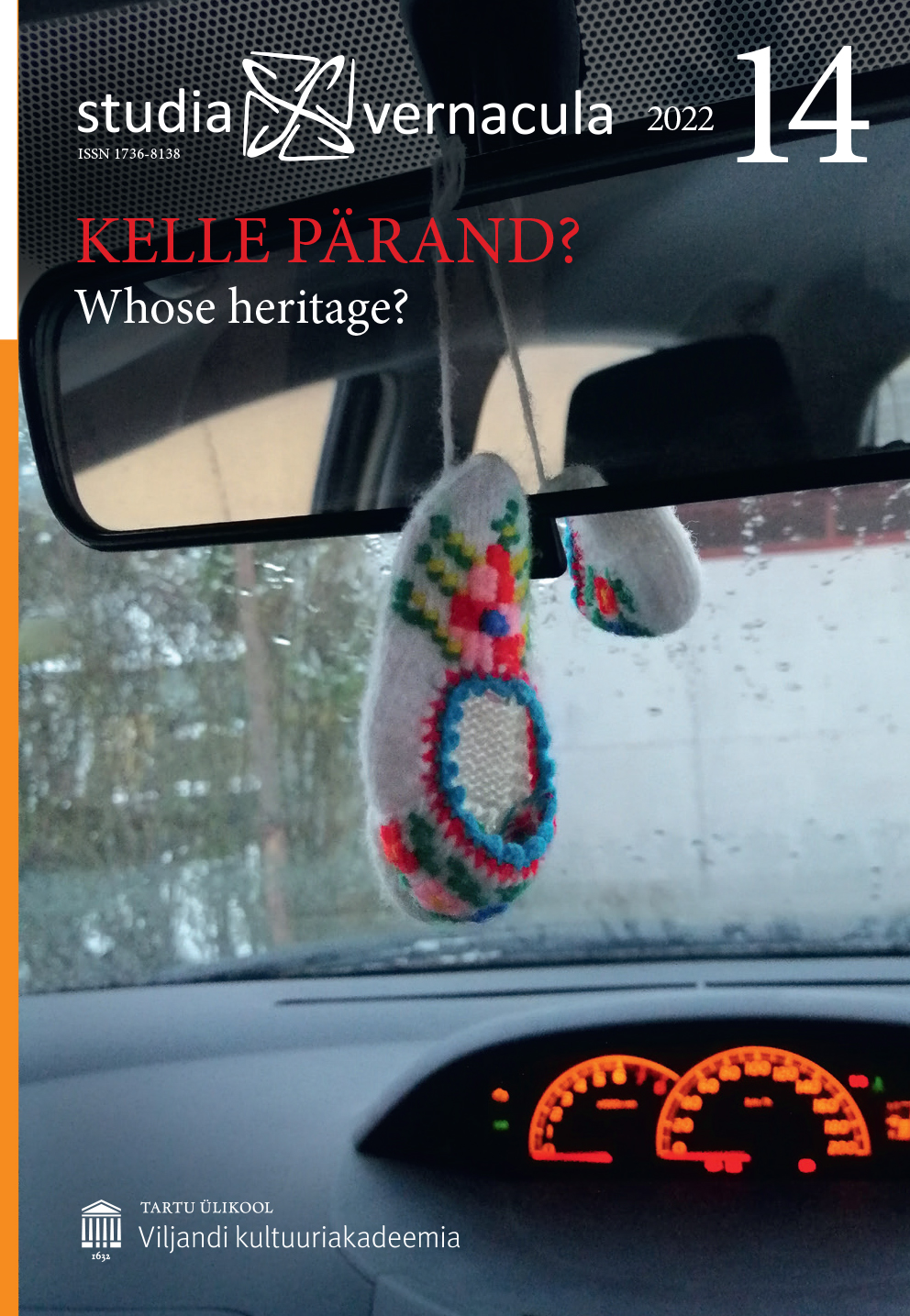
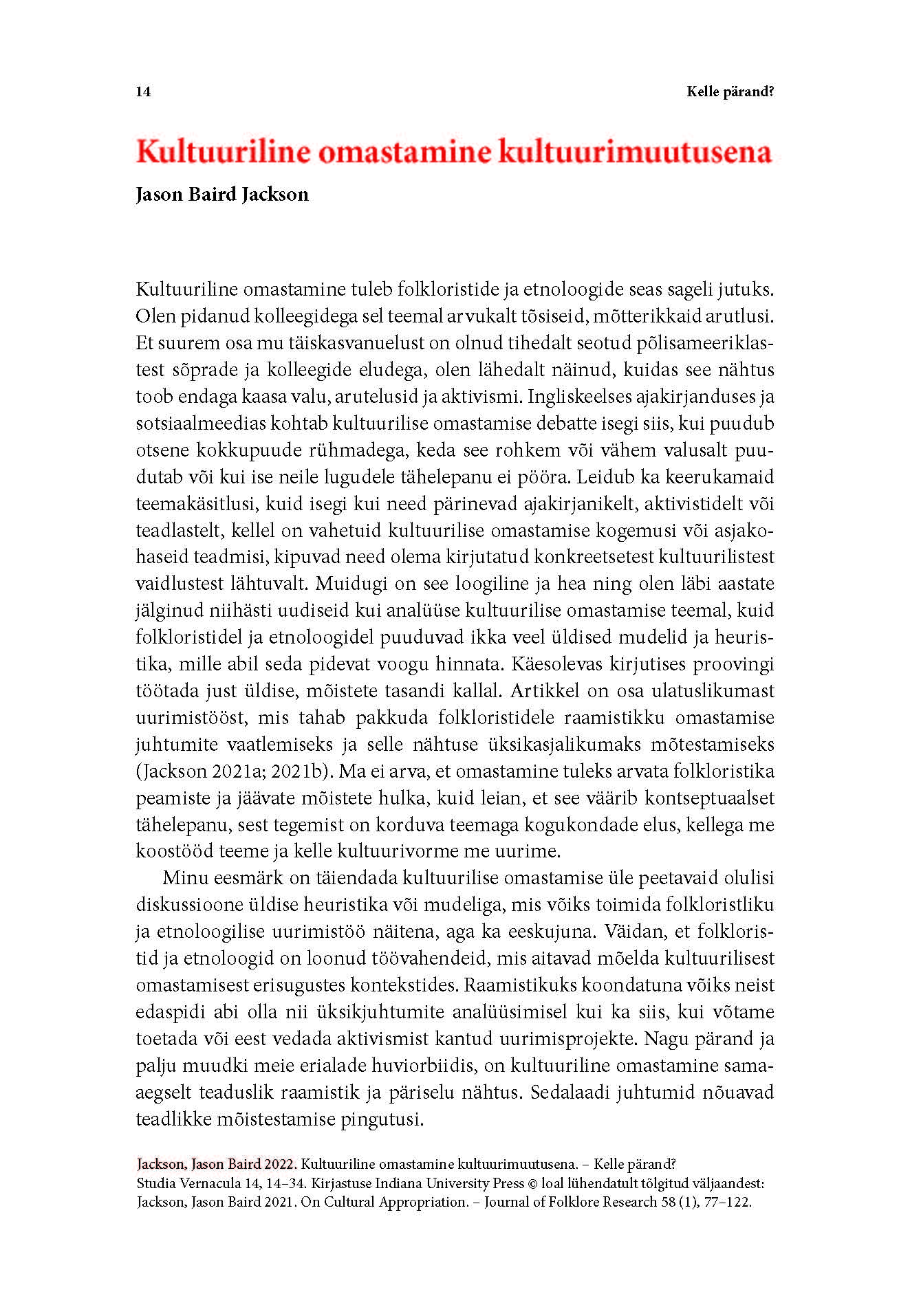
Article: “Kultuuriline omastamine kultuurimuutusena” in Studia Vernacula 14

More good news in terms of publication work. I am pleased to share that my article “Kultuuriline omastamine kultuurimuutusena” is now published in Estonian in the wonderful journal Studia Vernacula (see volume 14). This is a translation (minus the case studies) of my earlier paper “On Cultural Appropriation,” which appeared in English in the Journal of Folklore Research (volume 51, number 1 in 2021). Special thanks go to Elo-Hanna Seljamma for work translating the paper, to Kristi Jõeste for inviting me to contribute the paper, and to Madis Arukask for discussing my contribution in an editorial appearing in the new issue. Studia Vernacula is a wonderful open access journal beautifully produced in digital and print form. Even if you do not read Estonian, I urge you check it out with the help of Google Translate or a similar service. So much wonderful material culture studies work appears therein year after year.

Article: “A Survey of Contemporary Bai Craft Practices in the Dali Bai Autonomous Prefecture, Yunnan, China” in Museum Anthropology Review 16(1-2)

I am very happy to note a new co-authored article titled “A Survey of Contemporary Bai Craft Practices in the Dali Bai Autonomous Prefecture, Yunnan, China.” It was jointly written with Wuerxiya (first author), C. Kurt Dewhurst (third author) and Cuixia Zhang (fourth author) and it appears in Museum Anthropology Review volume 16, numbers 1-2. This is the special double issue published in honor of Daniel C. Swan, as noted in an earlier post on Shreds and Patches. The article is based on work undertaken by a much larger bi-national team within the “Collaborative Work in Museum Folklore and Heritage Studies” sub-project of the broader “China-US Folklore and Intangible Cultural Heritage Project,” a collaboration (2007-present) of the American Folklore Society and the China Folklore Society. In particular, it describes work undertaken through the auspices of, and in partnership with, The Institute of National Culture Research at Dali University. Special thanks go to the Institute and its leadership.

Find the article online at Museum Anthropology Review: https://scholarworks.iu.edu/journals/index.php/mar/article/view/34101

In this image is the first page of a journal article as typeset. The article pictured is "A Survey of Contemporary Bai Craft Practices in the Dali Bai Autonomous Prefecture, Yunnan, China." Visible are the names of the authors, the abstract, the key words and the first paragraph of text.
Presented as an image is the first page of the journal article “A Survey of Contemporary Bai Craft Practices in the Dali Bai Autonomous Prefecture, Yunnan, China.”

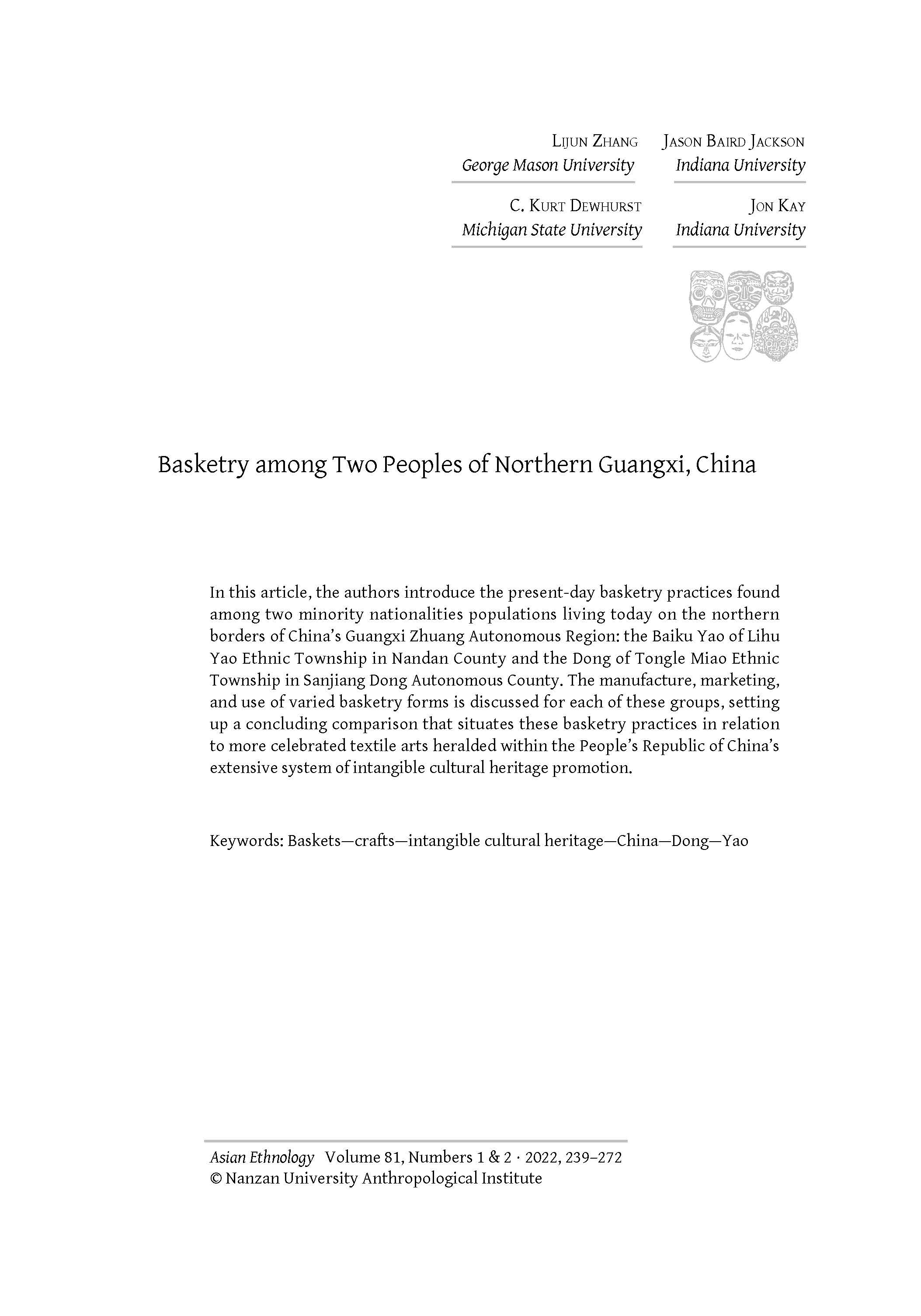
Article: “Basketry among Two Peoples of Northern Guangxi, China” in Asian Ethnology 81(1-2)

I am very happy to note the publication of “Basketry among Two Peoples of Northern Guangxi, China” in the latest double issue of Asian Ethnology. This article is one that I co-wrote with my friends and collaborators Lijun Zhang (first author), C. Kurt Dewhurst (third author), and Jon Kay (fourth author) and it is based on work undertaken by a much larger bi-national team within the “Collaborative Work in Museum Folklore and Heritage Studies” sub-project of the broader “China-US Folklore and Intangible Cultural Heritage Project,” a collaboration (2007-present) of the American Folklore Society and the China Folklore Society.

I am a huge fan of Asian Ethnology, a wonderful open access journal now in its 81st year. Check out the huge volume that our paper is a part of, Find Asian Ethnology online here: https://asianethnology.org/ and also in JSTOR

Find our article here: https://asianethnology.org/articles/2386

Find Jon Kay’s companion article here: https://asianethnology.org/articles/2387

His project is distinct from ours, but find William Nitzky’s article (also) on the Baiku Yao people today here: https://asianethnology.org/articles/2384

This is a image of page one of the published journal article "Basketry among Two Peoples of Northern Guangxi, China. It shows the author's names, the article title, an abstract and the keywords along with the journal's logo, which are a group of line drawn masks from Asian traditions.
A image of page one of the typeset version of the scholarly article “Basketry among Tow Peoples of Northern Guangxi, China” published in Asian Ethnology.

Article: “Towards Wider Framings: World-Systems Analysis and Folklore Studies” in Journal of Ethnology and Folkloristics 16(1)

Page one of the article “Towards Wider Framings” as typeset for the Journal of Ethnology and Folkloristics.

I am happy to report that my article “Towards Wider Framings: World-Systems Analysis and Folklore Studies” was published in the Journal of Ethnology and Folkloristics earlier this year. Readers will have the judge the article for itself, but I can’t say enough good things about JEF. Its a wonderful open access journal doing wonderful work in, and at the intersection of, my two fields. Thanks to everyone at the Estonian Literary Museum, the Estonian National Museum, and the University of Tartu who work to make the journal a success.

Find the article in two places online. In Sciendo here: https://sciendo.com/article/10.2478/jef-2022-0002 and in the JEF OJS instance here: https://www.jef.ee/index.php/journal.

Museum Anthropology Review Volume 16: Studies in Museum Ethnography in Honor of Daniel C. Swan

Social media is changing again and it seems like a good time to give Shreds and Patches more love and attention.

My collaborator and special issue co-editor Michael Paul Jordan and I are very pleased to announce the publication of a new double-issue of Museum Anthropology Review titled Studies in Museum Ethnography in Honor of Daniel C. Swan

Find the new collection in honor of Dan in Museum Anthropology Review online here: https://scholarworks.iu.edu/journals/index.php/mar/issue/view/2153 Thanks to all of the authors, production staff, publishers, peer-reviewers, and helpers who made this collection possible.

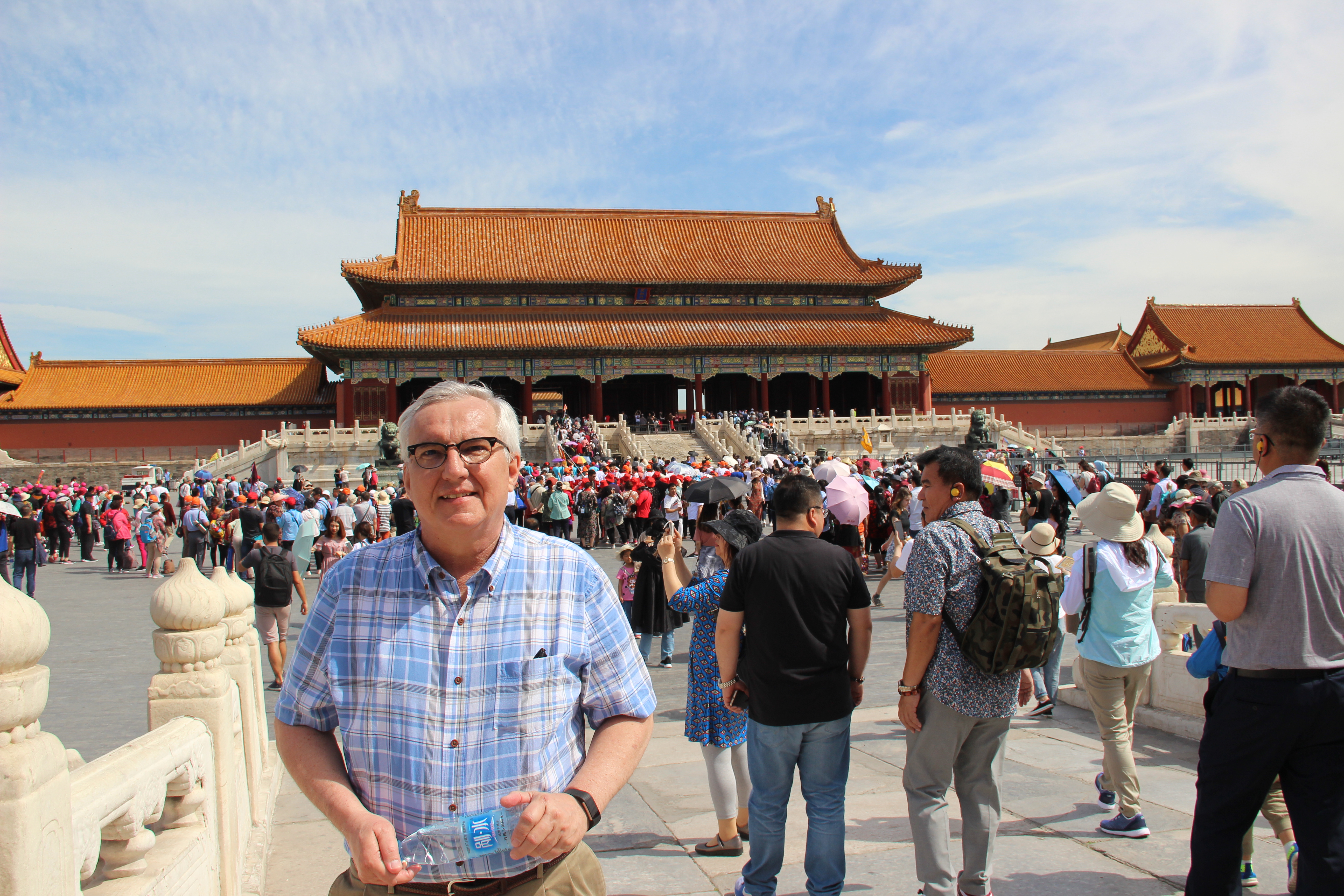
Daniel C. Swan pictured wearing glasses and holding a water bottle while standing in front of a large building and a plaza filled with many tourists. He wears a plaid button-down shirt in blue and white and he looks towards the camera while the other people in the scene face away from the camera as they move into the plaza and the building beyond. The sky is vivid blue with streaks of high white clouds. The tile roofs of the buildings behind the subject are orange.
The above image appears in the introduction to the special collection “Studies in Museum Ethnography in Honor of Daniel C. Swan” with the following camption. “In the days following the Seventh Forum on China-US Folklore and Intangible Cultural Heritage and on the eve of the global COVID pandemic, Daniel C. Swan was one of 19.3 million reported visitors to the Forbidden City (a.k.a Palace Museum) in 2019. May 21, 2019. Photograph by Michael Paul Jordan.”

Bamboo Basket Hampers Used by Tobacco Farmers in Nanhua County, Yunnan, China

While doing background work on FEI Xiaotong and ZHANG Zhiyi’s studies of the basketry industry(*) in Yunnan, China, my colleague W. discovered this webpage with a pair of images and a little bit of information on the production, sale, and use of large, oval-bottomed, oval-mouthed, open work bamboo tobacco hampers used by tobacco farmers to gather and transport mature tobacco leaves.

I will take down the screenshot below if called upon by the publisher to do so. Hopefully it is ok to share the page in its Google Translate version. The original Chinese text is available on the actual website, which is here: http://www.djcx.com/file_read.aspx?id=31810. The place pictured is Wudingshan town in Nanhua County, which is part of Chuxiong Yi Autonomous Prefecture, in Yunnan, China. During our team‘s travels in Yunnan, Guizhou, and Guangxi, we have not visited any tobacco producing regions and we have not ourselves documented this basket type, either in museum collections or in town or village settings.

*Fei, Hsiao-tung, and Tse-i Chang. Earthbound China: A Study of Rural Economy in Yunnan. Chicago: University of Chicago Press, 1945.

The Seventh Forum on China-US Folklore and Intangible Cultural Heritage: Collaborative Work in Museum Folklore and Heritage Studies

The following is a report on The Seventh Forum on China-US Folklore and Intangible Cultural Heritage: Collaborative Work in Museum Folklore and Heritage Studies (第七届中美民俗学与非物质文化遗产论坛: 博物馆民俗与遗产研究的协作工作). The version of record appears on the website of the American Folklore Society. This version adds more images. You can find a copy of the conference program here. –Jason Baird Jackson (杰森. 拜尔德. 杰克逊)

During three beautiful spring days in Beijing, a group of Chinese and American scholars and cultural workers gathered to discuss practices of collaboration in folklore studies and intangible cultural heritage work, with a focus on collaborations between ethnographic museums and between such museums and other groups in society. Held on May 19-22, 2019, this was the Seventh Forum on China-US Folklore and Intangible Cultural Heritage, one of a long-running series of conferences organized cooperatively by the China Folklore Society (CFS) and the American Folklore Society (AFS), as part of a broader binational collaboration begun in 2007. These forums have explored various aspects of cultural heritage policy, practice, and theory, giving US and Chinese participants an opportunity to learn about the state of the field as pursued in the national context that is not their own (Lloyd 2017).

This Seventh Forum, focusing on Collaborative Work in Museum Folklore and Heritage Studies, was held at the Indiana University China Gateway office in Beijing. Meeting under the auspices of the CFS and the AFS, the conference’s program was organized by the Mathers Museum of World Cultures and the Anthropology Museum of Guangxi (Guangxi Museum of Nationalities), with extensive logistical and practical support provided by the two societies and the gateway office staff. Generous financial support was provided by the Henry Luce Foundation and the Office of the Vice President for International Affairs at Indiana University.

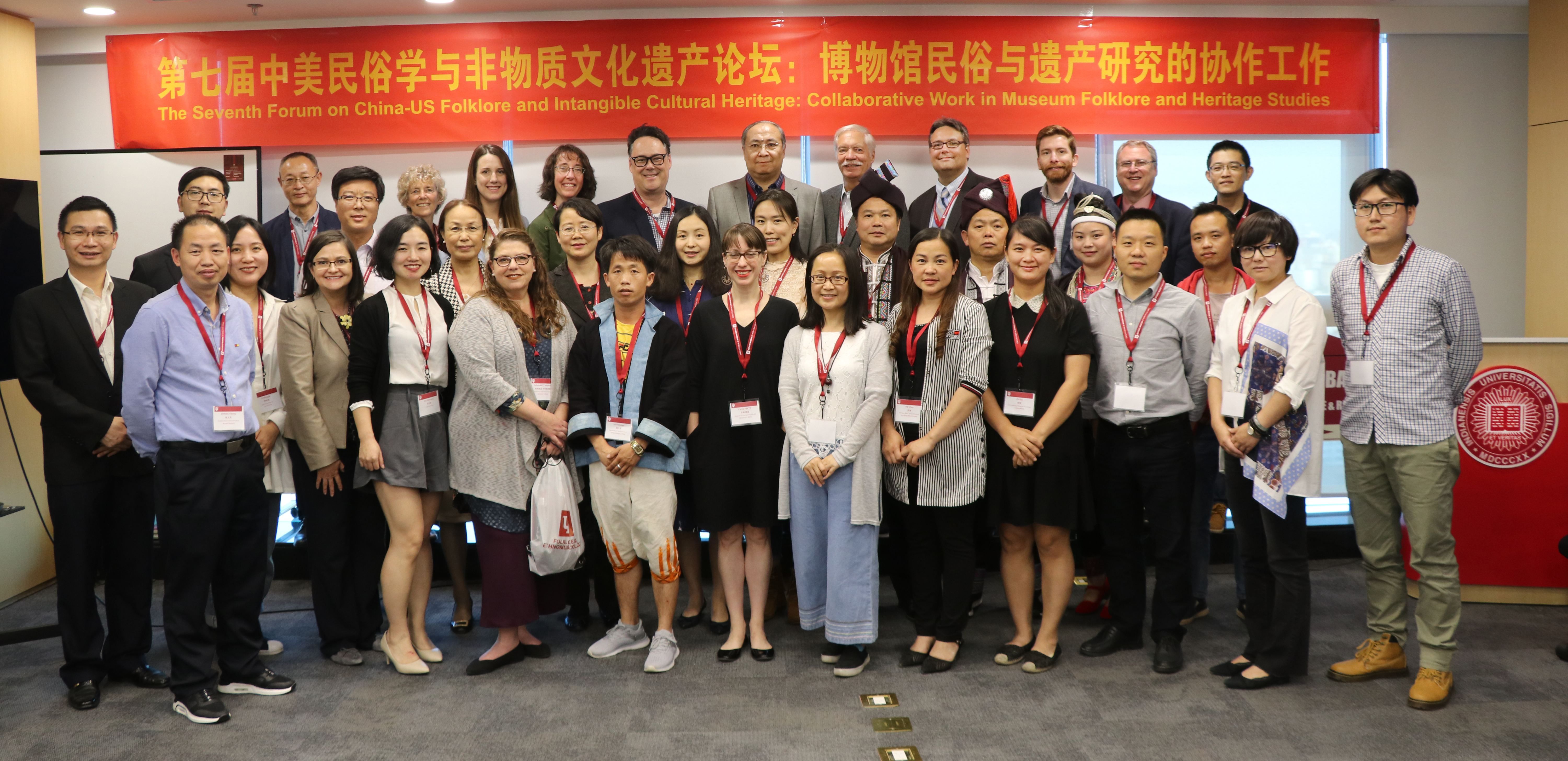
Delegates to the forum came from a diversity of American and Chinese museums and universities. Chinese institutions represented included the Chinese Academy of Social Sciences, Sun Yat-sen University, the Anthropology Museum of Guangxi, the Nandan Baiku Yao Ecomuseum, Beijing Normal University, the Sanjiang Dong Ecomuseum, East China Normal University, Fudan University, the Guizhou Nationalities Museum, Minzu University of China, Shandong University, and the Yunnan Nationalities Museum. American institutions represented included the Michigan State University Museum, the Museum of International Folk Art, Texas Tech University, the Mathers Museum of World Cultures (Indiana University), History Miami, the Sam Noble Oklahoma Museum of Natural History (University of Oklahoma), and the American Folklore Society (Figure 1).

IMG_2160 copy_ed

Figure 1. Delegates to the Seventh Forum on China-US Folklore and Intangible Cultural Heritage held at the Indiana University Gateway Office in Beijing, May 19, 2019. Shu Caiqian (Guizhou Nationalities Museum), Zhang Yibing (Guizhou Nationalities Museum, Zhu Gang (Chinese Academy of Social Sciences), Li Mingjie (East China Normal University), Wang Wei (Shandong University), Jessica Anderson Turner (American Folklore Society), An Deming (Chinese Academy of Social Sciences), Luo Wenhong (Fudan University), Marsha MacDowell (Michigan State University Museum), Surna (Minzu University of China), Kristin Otto (Mathers Museum of World Cultures), Felicia Katz-Harris (Museum of International Folk Art), Sarah Hatcher (Mathers Museum of World Cultures), Yang Lihui (Beijing Normal University), Lu Chaoming (Nandan Baiku Yao Ecomuseum), Jason Baird Jackson (Mathers Museum of World Cultures), Chen Xi (Sun Yet-sen University), Carrie Hertz (Museum of International Folk Art), Chao Gejin (Chinese Academy of Social Sciences), Wuerxiya (Mathers Museum of World Cultures), Fan Miaomiao (Anthropology Museum of Guangxi), C. Kurt Dewhurst (Michigan State University Museum), Yang Quanzhong (Sanjang Dong Ecomuseum), He Chun (Nandan Baiku Yao Ecomuseum), Michael Paul Jordan (Texas Tech University), Wu Dawei (Sanjang Dong Ecomuseum), Ou Bo (Anthropology Museum of Guangxi), Michael Knoll (History Miami), Lan Yuanyuan (Sanjang Dong Ecomuseum), Gong Shiyang (Anthropology Museum of Guangxi), Jon Kay (Mathers Museum of World Cultures), Luo Yong (Nandan Baiku Yao Ecomuseum), Mai Xi (Anthropology Museum of Guangxi), Zhao Fei (Yunnan Nationalities Museum), Wang Yucheng (Anthropology Museum of Guangxi).

On the afternoon of May 19, the conference began with warm words of welcome from AFS Executive Director Jessica Turner and CFS Past President Chao Gajin (Chinese Academy of Social Sciences), standing in for current CFS President Ye Tao (Chinese Academy of Social Sciences) who was unable to attend (Figure 2). Also offering brief opening remarks on behalf of the program committee were Jason Baird Jackson (Mathers Museum of World Cultures) and Gong Shiyang (Anthropology Museum of Guangxi) (Figure 3). These remarks preceded the forum’s keynote address by C. Kurt Dewhurst (Michigan State University Museum). Extending an earlier discussion of principles for museum collaboration (Dewhurt and MacDowell 2015), Dewhurt reflected on a range of museum collaborations in which he and the MSU Museum have participated. Among the collaborations that Dewhurst addressed were earlier phases of the AFS-CFS partnership, which has included two museum sub-projects (2013-2016; 2017-2019). The first of these encompassed the Fifth and Sixth forum events, the traveling exhibition and bilingual catalogue Quilts of Southwest China (MacDowell and Zhang 2015), and numerous other elements (Lloyd 2017). In this phase, three Chinese museums and three US museums partnered together (Dewhurst and Lloyd 2019). In the more recent phase, collaborators from the three U.S. museums have joined with the Anthropology Museum of Guangxi for a program of joint research focused on textiles and intangible cultural heritage policy in two northern counties of the Guangxi Zhuang Autonomous Region. Central to this new phase of work are the Nandan Baiku Yao Ecomuseum and the Sanjiang Dong Ecomuseum. Thus, while Dewhurst’s keynote was a general reflection on museum collaboration, his presentation also served to orient conferees to the specific joint AFS-CFS supported projects that gave the forum its organizational context.

The keynote address was followed by a panel discussion in which representatives from the Sanjiang Dong Ecomuseum and Nandan Baiku Yao Ecomuseum described their work and the community and organizational collaborations in which they participate (Figure 4). American participants appreciated this opportunity to learn about the innovative work of these ecomuseums first-hand and drew comparisons to various kind of community-based museums in the US. While Chinese delegates were more knowledgeable about the form that ecomuseums take in China, they also appreciated the chance to engage with the ecomuseum leaders directly in a comparative scholarly context.

It was an honor that many Beijing-based leaders in the CFS and in Chinese folklore studies overall could attend these opening events, which also included a welcoming banquet generously hosted by the CFS. This gathering was enlivened further when the leaders of the Sanjiang Dong Ecomuseum introduced both Dong flute music and toasting songs to the group. For many American delegates, this was a memorable first experience with the richness of Chinese banquet customs and the beauty of Dong music (Figure 5).

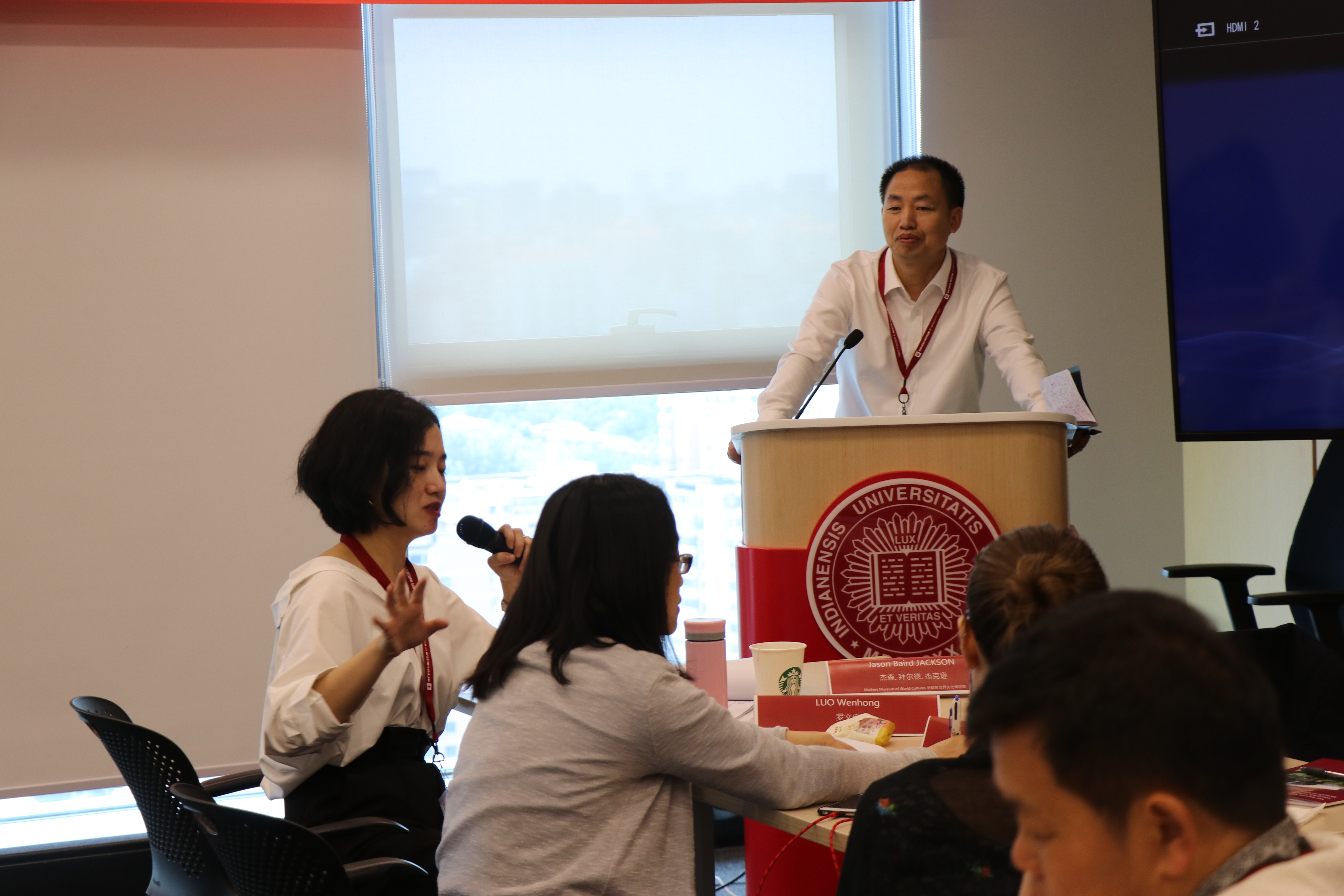
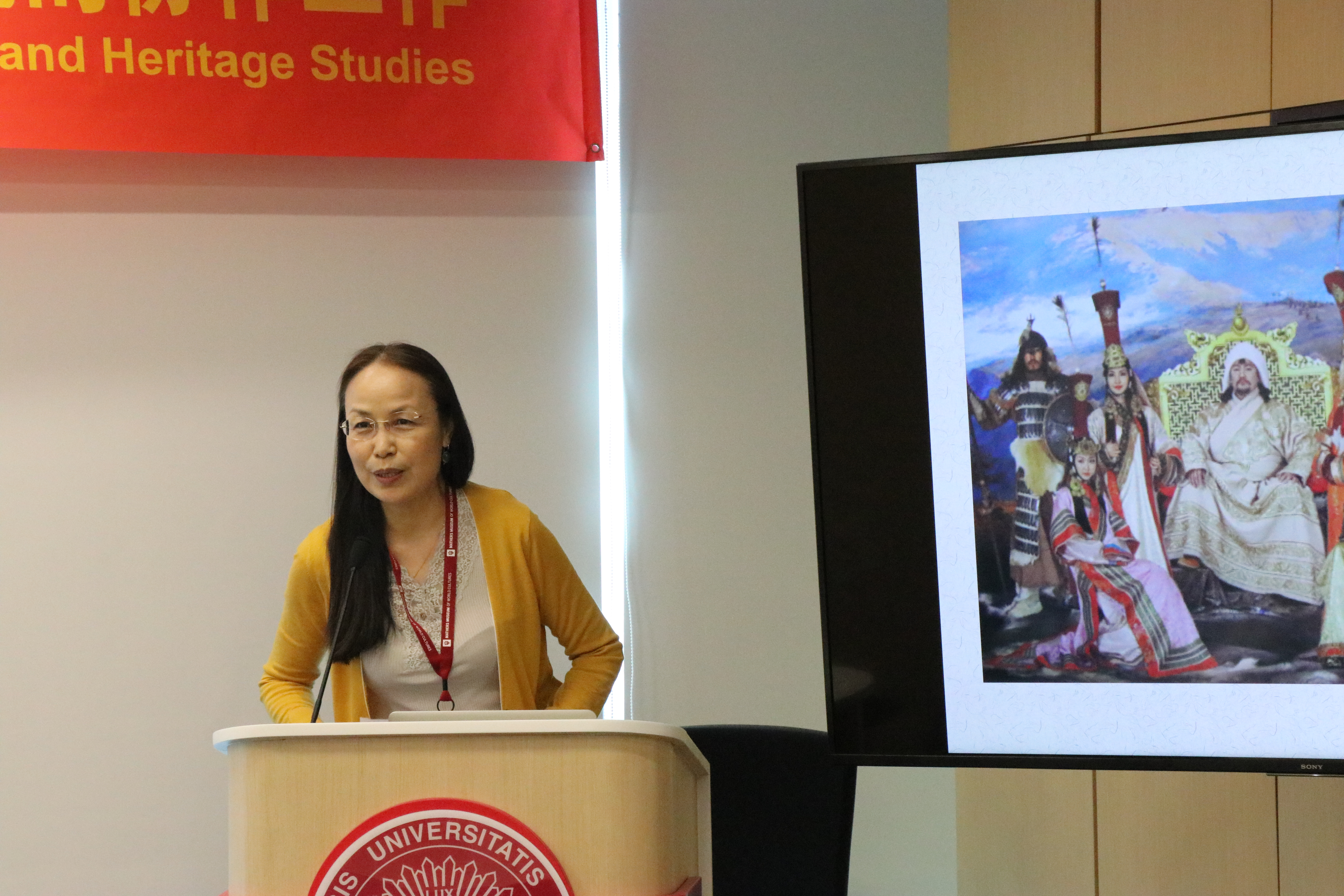
The second day of the conference was a full day featuring presentations from Chinese and American delegates. In line with the goals of the forum, the presenters described specific museum collaboration projects, using them as the basis for broader reflections on the work of museum ethnography and heritage studies today. Translation for most conference presentations was very ably done by Chen Xi (Sun Yat-sen University) and Luo Wenhong (Fudan University) (Figure 6). A number of themes emerged through the juxtaposition of presentations throughout the conference. These included: (1) the nature of museum-based ethnographic and exhibition projects in urban contexts, (2) the dynamics unique to heritage-oriented fieldwork pursued across differences of language, culture, and institutional context, (3) the place of objects and material culture studies within museum collaborations, (4) the use of exhibitions as catalysts for broader collaborations and relationship building, (5) the value of older museum collections for contemporary communities and craftspeople, (6) the place of documentary video in museum ethnography, and (7) the special importance that attaches to national folk costume in diverse museum and local cultural contexts in the current era (Figure 7).

The conference’s third day featured a morning of additional presentations followed by a special outing in which conferees visited Beijing’s Shichahai historic area to learn about cultural preservation and heritage tourism activities centered there (Figures 8-9). Participants enjoyed a hutong tour and a visit to the Drum Towner of Beijing (Gulou). While she could not attend the forum, this outing was curated by Zhang Lijun (George Mason University) and drew upon her folklore research interpreting the narrative performances of hutong tour guides (Zhang 2016, 2019). The conference concluded with a banquet, hosted by AFS and featuring Yunnan cuisine. Highpoints of this concluding gathering were many individual expressions of friendship and goodwill as well as a vigorous singing competition staged between the binational groups gathered around two large banquet tables. Heartfelt singing in Dong, Yao, Mandarin, Mongolian and English brought the seventh forum to a joyful close.

References Cited

Dewhurst, C. Kurt, and Timothy Lloyd. 2019. “The American Folklore Society-China Folklore Society Folklore and Intangible Cultural Heritage Project, 2013-2016.” Museum Anthropology Review 13 (1): 59-68. https://doi.org/10.14434/mar.v13i1.25405

Dewhurst, C. Kurt, and Marsha MacDowell. 2015. “Strategies for Creating and Sustaining Museum-Based International Collaborative Partnerships.” Practicing Anthropology 37 (3): 54–55. https://doi.org/10.17730/0888-4552-37.3.54

Lloyd, Tim. 2017 “The Inside Story of the AFS China-US Project.” https://www.afsnet.org/news/349609/The-Inside-Story-of-the-AFS-China-US-Project.htm, accessed June 12, 2019.

MacDowell, Marsha, and Lijun Zhang, eds. 2016. 中国西南拼布 | Quilts of Southwest China. Nanning: Guangxi Museum of Nationalities. [Distributed in the United States by Indiana University Press.]

Zhang, Lijun. 2016. “Performing Locality and Identity: Rickshaw Driver, Narratives, and Tourism.” Cambridge Journal of China Studies 11 (1): 88-104. https://www.repository.cam.ac.uk/handle/1810/260292

Zhang, Lijun. 2019. “A Brief Guide to Shichahai.” Video Presentation Prepared for The Seventh Forum on China-US Folklore and Intangible Cultural Heritage: Collaborative Work in Museum Folklore and Heritage Studies, Beijing, China.

IMG_1984

Figure 2. Figure 2. Chao Gajin welcomes delegates to the Seventh Forum on China-US Folklore and Intangible Cultural Heritage: Collaborative Work in Museum Folklore and Heritage Studies. May 19, 2019. Photograph by Jon Kay.

IMG_2001

Figure 3. Figure 3. Gong Shiyang addresses delegates to the Seventh Forum on China-US Folklore and Intangible Cultural Heritage. May 19, 2019. Photograph by Jon Kay.

IMG_2072 copy

Figure 4. Wu Dawei offers remarks on the work of the Sanjang Dong Ecomuseum during the ecomuseum panel discussion. Left to Right: Lu Chaoming, He Chun, Lan Yuanyuan, Yang Quanzhong, Wu Dawei, Luo Wenhong (translating), Jason Baird Jackson. May 19, 2019. Photograph by Jon Kay.

IMG_2434

Figure 5. Wu Dawei performs Dong flute music at the opening banquet. May 19, 2019. Photograph by C. Kurt Dewhurst.

IMG_2297

Figure 6. Zhang Yibing discusses the work of the Guizhou Nationalities Museum with Luo Wenhong providing English translation.. May 20, 2019. Photograph by Jon Kay.

IMG_2320

Figure 7. Carrie Hertz discusses research related to the exhibition Dressing with Purpose. May 20, 2019. Photograph by Jon Kay.

IMG_2475

Figure 8. Surna discusses her research on Mongol national dress. May 21, 2019. Photograph by Jon Kay.

IMG_7434

Figure 9. Lan Yuanyuan and He Chun begin a rickshaw tour of the Shichahai neighborhood in Beijing. May 21, 2019. Photography by Jason Baird Jackson.