Skip to content

Posts from the ‘Ethnographic Archives’ Category

Yesterday was a Patchwork Day

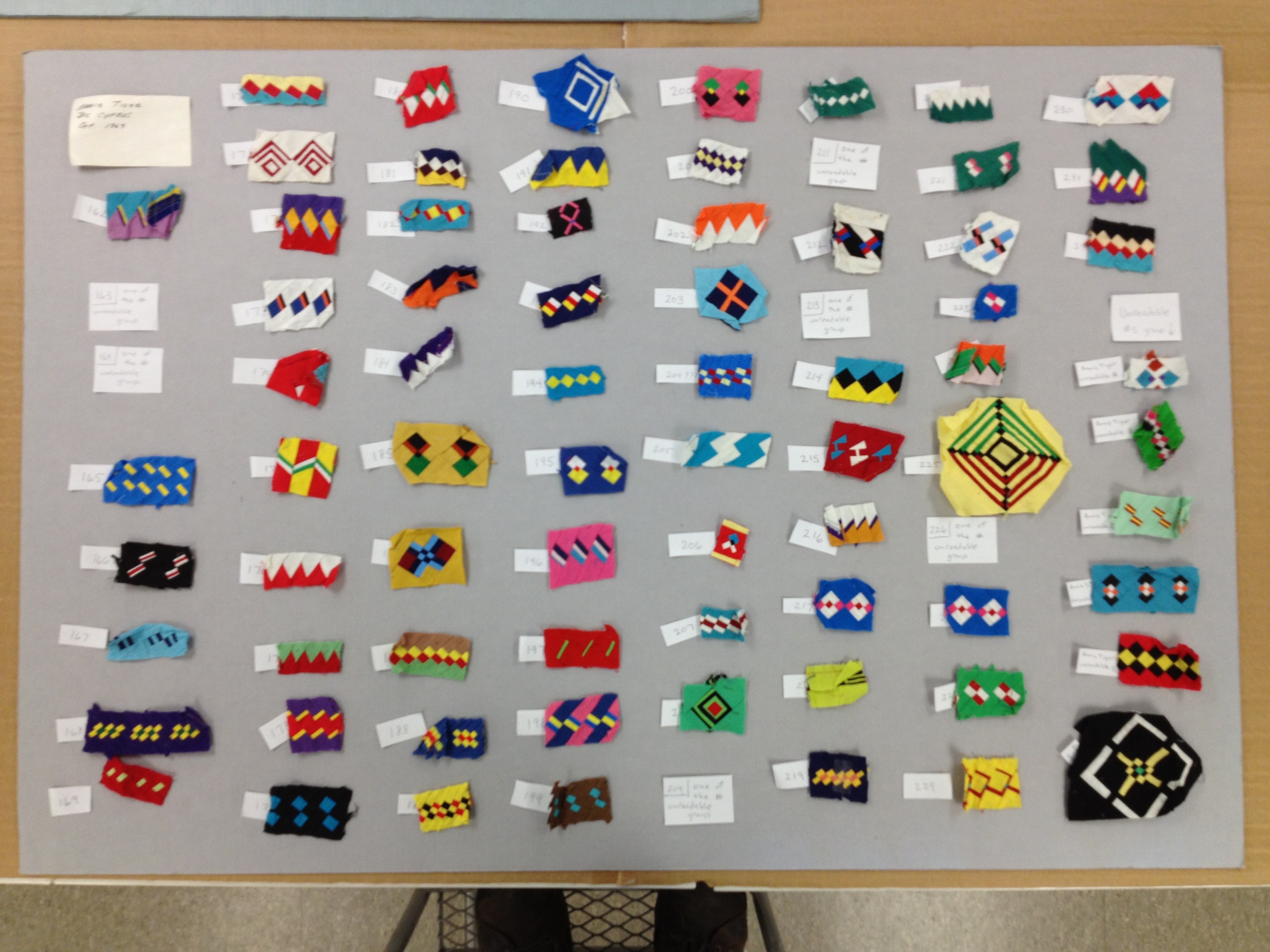
I was not able to put together a post last night, so here is just one of the couple hundred pictures I shot yesterday. This one is another array of Florida Seminole patchwork samples. These were all collected in 1969 and are by the same seamstress. As with the other objects that I am looking at, they are destined for the collections of the Department of Anthropology, National Museum of Natural History, Smithsonian Institution.

On the Study of Shreds and Patches

Yesterday my work with the William C. Sturtevant collection focused on the material culture side of his efforts to document the history, practice, and significance of the unique Florida Seminole art form known as “patchwork.” Basically, I organized and quickly looked at a couple of hundred patchwork samples such as those arrayed in the image presented here.

I have done little work yet with documents, but a large folder of notes associated with Dr. Sturtevant’s patchwork studies were handy and I took a quick peak. There is a lot there. I hold off on talking about that and describe a single note that is very relevant to this website.

For its early years, this website was just associated with my name. A while back though, it started to seem clear (to me, at least) that it needed a more blog-like name. The name the I chose was Shreds and Patches. I should have explained the source of this name at the time, but didn’t. It was a soft re-launch, I guess. Anyway, the first thing that my eye fell on when peaking into Dr. Sturtevant’s patchwork notes folder was a single slip of paper that explains the source of my name.

It is a medium sized slip of paper in his own hand and it is a quotation–the very quotation from which the title of this blog comes. The source is a famous, oft debated passage from the conclusion of a book by Robert Lowie. I have not gone back to the source to check Sturtevant’s note, but here it is as he has it.

“Nor are the facts of culture history without bearing on the judgement of our own future. To that planless hodgepodge, that thing of shreds and patches called civilization, its historian can no longer yield superstitious reverence. He will realize better than others the obstacles to infusing design into the amorphous product; but in thought at least he will not grovel before it in fatalistic acquiescence but dream of a rational scheme to supplant the chaotic jumble.”–p 441 (concluding paragraph of Lowie’s Primitive Society (1947, N.Y., Liveright; 1st ed. 1920; on pp ix-x of the new preface to the ’47 ed, RHL [Lowie] complains that this famous passage has been misinterpreted)

Lowie was one of Bill Sturtevant’s undergraduate teachers at Berkeley. I can talk some other time about the significance and history of this passage from Lowie. Here it is interesting to think what it is doing in Bill’s patchwork notes. Two possibilities have occurred to me.

If he meant it to be there, it was clever because it suggested that he was going to draw upon anthropology’s most famous theoretical discussion of “patches” in his empirical project on patches (of the Seminole sort). Alternatively, and amusingly, it could have been filed in this place by someone else because a quick scan of the text could suggest that because it is about patches it needed to go with the patchwork notes. I’ll get to the bottom of it someday, perhaps. In any case, it provides the answer to the question of why I named the blog as I did. (Lowie was not the original source of the phrase Shreds and Patches, just the one who gave it anthropological resonance in theorizing the nature of culture and so-called “civilization.”

Note.  The patchwork samples shown above are not yet numbered, but they are part of the William C. Sturtevant Collection at the National Museum of Natural History, Smithsonian Institution.

Pot Holders, Or William C. Sturtevant Collections Research, Day 1

I am in Washington at the start of a period of research studying the collection of objects gathered over much of the career of Smithsonian anthropologist William C. Sturtevant (1927-2007). (For background on W.C.S., see this biographical sketch that I posted to the Museum Anthropology weblog and this Washington Post obituary by WP staff writer Louie Estrada.)

While Dr. Sturtevant was long associated with the Smithsonian, his individual research collection grew and grew over the course of his career and was not accessioned into the holdings of the National Museum of Natural History until after his death in 2007. My work with the objects is an extension of the Southeastern Native American Collections Project (SNACP), but it also aims to assist the museum in the work of organizing and cataloging the Sturtevant Collection.

Today was mainly a get organized day, but I can share a glimpse of the objects that was looking at.

Dr. Sturteveant worked throughout his career on issues in Florida Seminole ethnography, linguistics, ethnology, and ethnohistory. He was always particularly interested in material culture and he went to considerable lengths to document the rich visual and material culture of the Seminole people living in my home state. (I first met Dr. Sturtevant while still an undergraduate when he attended a conference on Seminole folk art not far from my family home.)

It will take a very long time to sort out the details, but I began (metaphorically) unraveling the threads of his collection and its history with initial study of eight relatively simple objects–patchwork decorated pot holders made for sale to non-Seminole tourists by Seminole women during in the 1980s. In addition to their aesthetic richness and visual interest, such objects speak to the complex ways that the Seminole people have adapted to life in one of the most complex corners of North America. The Seminole engagement with tourism began in the early 20th century, it continued through the period represented by these pot holders, and it continues up to the present-era, in which the Seminole Tribe of Florida is the force behind a myriad of tourist destinations, including the global Hard Rock cafe and casino enterprise.

For four of the eight pot holders that I looked at today, I already know the name of the artist. A few of the as-yet artist-unidentified objects are pictured below. All objects are from the collections of the Department of Anthropology, National Museum of Natural History. I especially thank the department’s staff for hosting my research visit. Photographs shown here are my own quick and simple iPhone snapshots. (Better photographs can come later.)

Sturtevant Collection T162

Patchwork Pot Holder, Florida Seminole

(Above) Patchwork Pot Holder, Florida Seminole, Sturtevant Collection T162, Department of Anthropology, National Musuem of Natural History, Smithsonian Institution. Photograph by Jason Baird Jackson

Patchwork Pot Holder, Florida Seminole

Patchwork Pot Holder, Florida Seminole

(Above) Patchwork Pot Holder, Florida Seminole, Sturtevant Collection T111A, Department of Anthropology, National Musuem of Natural History, Smithsonian Institution. Photograph by Jason Baird Jackson

Patchwork Pot Holder, Florida Seminole

Patchwork Pot Holder, Florida Seminole

(Above) Patchwork Pot Holder, Florida Seminole, Sturtevant Collection T111B, Department of Anthropology, National Musuem of Natural History, Smithsonian Institution. Photograph by Jason Baird Jackson

Patchwork Pot Holder, Florida Seminole

Patchwork Pot Holder, Florida Seminole

(Above) Patchwork Pot Holder, Florida Seminole, Sturtevant Collection T111C, Department of Anthropology, National Musuem of Natural History, Smithsonian Institution. Photograph by Jason Baird Jackson

I have a lot of data management work to accomplish before tomorrow, but I could not resist sharing this glimpse.

Another World is Possible: Open Folklore as Library-Scholarly Society Partnership

Preface

In the wake of the SOPA/PIPA protests, debate over the Research Works Act, the growing boycott of Elsevier by scholars in many fields, and more local discussions of the ways that various scholarly societies in my own fields of interest (anthropology, folklore studies) responded to the recent call by the [U.S.] White House Office of Science and Technology Policy for comment on public access to federally funded research, there is a great deal of additional attention being given to the changing nature of the scholarly communications (publishing) system and our hopes for its future.

One key issue centers on scholarly society publishing programs and how they can best be advanced in the present and into the future. At the 2011 American Anthropological Association meetings I spoke in two different contexts about these issues. I have shared here previously my remarks to the “Future of AAA Publishing” event (Jackson 2011b; for context, see Nichols and Schmid 2011 and Brown 2011). That presentation was on “Green Open Access Practices.”

I also spoke in the Digital Anthropologies: Projects and Projections panel organized by Mike and Kim Fortun and sponsored by the Society for Cultural Anthropology. In that event (which has been well documented by Daniel Lende (2011), my goal was to describe the Open Folklore project as both a broader community effort and as a specific digital platform, so as to illustrate a more general point about the fruitful possibilities that can come from direct partnerships between libraries and the library community and scholarly societies.

Libraries and scholarly societies now have a customer-to-business relationship and it is one that is growing ever more strained as commercial publishers become central partners in many scholarly society publishing programs. I evoked the alter-globalization motto Another World is Possible in my title because I wanted to suggest that the course that we are on is not the only one available to us. I believe, on the basis of a lot of time spent over the past five years with university librarians around the Midwestern U.S., that the research library community would much rather work with scholarly societies collaboratively in the shared real and digital spaces in which scholars and librarians (and students) already labor together rather than engage antagonistically in a neoliberal marketplace that has been shaped by the business practices pioneered by firms such as Elsevier, Springer and (yes) Wiley-Blackwell. Open Folklore is just one of many university-scholarly society partnerships that are exploring how to make this alternative framework real.

I should have just shared my presentation at the time of the AAA meetings, but I had hope that I could quickly work on it some more before getting it into wider circulation. Time has not been available for that work, but the current interest in these issues suggests that I might now have an interested audience and a second chance to share it below in the form that I presented it in Montreal.

My remarks below should not be taken as an official statement of the Open Folklore project team, the Indiana University Libraries, or the American Folklore Society. They reflect my own experience with these issues, although they of course also draw upon the rich experiences that I have had partnering with talented, committed colleagues working toward the goal of achieving Open Folklore’s aspirations. The paper below has been edited lightly just to recontextualize the language for a reader not at the original panel (meaning simple removal of language like, “so and so will probably speak later this morning about…”). I wish to take this opportunity to especially thank Mike and Kim Fortun for their remarkable service to the field as editors of Cultural Anthropology and as organizers of the Digital Anthropology event.


Another World is Possible: Open Folklore as Library-Scholarly Society Partnership

Jason Baird Jackson

Indiana University

Building upon shared values, facing common problems, and recognizing new opportunities, partnerships linking scholars, scholarly societies, and research libraries are a particularly hopeful development in the changing scholarly communication system. In my remarks, and as an example of current possibilities, I will quickly describe the Open Folklore project and situate it in the context of the serials crisis, the corporate enclosure of society journal programs, the erosion of the university press system, the development of open source software for scholarly communication, and the rise of the open access movement as a progressive response to these changes. For those wanting basic information on using Open Folklore associated resources in your research and teaching, I urge you to visit the Open Folklore Portal site online and to consult the instructional screencasts that my collaborators and I have shared there, and on YouTube.

By way of introduction, I can note that OF is a joint project of the American Folklore Society and the Indiana University Bloomington (IUB) Libraries. The two lead partners share as desire to make more reliable folklore scholarship—in many genres—discoverable and freely available online.  The Open Folklore team is doing this work but so are many colleagues in many places. Consulting the Open Folklore website, which I will come to in a moment, provides an eye-opening and encouraging sense of the OA work that a wide and deep network of folklorists have already been pursuing. Launched in 2010, the project has grown rapidly and made significant progress in its efforts to foster and encourage the development of an interconnected and interoperable, but also distributed and low-cost, system of open access projects and resources.

The Open Folklore project is more than its associated portal site. The project is pursuing educational projects aimed at educating scholars about open access issues. Importantly, it is also working with rights holders and publishing partners to encourage the pursuit of sustainable open access projects that comply with the basic technical standards already extant in the broader scholarly communications community. Read more

Time to Apply to Participate in the Summer Institute in Museum Anthropology

Happy New Year! With the new year comes the season in which thoughts turn towards summer plans. A great summer program for graduate students interested in material culture studies is the Summer Institute in Museum Anthropology (SIMA). Held at the Smithsonian Institution’s National Museum of Natural History and funded by the [U.S.] National Science Foundation, this is a month-long intensive course focused on promoting “broader and more effective use of museum collections in anthropological research by providing a supplement to university training.”

“Working intensively each summer with 12-14 students interested in museum research, the institute: [1] introduces students to the scope of collections and their potential as data, [2] provides training in appropriate methods to collect and analyze museum data, [3] makes participants aware of a range of theoretical issues relating to collections, [and 4] positions students to apply their knowledge within their home university.”

Graduate students in anthropology and neighboring fields (including folklore studies) can find full information and application instructions on the SIMA website. As noted there: “The program covers students’ room, board, and tuition. Housing is provided at a local university and a small stipend will be provided for food and other local expenses. Participants are individually responsible for the cost of travel to and from Washington, DC. This is an intensive residential program and the participants are expected to devote full time to the training. Preparatory readings are assigned to ensure that students arrive with comparable background knowledge.”

This is a great program and a great opportunity. Please consider applying.

New Open Access Tools, Resources, Partnerships, and Content Announced @openfolklore

I am happy to report that real and significant progress in the Open Folklore project continues to be made. A year ago (October 13, to be exact) the American Folklore Society and the Indiana University Bloomington Libraries launched the Open Folklore project and its associated web portal. Open Folklore is about promoting open access in the field of folklore studies (/ethnology) and about fostering partnerships among those working towards the goals of open access in the field. On behalf of the OF project team, I was the author of a news release/project report on the most recent accomplishments of the project and the most recent content additions accessible via the portal site. This was published this morning and is available from the Open Folklore portal.

As readers of the news release will discover, highlights over the past six months include making programs and reports related to the annual meetings of the American Folklore Society (going back to 1889) freely accessible, the launch of the AFS Ethnographic Thesaurus, and the continued growth in the number of AFS section journals being made freely accessible in digital form. The big picture is that the community is continuing to come together to advance the goal of making folklore scholarship and resources more discoverable and accessible to community members, students, tradition bearers, and scholars worldwide. As was recognized this summer when OF was recognized with the Outstanding Collaboration Award by the Association for Library Collections and Technical Services (ALCTS) during the American Library Association meetings, folklorists have a lot to be proud of. We are pioneering in many parts of the scholarly communications world, from the development of open access journals, books, repositories and archives to developing generalizable collaboration strategies for organizational partnership, especially between libraries, non-commercial publishers, and scholarly societies.

I encourage everyone to get caught up with what OF has been up to over the past six months and to continue to spread the word about the project while putting the tools and resources available at http://openfolklore.org to use in your work.

Mathers Museum, Glenn Black Lab Merger Yields Cultural History Powerhouse

IU news announced back home:

Mathers Museum, Glenn Black Lab Merger Yields Cultural History Powerhouse

This is a big deal for the students with whom I work, the colleagues with whom I collaborate, and the collections that I have been studying.

Anthropologist Robert Reeves Solenberger (1916-2006)

In a paper that I published in 2002, I drew upon unpublished ethnographic notes compiled in 1940-1941 by then University of Pennsylvania graduate student Robert R. Solenberger. Solenberger was a student of Frank G. Speck and others on the faculty at Penn. The notes that I drew upon in my paper are part of the Speck Papers at the American Philosophical Society. I have today been working on a new paper that draws upon the same unpublished manuscript by Solenberger. In 2000, when I was working on the paper mentioned above, I was able to track down Professor Solenberger in retirement in Tuscon, AZ and to speak with him on the phone about his graduate studies and the materials that I was then drawing upon.

Taking up work on a new project based on his notes, I went online tonight to see what more I could learn about Solenberger’s career. I learned that he passed away (in his 90s) a few years ago. I found various bits of information on his life, work, and history, but did not find a professional obituary. Based on the information that I pieced together tonight, I offer the following brief sketch.

Robert R. Solenberger (1916-2006) earned a M.A. in anthropology from the University of Pennsylvania in 1940 with a thesis on “An Interpretation of Material on the Anthropology of East Africa Based upon Mediaeval Arabic Writers.” and was on the faculty of the Department of Sociology and Anthropology at Bloomsburg State College (now Bloomsburg University). He published a prominent series of articles focused on the Marianas Islands, where he worked in the 1950s. (These appeared in Human Organization, Anthropological Linguistics, and Oceania, among other outlets.) During his graduate training, he participated in archaeological research at Clovis, New Mexico in 1937 (under the direction of John L. Cotter). He was a Quaker and a conscientious objector during World War II.

My sources include published works discoverable via Google Scholar and the Internet Archive, as well as the following Google discoveries:

http://www.biblerecords.com/solenberger.html
http://www.fum.org/QL/issues/0709/passages.htm
http://www.upenn.edu/gazette/0302/0302notes.html
http://www.upenn.edu/gazette/0707/obits.html

He appears on the AAA Honor Roll of Donors in the last years of his life, but I could find no professional obituary in a AAA publication or elsewhere. A Society of Friends memorial sketch is available.

It was an honor to speak with this anthropology elder early in 2000. I record here my thanks for his kindness and his interest in my work. I also express appreciation for his work, including the six pages of Southeastern Indian ethnography that he compiled in 1940 while on a road trip with  through Virginia, North Carolina, and Florida.

Rest in Peace.

(Additions and corrections to this sketch are very welcome.)

Mukurtu: An Indigenous Archive and Content Management Tool | New Website Announcement

From a December 20, 2010 Mukurtu Project Press Release:

Mukurtu: An Indigenous Archive and Content Management Tool
New Website Announcement
http://www.mukurtuarchive.org

Project Director: Dr. Kimberly Christen; Director of Development: Dr. Michael Ashley; Lead Drupal Developer: Nicholas Tripcevich

In March 2010 the Mukurtu project was awarded a National Endowment for the Humanities Digital Humanities Start‐Up grant to produce a beta‐version of an open‐source, standards‐based community digital archive and content management platform. As the third phase of an ongoing software production project, the Mukurtu team is aware that indigenous and tribal libraries, archives and museums are underserved by both off‐the‐shelf content management systems (CMS) and open source CMS and digital archive/web production tools. Over the last decade as web technologies have diversified to include user‐generated content and more sophisticated digital archive and content management tools the specific needs of indigenous collecting institutions have been left out of mainstream productions.  Based on long‐term research and collaboration with indigenous communities and collecting institutions, Mukurtu’s development and production has focused on producing a digital archive and content management tool suite that meets the expressed needs of indigenous communities globally. Specifically, Mukurtu:

  1. Allows for granular access levels based on indigenous cultural protocols for the access and distribution of multiple types of content;
  2. Provides for diverse and multiple intellectual property systems through flexible and adaptable licensing templates;
  3. Accounts for histories of exclusion from content preservation and metadata generation sources and strategies by incorporating dynamic and user‐friendly administration tools;
  4. Provides flexible and adaptable metadata fields for traditional knowledge relating to collections and item level descriptions; and
  5. Facilitates the exchange and enhancement of metadata between national collecting institutions and related indigenous communities through robust import/export capabilities.

The Mukurtu software tool suite is under development now with a system demonstration site planned for Spring 2011. Our informational website, development blog, and wiki are now live. These sites allow us to chronicle our development progress, provide updates and engage with users as we move forward to a full launch in August 2011.

Please visit the new site at: www.mukurtuarchive.org and follow the links to learn more about the Mukurtu project goals, development, and collaborations.

Excellence in Folklore Scholarship Leads to Utah State University Joining HathiTrust

An important Utah State University Press release:

LOGAN — In an agreement called transformative, Utah State University Libraries has joined the HathiTrust, a shared digital repository that more than doubles the available books in USU’s collection.

“With the scope and range of HathiTrust, a national digital library is coming into being and Utah State University is among the first ranks in that effort,” said Rick Clement, dean of libraries at USU. “This is an exciting development, not only for the main campus but for the five other campuses in the USU system and for our distance education students.”

Utah State University signed a partnership agreement with HathiTrust, becoming the 35th school in the country to become a partner institution. The previous three partners to join HathiTrust are Cornell, Dartmouth, and the Triangle Research Libraries Network (including Duke, North Carolina at Chapel Hill, North Carolina Central and North Carolina State).

“Utah State University now has a seat at the table at this important enterprise,” Clement said. “We join important and diverse partners, including Google, Microsoft and the Internet Archive.”

HathiTrust is a partnership of major academic and research libraries collaborating in a digital library initiative to preserve and provide access to the published record in digital form. It was launched in 2008 and has a growing membership of visionary schools.

Utah State University is the first university in the state of Utah and the region to become a partner member of HathiTrust.

“Utah State brings a unique perspective to the HathiTrust,” said John Wilkin, executive director of HathiTrust. “Our collection will be enhanced by the hundreds of open access titles that USU Press will deposit, and we welcome their contribution to digital preservation and services as a sustaining partner.”

HathiTrust was originally conceived as a collaboration of the 13 universities of the Committee on Institutional Cooperation (the Big Ten schools) and the University of California system to establish a repository for the universities to archive and share their digitized collections.

As the 35th partner school, Utah State University has access to 1.6 million electronic, or digitized, items in the public domain. For comparison, on-site, USU has the same number of books in the Merrill-Cazier Library collection.

“This doubles the number of books in our collection,” Clement said. “For a university like Utah State University, this is such a good fit.”

The move is not only a valuable resource for students and faculty at the Logan campus, but at the five other campuses and distance education sites throughout the state.

“The access this provides is invaluable for our students,” Clement said. “The library is being used more, but not always by students coming through the door. Library usage is up but there is more and more available in the electronic world. The resources made available through HathiTrust can be tapped via our library website by students throughout the USU system.”

Over the past two years, HathiTrust member schools have contributed more than 7 million volumes to the digital library, digitized from their library collections through a number of means, including Google and Internet Archive digitization and in-house initiatives. Of that 7 million, more than 1.6 million of the contributed volumes are in the public domain and are freely available on the Web.

An advantage of being a partner school is that students and faculty at USU can both view and print all or a portion of each available book. Non-member schools can view the items but cannot produce printed copies. And while a book from the stacks of the Merrill-Cazier Library can only be used by one individual at a time, the digital volumes in HathiTrust can be viewed and used by an infinite number at the same time.

HathiTrust serves a dual role. First, as a trusted repository it guarantees the long-term preservation of the materials it holds, providing the expert curation and consistent access long associated with research libraries. Second, as a service for partners and a public good, HathiTrust offers persistent access to the digital collections. This includes viewing, downloading and searching access to public domain volumes and searching access to copyright volumes.

USU’s road to joining HathiTrust began with a partnership with Indiana University, Clement said. Indiana, among the founding schools of HathiTrust, has digitized its folklore collection creating an Open Folklore website.

“Indiana and USU are considered among the top folklore programs in the country,” Clement said. “We’re digitizing a great deal of our folklore archive, and Indiana was interested in making available the folklore books published by USU Press. Indiana’s request for this material morphed into our full partner association with HathiTrust.”

USU Libraries’ effort to join HathiTrust was supported by two important offices on campus.

“Executive Vice President and Provost Raymond Coward and the Vice President for Research Brent Miller have been extremely supportive in this move,” Clement said. “USU Libraries appreciates their support and effort in this endeavor. When the partnership agreement was announced, President Albrecht was highly enthused.
“Our partnership with the HathiTrust will bring an ever-growing number of digital books to our students, faculty and staff,” Clement said. “While we continue to value traditional books, we also understand that the HathiTrust is the future for providing access to our multi-campus system and our many distance-education students. It is truly transformational.”