Skip to content

Posts from the ‘Digital Projects’ Category

What’s New in Museum Anthropology Review?

I am very pleased to announce the publication of Museum Anthropology Review 4(1). This is the spring 2010 issue and there are a number of things to say about it.  First, a huge expression of  thanks go to everyone who worked to bring it into the world. Managing editor Janice Frisch in particular deserves special credit for working hard to bring several new features online.

First things first, the issue contains a lot of wonderful content. Measured in old-fashioned pages, the issue serves up 143 pages brought to the world by twenty-two generous and smart authors. Thanks to all.

The issue is also the first in which we have published a contribution in a language other than English. Christian Bromberger’s valuable essay “From Race To Culture To Esthetics: A Museographic Journey into French Ethnology” is published here in both French and English versions. My Indiana University colleagues Raymond J. DeMallie and Noemie Waldhubel assisted in the preparation of Professor Bromberger’s bilingual essay for publication. Where possible, we hope to publish additional content in languages other than English thereby contributing to the further internationalization of museum and material culture studies.

MAR 4(1) is the first for which we are offering contributions in both PDF and a new HTML format designed to match the new journal style that was developed last year. While several early issues of the journal featured content in a very rough and ready HTML format, we are now using a relatively sophisticated (CSS) style sheet and we hope that we have really improved reader’s experiences with the journal. If you encounter problems, please let us know.

As always, MAR is a fully open access journal that is available to all interested readers at no cost. This is possible because of the wonderful support provided by the very talented librarians behind Indiana University Bloomington’s IUScholarWorks project. They are heroes in the work of building a better and more ethical system of scholarly communication.

Please consider signing up as a “Reader” at the journal’s website. Its free and it helps us measure support for the journal. You’ll also get table of contents sent twice per year by email. Museum Anthropology Review is also on Facebook.

Help Ted Striphas Make an OA Audiobook of The Late Age of Print

Help Ted Striphas make an open access audiobook version of The Late Age of Print: Everyday Book Culture from Consumerism to Control.

My IUB colleague Ted Striphas published The Late Age of Print: Everyday Book Culture from Consumerism to Control in 2009 with Columbia University Press. Coincident with the release of the copyrighted physical volume last year, Columbia released a free, CC-licensed PDF of the book. The goal of Ted’s next effort is to produce a text-to-speech (T-T-S) version of the book, which will be released freely online under a Creative Commons 3.0 BY-NC-SA license.  Kudos to Columbia University Press for supporting these progressive projects, including the new audiobook making effort.

Describing his project and seeking community help on it, Ted writes:

“Producing a T-T-S version of the book will require a great deal of textual cleanup — more than I can muster given my professional commitments, plus a newborn in my life.  Consequently, I’ve set up a wiki site — http//www.thelateageofprint.org/wiki — in the hopes that I might be able to crowdsource some help.”

“Why do I want to create a Late Age of Print audiobook?  First, I’m trying to promote both the idea and practice of free, open-source scholarly work — an issue that I address at length in an essay just out in the journal Communication and Critical/Cultural Studies, on the politics of academic journal publishing.  Second, it seems profoundly unfair to me that people with vision impairments cannot access many scholarly titles, since few ever get transformed into audiobooks.  I’m hoping that my wiki might become a model for similar projects.  Admittedly, the project will serve to promote the book as well.”

If you are interested in helping on this worthy project and, along the way, demonstrating your support for open access scholarly publishing, everything you need to know should be findable on the website for The Late Age of Print.

(PS:  I cannot get the block quote function to work for me today, hence the old fashioned formatting.)

Fund for Folk Culture Publications Available Online Through Indiana-AFS Partnership

From an AFS news release on behalf of the Fund for Folk Culture:

The Indiana University Bloomington Libraries and the American Folklore Society, in partnership with The Fund for Folk Culture and the Indiana University Department of Folklore and Ethnomusicology, are pleased to announce the availability of a series of policy publications created by The Fund for Folk Culture.

The Fund, which was created in 1992 and suspended its programs in early 2009, supports the creation, conservation, innovation, and value of traditional culture and folk arts in community life through grantmaking, convenings, the creation of networks, and research and publications, all focused on issues critical to artists, tradition bearers, and the organizations supporting their work. Its goal is to “create a world in which diverse cultural heritages are honored and all people have the right and resources to exercise preservation of their cultural traditions and to create new traditions for the times.”

The body of Fund for Folk Culture publications now available includes a three-part Issues in Folk Arts and Traditional Culture Working Paper series; reports on three meetings devoted to the examination of issues facing refugee and immigrant communities, and individual folk artists, in the US; a report on the “Folklore’s Futures: Scholarship and Practice” symposium sponsored by the Fund and the American Folklore Society in 2006; and two monographs, Culture and Commerce: Traditional Arts in Economic Development and Envisioning Convergence: Cultural Conservation, Environmental Stewardship and Sustainable Livelihoods. Other Fund publications will be made available in the near future.

These published works are being made available in digital form as part of the IUScholarWorks Repository.  In this form, each published work has a durable URL (web address) that will remain stable, insuring that future citations to this work will lead back to the full source itself.  This published work is fully open access and documents are provided in PDF format.  The IUB Libraries are committing to the migration of these materials to future file formats so as to preserve the availability of these works.  The IUScholarWorks Repository uses standard metadata protocols, insuring that the works included in it are easily findable through such services as Google Scholar and OAIster, the Open Archives Initiative database, a union catalog containing records for millions of digital scholarly resources.

Now available and searchable in IUScholarWorks Repository, the publications of The Fund for Folk Culture join a growing corpus of fully accessible publications in folklore studies, including the full back files of The Folklore and Folk Music Archivist and Folklore Forum.  The IUB Libraries and the American Folklore Society are exploring the possibility of other partnerships to create greater accessibility for important classes of publication in our field that are presently without a long-term digital home.

Find the publications of The Fund for Folk Culture online here:  https://scholarworks.iu.edu/dspace/handle/2022/3850

Website Visitation Statistics

Website Usage Stats to November 23, 2009

Google Books Meets Stith Thompson

Craig Fehrman has published an essay in Nuvo: Indy’s Alternative Voice that looks at the state of the Google Books project through the lens of the Indiana University Library’s wonderful and legendary Folklore Collection. (Much of) the Folklore Collection has been digitized in partnership with the Google Book project. Its greatness as a collection stems from the efforts of long-serving Distinguished Service Professor Stith Thompson (1885-1976), the founder of what is today the Department of Folklore and Ethnomusicology. Fehrman uses the story to make a case for copyright reform and is particularly disturbed by the way that vernacular culture becomes enclosed through publication.

Kindle for Academics

Alex Golub in Inside Higher Education on the Kindle for Academics.

Celebrate Open Access Week with Museum Anthropology Review

Open Access Week begins on on Monday, October 19 and, in celebration, Museum Anthropology Review will be publishing its next issue– 3(2). Its a great issue and we look forward to sharing it with the world in beautiful, accessible, affordable Gold OA.

If you like the journal, please register as a reader and/or author. Its free. Your registration helps us know who is invested in the future of the journal and you can get free table of contents sent by email.

Along similar lines, please consider becoming a Fan of Museum Anthropology Review on Facebook.

Happy Open Access Week.

Presenting at an Information Technology Conference Tomorrow!

It would have seemed unimaginable a few years ago, but these days weird stuff happens more and more often. Tomorrow I will be presenting at the Statewide IT Conference put on by Indiana University.  The conference will be held at our campus in Indianapolis (IUPUI). I will be speaking about my experiences using Open Journal Systems to publish Museum Anthropology Review in partnership with the wonderful folks at the Indiana University Bloomington Libraries. I love every aspect of my experiences getting MAR up and running.  My friends and colleagues in the fields of museum and material culture studies have really done wonderful work with, and for, the journal.  As important are all of the great folks at the library’s IUScholarWorks and Digital Library Programs who have have done so much to make it happen behind the scenes. And a great piece of open source software–OJS–is also crucial to the effort.  I am so thankful for the hard work of so many people in the open source and open access movements. In this case, I am particularly thankful for the Public Knowledge Project and its funders. Thanks go as well to community of open access anthropology advocates and pioneers.

I learned a lot trying to speak to the CIC librarians last May. I am guessing the IT community will teach me a great deal tomorrow as well.

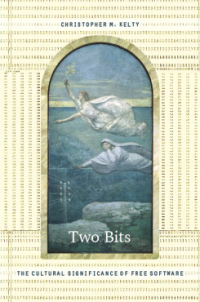
Two Bits by Chris Kelty is Great

kelty_cvr_medA few days ago I finished reading Chris Kelty‘s wonderful book Two Bits: The Cultural Significance of Free Software (Duke University Press, 2008).  During the academic year, I could not get to it but it was a treat to read it at a time in which it could be the only big thing that I was reading (as opposed to reading it alongside course readings).  While I would have benefited greatly from reading it last year (when my involvement in the issues that it treats really began to expand), it will do me much good in the days ahead, as it relates very centrally to the work that I am now doing on scholarly communications issues.  It provides invaluable context on the emergence and present-day life of open source software, but it also offers a range of valuable theoretical, interpretive and methodological tools that are portable to other contexts.  The book also examines, in a very sophisticated way, the manner in which the processes and ideas and values of free and open source software have been extended into projects like Connexions (about which my department held a really fruitful meetup recently) and the Creative Commons license system.  All of this work is done very artfully and in ways that we can all learn from.

This post is no surogate for a careful review, but I want to flag the book’s importance to me and to suggest that it is going to be touchstone work for many of the projects that I am increasingly involved in. More ambitiously, I want to plead with my friends and colleagues to read it so that we can talk about it and draw upon it in our efforts together and in our conversations. It is a great work of ethnography, history, and theory.  It is also an experiment that modulates the very processes that it describes, as is evident on the excellent and innovative website that Chris has built to extend the book.  One can purchase the book the conventional way, but it is also available to freely read and remix in a variety for formats via the website.  Some of the background for this is also provided in the “Anthropology of/in Circulation” project that Chris led and that I particupated in.  Find the article version of that project here in IUScholarWorks Repository.

Thank you Chris.

Christen and Hennessy on Issues in Digital Ethnography

The new (April 2009) issue of Anthropology News features an exceptionally large amount of interesting material. I have not digested it all, but I want to point to the first two articles. Leading the issue is a piece by Kimblery Christen titled “Access and Accountability: The Ecology of Information Sharing in the Digital Age. It is a great short and accessible summary of her key arguements about possibility and responsibility in collaborative ethnographic work. It builds on the remarkable range of practical, technical and theoretical projects that she has been pursuing for a number of years.  (These have been a regular topic on this site and her own website provides a rich introduction.)

The second paper–a wonderful companion to the first–is “Virtual Repatriation and Digital Cultural Heritage” by Kate Hennessy. I builds on collaborative media projects that she and Amber Ridington have been pursuing with a Canadian First Nations community.  This piece is a powerful complement to the  Dane Wajich site and other projects that they have pursued because it offers a glimpse behind the scenes at the kinds of challenges these efforts can entail.

I recommend both of these contributions highly.  They showed up in my mailbox on Monday and I was teaching with them on Tuesday. Kim and Kate (and their project partners) are doing amazing work.