Skip to content

Posts from the ‘Anthropology’ Category

People Make Collections: Anthropologist Michael Davis (1942-2012)

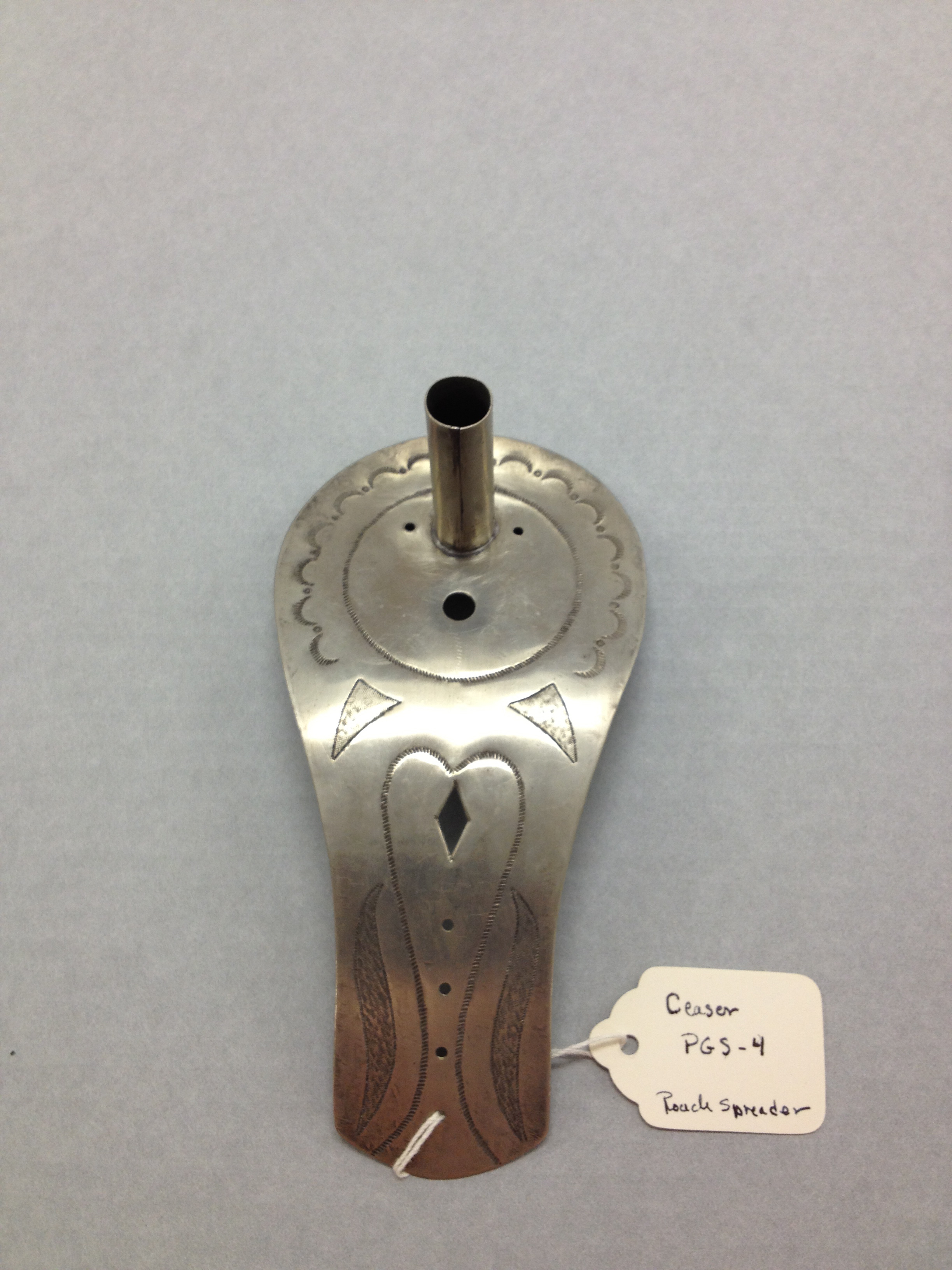
Museum collections are made by people who gather together the things that other people make. Earlier this week I was looking at a group of objects in the William C. Sturtevant Collection that were gathered together and documented by then-University of Oklahoma doctoral student Michael Davis. This is an exceptional collection of German silver jewelry made in the 1960s by an impressive number of Native American artists working on the Southern Plains.

After his OU studies, Michael Davis went on to become a Professor of Anthropology at Truman State University in Kirksville, Missouri. I wanted to congratulate him on the quality of the collection that he made and the exceptional way in which he documented it. Thinking about getting in touch, I discovered sadly that he passed away a few months ago. An obituary appears in the Kirksville Daily Express and is available online.

One reason that we make museum collections is to preserve something of the past for the sake of the future. I hope that Professor Davis, as well as the artists whom he documented, would be pleased to know that their work is being appreciated by those who have come along after them.

A German silver roach spreader by Pawnee smith Julius Ceasar (1910-1982) collected for the National Museum of Natural History by Michael Davis (1942-2012) and found as part of the William C. Sturtevant Collection, Department of Anthropology, National Museum of Natural History.

Occupy and Open Access in Anthropologies (and Elsewhere)

I wish to express thanks to Ryan Anderson  [@ethnografix] for his editorial work on the online magazine Anthropologies [@AnthroProject]. Specifically I would like to highlight the publication’s new issue (#12), which is thematically focused on “Occupy and Open Access.” I really appreciate Ryan’s invitation to contribute to the issue. My essay is titled “We are the One Percent: Open Access in the Era of Occupy Wall Street.” In it I try to explore the mutual resonances of the Occupy and Open Access movements.

Daniel Lende, Barbara Fister, Kim and Mike Fortun, Laurence Cuelenaere, Doug Rocks-Macqueen, Kyle Schmidlin, and Ryan are the other contributors.

The essay by Kim and Mike Fortun is based on the presentation that Kim gave at the 2011 American Anthropological Association meetings in Montreal. Focusing on how the journal Cultural Anthropology, which she and Mike previously edited, might be transitioned into gold open access status, their essay complements my presentation on green open access strategies, which was delivered on the same occasion. The original event was a session on the present status and future prospects of the publishing program of the American Anthropological Association. (For other presentations from the event, see the links here.)

In related news, consider also checking out Chris Kelty’s recent essay on “The Disappearing Virtual Library,” the video from presentations made at the “Protests, Petitions and Publishing: Widening Access to Research in 2012” event held at Columbia University last month, and Barbara Fister’s recent “Dispatches from the Library of Babel.”

Update: Daniel Lende has written a more detailed and sophisticated overview and discussion of the new Anthropologies issue. Find it at Neuroanthropology.

Another World is Possible: Open Folklore as Library-Scholarly Society Partnership

Preface

In the wake of the SOPA/PIPA protests, debate over the Research Works Act, the growing boycott of Elsevier by scholars in many fields, and more local discussions of the ways that various scholarly societies in my own fields of interest (anthropology, folklore studies) responded to the recent call by the [U.S.] White House Office of Science and Technology Policy for comment on public access to federally funded research, there is a great deal of additional attention being given to the changing nature of the scholarly communications (publishing) system and our hopes for its future.

One key issue centers on scholarly society publishing programs and how they can best be advanced in the present and into the future. At the 2011 American Anthropological Association meetings I spoke in two different contexts about these issues. I have shared here previously my remarks to the “Future of AAA Publishing” event (Jackson 2011b; for context, see Nichols and Schmid 2011 and Brown 2011). That presentation was on “Green Open Access Practices.”

I also spoke in the Digital Anthropologies: Projects and Projections panel organized by Mike and Kim Fortun and sponsored by the Society for Cultural Anthropology. In that event (which has been well documented by Daniel Lende (2011), my goal was to describe the Open Folklore project as both a broader community effort and as a specific digital platform, so as to illustrate a more general point about the fruitful possibilities that can come from direct partnerships between libraries and the library community and scholarly societies.

Libraries and scholarly societies now have a customer-to-business relationship and it is one that is growing ever more strained as commercial publishers become central partners in many scholarly society publishing programs. I evoked the alter-globalization motto Another World is Possible in my title because I wanted to suggest that the course that we are on is not the only one available to us. I believe, on the basis of a lot of time spent over the past five years with university librarians around the Midwestern U.S., that the research library community would much rather work with scholarly societies collaboratively in the shared real and digital spaces in which scholars and librarians (and students) already labor together rather than engage antagonistically in a neoliberal marketplace that has been shaped by the business practices pioneered by firms such as Elsevier, Springer and (yes) Wiley-Blackwell. Open Folklore is just one of many university-scholarly society partnerships that are exploring how to make this alternative framework real.

I should have just shared my presentation at the time of the AAA meetings, but I had hope that I could quickly work on it some more before getting it into wider circulation. Time has not been available for that work, but the current interest in these issues suggests that I might now have an interested audience and a second chance to share it below in the form that I presented it in Montreal.

My remarks below should not be taken as an official statement of the Open Folklore project team, the Indiana University Libraries, or the American Folklore Society. They reflect my own experience with these issues, although they of course also draw upon the rich experiences that I have had partnering with talented, committed colleagues working toward the goal of achieving Open Folklore’s aspirations. The paper below has been edited lightly just to recontextualize the language for a reader not at the original panel (meaning simple removal of language like, “so and so will probably speak later this morning about…”). I wish to take this opportunity to especially thank Mike and Kim Fortun for their remarkable service to the field as editors of Cultural Anthropology and as organizers of the Digital Anthropology event.


Another World is Possible: Open Folklore as Library-Scholarly Society Partnership

Jason Baird Jackson

Indiana University

Building upon shared values, facing common problems, and recognizing new opportunities, partnerships linking scholars, scholarly societies, and research libraries are a particularly hopeful development in the changing scholarly communication system. In my remarks, and as an example of current possibilities, I will quickly describe the Open Folklore project and situate it in the context of the serials crisis, the corporate enclosure of society journal programs, the erosion of the university press system, the development of open source software for scholarly communication, and the rise of the open access movement as a progressive response to these changes. For those wanting basic information on using Open Folklore associated resources in your research and teaching, I urge you to visit the Open Folklore Portal site online and to consult the instructional screencasts that my collaborators and I have shared there, and on YouTube.

By way of introduction, I can note that OF is a joint project of the American Folklore Society and the Indiana University Bloomington (IUB) Libraries. The two lead partners share as desire to make more reliable folklore scholarship—in many genres—discoverable and freely available online.  The Open Folklore team is doing this work but so are many colleagues in many places. Consulting the Open Folklore website, which I will come to in a moment, provides an eye-opening and encouraging sense of the OA work that a wide and deep network of folklorists have already been pursuing. Launched in 2010, the project has grown rapidly and made significant progress in its efforts to foster and encourage the development of an interconnected and interoperable, but also distributed and low-cost, system of open access projects and resources.

The Open Folklore project is more than its associated portal site. The project is pursuing educational projects aimed at educating scholars about open access issues. Importantly, it is also working with rights holders and publishing partners to encourage the pursuit of sustainable open access projects that comply with the basic technical standards already extant in the broader scholarly communications community. Read more
Stuff to Check Out: Digital Return, Open Access, Annotum, Anthropology Report

There is a lot going on these days. Here are a few things I am taking note of. I hope to check these projects and tools out more carefully soon.

The upcoming Digital Return workshop being organized by Kim Christen, Josh Bell and Mark Turin.

Peter Suber’s forthcoming book Open Access to be published in March by MIT Press.

The Annotum theme for WordPress–a means for building more journal functionality into WordPress and WordPress.com sites.

Anthropology Report, recently launched by Jason Antrosio

On Green OA and the Future of AAA Publishing at #AAA2011

Yesterday I participated in the forum on the “Future of AAA Publishing” that was staged during the 2011 American Anthropological Association meetings. I joined this event because I was asked to do so by Michael F. Brown, a fine colleague who would is working hard to be helpful in the organization’s scholarly communications vision quest. My prepared remarks from the event are offered below CC-BY-NC-SA 2.0). Readers of my statement will see that I did not really address the future as much as try to engage the muddled present. I care very much about the future of scholarly communications and am very interested in all the excellent thought that colleagues beyond anthropology and folklore studies are giving to cutting edge discussions of it. The context and venue for my remarks, as well as the five minute time limit on panelist statements, shaped how I used my time. I was trying to serve an educational role. Each panelist had a different piece of the story to reflect upon (association finances, tenure and promotion, international issues, etc.), thus there was not space or audience readiness for more complex matters, such as curatorial models of journal editing, metadata protocols, the weakness of STEM-centered philanthropic efforts in Africa, open source platforms, patron driven acquisition, non-disclosure agreements vis-a-vis big bundle deals, etc. Things are what they are.

Green Open Access Practices

Jason Baird Jackson

I want to thank the organizers of today’s event for their invitation to participate in this discussion. I have had a lot to say elsewhere [ex: my interview with Ryan Anderson on OA and anthropology] about publishing practices in our field and my remarks will be focused on a single node in the larger network of issues. I agreed to take on the slice dealing with green open access practices because this is a realm in which the matters before us are largely no longer policy setting debates but are instead questions of education and implementation. It is in this more modest context that I hope to contribute some observations that may be useful.

Despite organizationally opposing so-called green open access mandates (ex: AAA 2006; Calpestri 2006; Davis 2010), the American Anthropological Association is already a green open access [-friendly] publisher (AAA 2006). I am very proud of the association’s leadership in this regard. We were ahead of the curve when, in 2005, the association adopted an author agreement that allowed association authors to circulate post-prints in conformity with standard green OA practices and in compliance with the mandates that govern the work of some of our colleagues (AAA 2006). In adopting a green author agreement, the AAA joined the approximately 63% of scholarly journals that similarly allow authors to circulate their work down the green open access path (RoMEO 2011). But what does this mean? How does one do it? Read more

Interview on Open Access @savageminds

Thank you very much to anthropologist Ryan Anderson for inviting me to do an interview on open access issues in anthropology. He has begun publishing it on Savage Minds and re-broadcasting it on his weblog ethnografix. Ryan is also one of the organizers of the online anthropology magazine anthropologies. The current issue focuses on Appalachia and includes essays by Britteny M. Howell, Ann Kingsolver, Tammy L. Clemons, Shaunna L. Scott, Amanda Fickey and Lynne Rieske-Kinney, and Sarah Raskin. Check it out.

Follow Ryan on Twitter at @ethnografix

Genres Leak, Being a Reflection on Michael E. Smith’s Essay on Semi-, Quasi- and Pseudo- Journals

On his weblog Publishing Archaeology, Michael E. Smith raises key questions about the status of a mode of scholarly communication for which he is in search of a name. To guide his thinking, he considers two actual web publishing projects in anthropology: (1) Anthropologies and (2) Anthropology of This Century. Committed to the centrality of the established peer-reviewed journal form (but eager to advance open access and also a blogger himself) he wonders what to call these journal-like publishing efforts. Noting that these publishing efforts have some clear similarities to conventional journal but that they are also, in some ways, different, the possibilities that occur to him include semi-, quasi-, and pseudo- journal.

I do not have answers for Michael’s questions all nailed down perfectly myself, but I doubt that semi-journal or quasi-journal or pseudo-journal will, in practice, stick. There are a great many experiments going on in scholarly communication and I think that we will eventually discover the right names for specific kinds of projects. I think that the label “journal” is likely going to continue to spread to refer to a greater diversity of communicative forms. For me, the key thing that we know now is that it is important not to conflate platforms with genres (or with quality). Read more

If robots write one of these biographies about you, will you purchase it?

Its crazy stuff like this that makes my senior colleagues so dubious about the internet in general and the changing publications landscape in particular.

I follow a twitter feed called Anthropology Books. I have never investigated who put it together and I do not know anything about it except that it has been useful to me. Using some kind of automated approach, the person or software behind Anthropology Books has been very usefully telling me (and about 1000 other folks) about “All new anthropology books posted on their publication day.” If a title seems interesting, there is a link that takes one to the book’s Amazon.com page.

Today, books with the names of famous and not-so-famous anthropologists (and folklorists) started showing up in the stream today. Alan Dundes was one that caught my eye first. He is very important figure in folklore studies and a very good candidate for a proper biography. Other names started showing up, including those of active colleagues who are basically my own age! They all had unfamiliar to me authors and publishers.  There was a flood of them today.

Looking at the books on Amazon.com, one is (sometimes) confronted with the information that “the content of this book primarily consists of articles available from Wikipedia or other free sources online.” I took this quote from the book on Dorothy Eggan. This 84 page book is selling for $47.00 and has been published by Lect Publishing. The book is credited to the editorship of Nuadha Trev. This editor shows up in Amazon.com as the person behind about 3000 books. Lect Publishing is only one of several names associated with the same basic project and Nuadha Trev is only one of several editors.

I know that others have been writing a lot recently about Amazon’s publishing toolkit. Also at issue here is the CC licensing of Wikipedia etc. content. The student publishing group that I work with here at Indiana–Trickster Press–makes great use of CreateSpace+Amazon for the publication of real peer-reviewed monographs and I am certainly appreciative of, and in debt to, the Creative Commons. These resources are not to blame for the creation of this kind of spam-like books, but I think that they represent a problem on several fronts. Perhaps it is enough to say that they give the Creative Commons, Wikipedia, Amazon, remix, and scholarly communications reform a bad name.

I would love to know who would purchase one of these books. Maybe some of them are traps designed to extract cash out of their living subjects. Here is an example. The publisher “Fedel” has just published a 108 page/$54 book on ethnomusicologist/linguist/anthropologist Aaron Fox. (He and I know people in common but are not yet acquainted.) Would Professor Fox feel like he had no choice but to purchase this book to see what it said about him? Would I feel similarly compelled if one were published on me? His is one of about 3000 titles edited by “Christabel Donatienne Ruby”, but does Christabel Donatienne Ruby actually exist?

I would also love to know about the technical infrastructure that automatically (?) assembles these books and feeds them into Amazon. Anybody understand this stuff?

Update:  Thankfully the people behind the wikipedia article for VDM Publishing seem to understand it pretty well. For background, see the entry here. See also the discussion on slashdot here.

Appreciation for those Working on Protection of Human Subjects Reform

Here are two sentences of appreciation for those working hard to educate policy makers at the U.S. Department of Health and Human Services about the complexities of human subjects protections policies vis-a-vis ethnography and other humanities and social science methods. I very much appreciate the important work of the American Anthropological Association and the American Folklore Society in this area. Find the recent AAA statement here and the new AFS one here.

Scholarly Communication and the Occupation of Everything

In the current context of global protest, economic failure and political transformation, anthropologists of many backgrounds are finding their voice and addressing the critical issues of the moment. For those with jobs that are being given the speedup treatment, it is hard to keep up with all of the thoughtful and provocative work being created and shared (especially online) right now. The evocative opening line of Jason Antrosio’s recent essay “Anthropology, Moral Optimism, and Capitalism: A Four-Field Manifesto” hints as the gestalt.

A spectre is stalking Capitalism–the spectre of Anthropology. All the Powers of Capitalism have bound themselves in a crusade against this spectre: the Florida Governor and the U.S. President, Dominique-Strauss Kahn and the IMF, Wall Street and Congress.

My thanks go to everyone who is tracking, discussing, fostering, and hosting these discussions. I hope other key nodes in the conversation will forgive me if I single out the Neuroanthropology bloggers Daniel Lende and Greg Downey for their vital work.

Open Access Week and Occupy Everything both continue and I still cannot muster time to read or say much. Rex Golub at Savage Minds is right when he observes that I always bury my lead. He might also note that I say everything too obliquely. So, for tonight, here is a restatement of my previous post in less opaque language.

Going forward from here, if your anthropological research tells you that large corporations are part of the problem, then please do not publish your discoveries or your proposals on this point in books and journals published by large corporations.