Skip to content

Posts from the ‘Academic LIfe’ Category

MLA Parternering with CUNY in Important Scholarly Communications Initiative: Commons in a Box

On the basis of my work on the Open Folklore project, I have spoken on a number of occasions in recent weeks about potential and power of scholarly societies partnering directly with universities in the development of tools, protocols, strategies, and projects in the scholarly communications domain. Along these lines, I am especially interested in the news that the Modern Language Association will be a partner in the Commons in a Box project announced by The City University of New York. This project brings together the open source tools already being used by CUNY Academic Commons and will make them available and easily installable at other institutions. For the MLA and its 30K+ members, these software tools will be the basis for MLA Commons. Read all about it in Audrey Watter’s story at Inside Higher Education.  Congratulations CUNY! Congratulations MLA members!

For an account of my presentation to the Digital Anthropology panel at the recent AAA meetings, where I spoke about university library+scholarly society partnerships in light of the AFS+IU Libraries partnership on Open Folklore, see the detailed summary published by Daniel Lende at Neuroanthropology.

ACLS Publishes 2011 Haskins Prize Lecture by Henry Glassie in Print and Video [Free Online]

The American Council of Learned Societies (ACLS) has published the textual and video versions of the 2011 Haskins Prize Lecture by Henry Glassie, College Professor of Folklore Emeritus at Indiana University Bloomington. “Named for the first chairman of ACLS, the Charles Homer Haskins Prize Lecture has as its theme “A Life of Learning.” The lecturer is asked “to reflect on a lifetime of work as a scholar and an institution builder, on the motives, the chance determinations, the satisfactions (and dissatisfactions) of the life of learning, to explore through one’s own life the larger, institutional life of scholarship.”” Professor Glassie delivered his Life of Learning lecture during a meeting of the ACLS in Washington, DC on May 6, 2011. The first folklorist recognized with the Haskins Prize, Professor Glassie was preceded in the lectureship by many scholars of distinction, including William Labov, Clifford Geertz, Natalie Zemon Davis, John Hope Franklin, and Mary R. Haas.

Congratulations again to my friend, colleague, and teacher Henry Glassie on this remarkable honor.

Open Access Interview Part Two @savageminds

Thanks again to Ryan Anderson for working with me on an interview exploring the basic issues relating to open access in anthropology and folklore. The second part of three has now been published on Savage Minds. As always I appreciate Savage Minds for hosting such considerations of these issues.

Leading North American Institutions Endorse the Berlin Declaration on Open Access to Knowledge

From a SPARC press release circulated today:

Washington, DC – Thirty-three research institutions, associations, and foundations in the U.S., Canada, and Mexico have made a commitment to Open Access to research by signing the Berlin Declaration on Open Access to Knowledge in the Sciences and Humanities. These top private, public, and non-profit organizations join nearly 300 more from around the world in another clear sign of the growing demand for change in the way scientific and scholarly research results are communicated and maximized. The announcement is made in conjunction with the ninth Berlin conference, at the Howard Hughes Medical Institute, which opened today.

The Berlin Declaration promotes the Internet as a medium for disseminating global knowledge. Its goal is to make scientific and scholarly research more accessible to the broader public by taking full advantage of the possibilities offered by digital electronic communication. Signatories support actions that ensure the future Web is sustainable, interactive, and transparent – and that content is openly accessible – in order to realize the vision of a global and accessible representation of knowledge. The leaders of research institutions, libraries, archives, museums, funding agencies, and governments from around the world have signed the Declaration – including CERN, the Chinese Academy of Sciences, Academia Europaea, and the German Max Planck Society (co-initiator and custodian).

North American signatories now include leading private research institutions (such as Harvard University and Duke University), public research institutions (University of Kansas, University of California-Los Angeles), Canadian research campuses (Concordia University, University of Quebec in Montreal), smaller academic institutions (Oberlin College, Grand Valley State University), non-profit organizations (Alliance for Information Science and Technology Innovation, Science Commons), major library coalitions (SPARC, the Association of Research Libraries, Canadian Library Association), and the Open Society Foundations (architect of the Budapest Open Access Initiative).

The full list is available at http://oa.mpg.de/lang/en-uk/berlin-prozess/signatoren/.

New signatory and Kansas University Provost Jeffrey S. Vitter emphasizes the university has been a leader in the Open Access movement as the first public institution in the United States to adopt a faculty-wide open-access policy. “Signing the Berlin Declaration is another step forward in this effort, and we are pleased to join the many fine institutions that are also committed to Open Access to scholarly research,” said Vitter, who is also speaking as part of this week’s conference.

Duke University’s Deborah Jakubs, Rita DiGiallonardo Holloway University Librarian & Vice Provost for Library Affairs, affirmed that institution’s involvement. “At Duke our interest in Open Access initiatives stems from our long-standing willingness to experiment to find the best models for scholarly communication and from our institutional commitment to putting knowledge in the service of society,” she said. “Signing the Berlin Declaration was a logical extension of commitments and values that we have held for a long time.”

Sean Decatur, Dean of the Colleges of Arts and Sciences at Oberlin College, adds:

“The faculty of Oberlin College have made a commitment to disseminating the results of their research as widely as possible.  That principled commitment is an expression of the view that Open Access to scholarship is an important step for the advancement of knowledge, helping to overcome barriers that restrict, rather than encourage, the sharing of ideas and engagement in discourse.  I am pleased that our faculty is so strongly supportive of Open Access and I am honored to sign the Berlin Declaration on their behalf.”

The cohort of North American signatories to the Berlin Declaration will be saluted at the conference-wide dinner this evening. Registration is full, but interested representatives of the media are invited to contact Jennifer McLennan, Conference Director, with inquiries.

The Berlin 9 Conference is organized by representatives from the science, humanities, research, funding and policy communities, including the Howard Hughes Medical Institute, Marine Biological Laboratory, the Max Planck Society, Association of Research Libraries, and SPARC (the Scholarly Publishing & Academic Resources Coalition). It takes place today and tomorrow, November 10.

For more information about the Declaration and how to sign, visit http://www.berlin9.org/about/sign.

For details about the Berlin 9 Conference, visit http://www.berlin9.org.

###

Matthew Guterl on The Future of the Library/Libraries

A fellow faculty participant in the November 2, 2011 “Faculty Discussion on the Future of University Libraries” held at Indiana University under the sponsorship of the Dean of Libraries and the Provost was my Department of American Studies colleague Matthew Guterl. Matt is Rudy Professor of American Studies and History and the Chair of the the Department of American Studies. A historian of race and race-relations in the Americas, he is the author of numerous key works in American Studies, including The Color of Race in America, 1900-1940 (Harvard University Press, 2001) and American Mediterranean: Southern Slaveholders in the Age of Emancipation (Harvard University Press, 2008). This site does not have a flashy title like The Edge of the American West, Crooked Timber, or Savage Minds but it is fun to welcome such a talented guest contributor to the blog part of my website. Rather than see them filed away unread, here are Matt’s thoughtful reflections on the future of libraries at IU and everywhere.

“The Future of the Library/Libraries”

Matthew Pratt Guterl

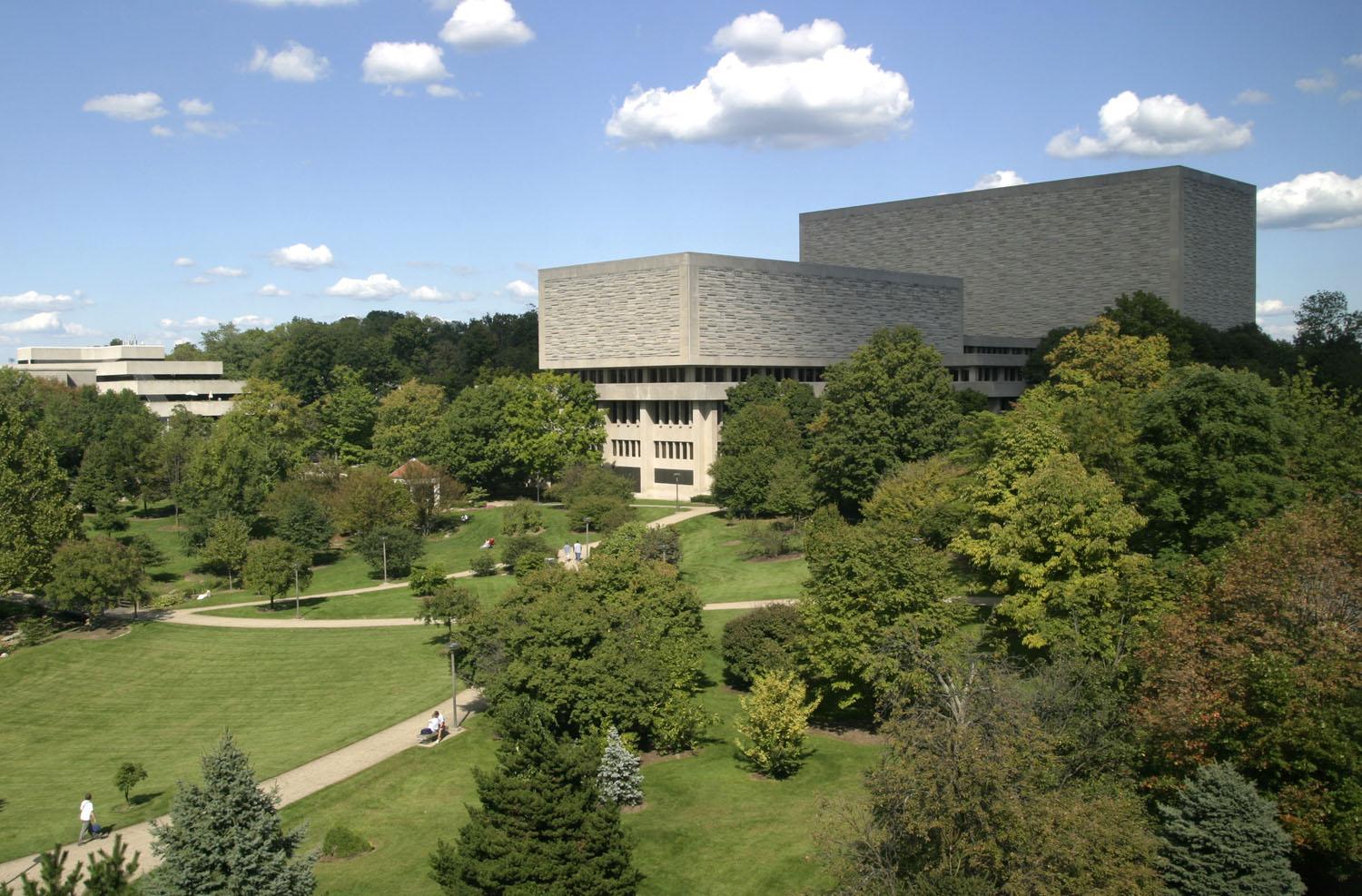
I haven’t been to the big limestone box on Jordan in over a year, but I use the library every day.

Once I needed to use the Reader’s Guide to Periodical Literature; now I use Google.  I used to check the stacks; now I just search by keyword on Project Muse, or wait for a Google Scholar alert to arrive in my inbox.  I used to store my handwritten notes and copies in fireproof boxes or plastic crates; now I have digital reproductions of the entire archive of my current project stored on my phone.

The last time I was there, in the Wells Library, it was for coffee and donuts.

Maybe the future of the library is not the same thing as the future of that building.

Wells Library, Bloomington, Indiana. Courtesy of Indiana University.

After all, even if I’ve been absent physically, I’ve clicked on the IU Libraries link more times than I can count, and trolled through its rich databases with great delight.  I have more need of the library-in-the-abstract than ever before.

The big limestone box – and all that it includes – is still important.  But ours is not the Fitchburg State library, and IU isn’t a second tier, branch campus.  When I wonder about the short-term future of “real” academic libraries with walls and windows and floors, my thoughts race to Rutgers-Newark, to IU-East, or Washington State-Tri-Cities, or Lincoln University, the places most likely to be first erased by budget cutting and spatial reallocation.  I think about small town libraries in places less well off than Bloomington.  I think about corporate libraries and law firm libraries and museum libraries.  I think about the impending extinction of the bookshelf at the old ski lodge, or the hotel lobby, where the accidental discovery of some old Faulkner text, or some Philip K. Dick collection, encourages a new thought. Our research library – the Wells Library – may be safe, for now.  These other, less secure sites, are not.

I worry, after thinking about all of this, about the right now, and about short term access for the less fortunate, confronted with the boxing up of the local library stacks, however meager, or the end of the hard copy, however scarce, and about the corresponding absence of laptops and ipads and wifi, which we imagine as open substitutes, available to anyone, in this age of receding material reality.

Yes, the Wells Library will survive for some time, much like the 42nd Street Branch of the New York Public Library, or the Library Company in Philadelphia.  The scale of the architecture ensures that, as does the vastness of the collections and the professionalism of the research faculty.  Such places, awe-inspiring and beautiful, still generate new knowledge, even while they also encourage new and necessarily generous donations, and serve as delightful backdrops for critical fundraising campaigns.  But eventually, perhaps inevitably, as the library becomes ever more disembodied, even these historic buildings may become repurposed reliquaries, like old Masonic temples turned into state office buildings, or old movie theatres turned into restaurants, or old plantations turned into museums and beds and breakfasts.  Or, like abandoned factories, they will simply be emptied of content and left to fall apart, or turned into loft apartments.

Of course, for those of us caught up in the past, it is easy to get nostalgic about what is lost in this transition.  I remember the smell of my first public library, nestled in a retrofitted old fire station next to my childhood home.  I remember reading Santayana on the steps of the New York Public Library, waiting for the doors to open, and excited about what might be revealed within.  I remember the pleasure of waiting for something to arrive, for my call number to light up, or of finding something unexpected, and of the pervasive smell of glue and paper and ink.   I remember discovering a letter, misfiled under the wrong name, proving what I thought to be a powerful point.   In my most troubled moments, I grow concerned that all of this – this set of possibilities, this travail – will be lost.

Nostalgia, though, is the conservative reflex of those confronted by rapid change.  And so I push back against it.  I imagine what is possible in our future.  And I think, instead, of how cool it will be when the poorest person in the world can press a button – even if the button is worn, and the screen is dingy – and call up the complete works of Toni Morrison, linked to every video interview she’s ever given, and joined with her correspondence, archived in public and for free.  As a public university now more indebted than ever to a bigger, more global “public,” we have a big role in making this future possible.

I’m not sure that this utopic vision includes the bricks-and-mortar of the Wells Library, though it surely includes research librarians.  In many ways, it is the antithesis of this place, which has more in common with the Royal Library at Alexandria than it does with Google books.  And I remember that when the College’s Strategic Planning Committee met a few years ago, we half-joked about creating a rooftop biergarten, with crystal slides to the ground floor.  But this vision most certainly includes the library as a liberal ideal, with a social function worth expanding, a political mission worth protecting, and a research agenda that deserves better articulation.
Open Access Proposals Made at an IU Faculty Forum on the Future of Libraries

What follows are the remarks and proposals that I offered during the libraries-focused event held today at Indiana University. Hosted by IU Provost Karen Hansen and Dean of the Libraries Brenda Johnson, the event was framed as “A Faculty Discussion on the Future of University Libraries.” I was one of eight members of the faculty invited to offer 5 minute reflections on the questions before the assembly. I took the opportunity to suggest that the time has come for the IU faculty to get moving toward a green OA mandate. A proposal towards that goal, and two related ends, are expressed in my comments, which I share here for those who might be interested. The opening remarks and slides by the Provost and the Dean did a nice job framing the issues and my fellow panelists all offered important reflections and goals. The event was very well attended and I thank everyone involved in organizing and attending the gathering. I think that the event was a good step forward towards additional discussions and the work ahead.

I want to thank Dean Johnson and Provost Hansen for their kind invitation to participate in today’s discussion. This afternoon, I wish to carefully offer three proposals while keeping to the allotted five minutes. This context explains my pre-preparation of these remarks.

I am not speaking on anyone else’s behalf, but my suggestions are conditioned by my past experiences, present commitments, and the collaborative projects on which I am working. My efforts as a curator, teacher, researcher, journal editor, library committee member, scholarly society board member, and collaborator working with disadvantaged communities still dealing with the legacies of colonialism, all shape my concerns and motivate my efforts as an activist for scholarly communications reform. My knowledge of the current scholarly communications system and its prospects have been profoundly shaped through my collaborations with librarians and technologists at the IU Libraries and I appreciate the many ways that they have supported and taught me. I have tremendous appreciation for all that the Libraries are doing to support my work and that of my students and colleagues.

I look forward to our discussions of the full range of topics surveyed by the Provost and the Dean, but my proposals focus on the activity that we once called publishing and the changing ways that the libraries engage with it. My hope is to provoke the faculty to take greater ownership in the work of scholarly communication and thereby to partner more meaningfully with our library in fostering a more equitable, ethical, sustainable and sensible communications and learning environment for ourselves, for the communities that need our work, for our debt-crushed students, and for every lifelong learner, regardless of their ability to pay to access our scholarship.

Later I will be very willing to provide needed background, but the most economical approach for me now is to just offer my three proposals for the faculty to consider. The IU Libraries are contributing in a number of key ways to an international effort to protect and improve the scholarly communications system, but without broader leadership here on our campus, there are limits to what can be accomplished. I have tremendous hope for what we might do by working together. Here goes:

  1. I propose that the Bloomington Faculty Council, in consultation with the Dean of the Libraries, the Office of the Provost, and the Vice Provost for Faculty and Academic Affairs, begin formal work towards what is known as a green open access mandate for faculty on the Bloomington campus. With mandates already in place at Harvard, MIT, California, Oberlin, Kansas and hundreds of other institutions worldwide, we are prepared to take advantage of the experiences of those who have preceded us on this path. Our leadership in IT, our international commitments, the prominence of our scholarship, and the stature of our library insure our success in such a venture. Delay wrongly suggests that we are not an institution of the first rank. Read more

Remembering Kara Bayless (1982-2010)

The wonderful memorial statements authored by American Folklore Society members and read publicly at the opening ceremonies of the 2011 AFS meetings are now online on the AFS website. Among them is a beautifully written statement about Kara Bayless an amazing Oklahoman, folklorist, and doctoral student in my home department. A star student, Kara was enrolled in my seminar at the time of her tragic passing last year during the 2010 AFS meetings. She is so missed by her many friends and colleagues.

Also remembered at the meetings, with statements now on the website were three distinguished elders in the field. Stetson Kennedy (1916-2011), Roger E. Mitchell (1925-2011) and Kathryn Tucker Windham (1918-2011).

Learn about their lives and work here: http://www.afsnet.org/?InMemorium

Libraries’ Collections and Services: Changing Expectations

Here at Indiana University, I am really looking forward to being part of a campus-wide discussion tomorrow that has been organized by the Provost and the Dean of the Libraries. The focus of the event is the future of research libraries in general and at Indiana University in particular. Much time will be devoted to general discussion with attendees, but the Provost and Dean will offer framing comments and I am part of a faculty panel with great campus colleagues. We will each offer five minutes of commentary to foster the general discussion. I am very appreciative of the Provost and Dean for organizing this event on questions so crucial to the future of the university and of scholarship in general. It will be interesting to see where things will go through and beyond this gathering.

Our Provost is headed to a position at her alma matter, the University of Minnesota. Having myself participated as a guest in cognate discussions with excellent librarians and faculty there, I have hope that our discussions in Bloomington will serve her well when she gets to Minnesota. IU and UM are both amazingly fortunate to have such excellent, forward looking librarians and great libraries.

If robots write one of these biographies about you, will you purchase it?

Its crazy stuff like this that makes my senior colleagues so dubious about the internet in general and the changing publications landscape in particular.

I follow a twitter feed called Anthropology Books. I have never investigated who put it together and I do not know anything about it except that it has been useful to me. Using some kind of automated approach, the person or software behind Anthropology Books has been very usefully telling me (and about 1000 other folks) about “All new anthropology books posted on their publication day.” If a title seems interesting, there is a link that takes one to the book’s Amazon.com page.

Today, books with the names of famous and not-so-famous anthropologists (and folklorists) started showing up in the stream today. Alan Dundes was one that caught my eye first. He is very important figure in folklore studies and a very good candidate for a proper biography. Other names started showing up, including those of active colleagues who are basically my own age! They all had unfamiliar to me authors and publishers.  There was a flood of them today.

Looking at the books on Amazon.com, one is (sometimes) confronted with the information that “the content of this book primarily consists of articles available from Wikipedia or other free sources online.” I took this quote from the book on Dorothy Eggan. This 84 page book is selling for $47.00 and has been published by Lect Publishing. The book is credited to the editorship of Nuadha Trev. This editor shows up in Amazon.com as the person behind about 3000 books. Lect Publishing is only one of several names associated with the same basic project and Nuadha Trev is only one of several editors.

I know that others have been writing a lot recently about Amazon’s publishing toolkit. Also at issue here is the CC licensing of Wikipedia etc. content. The student publishing group that I work with here at Indiana–Trickster Press–makes great use of CreateSpace+Amazon for the publication of real peer-reviewed monographs and I am certainly appreciative of, and in debt to, the Creative Commons. These resources are not to blame for the creation of this kind of spam-like books, but I think that they represent a problem on several fronts. Perhaps it is enough to say that they give the Creative Commons, Wikipedia, Amazon, remix, and scholarly communications reform a bad name.

I would love to know who would purchase one of these books. Maybe some of them are traps designed to extract cash out of their living subjects. Here is an example. The publisher “Fedel” has just published a 108 page/$54 book on ethnomusicologist/linguist/anthropologist Aaron Fox. (He and I know people in common but are not yet acquainted.) Would Professor Fox feel like he had no choice but to purchase this book to see what it said about him? Would I feel similarly compelled if one were published on me? His is one of about 3000 titles edited by “Christabel Donatienne Ruby”, but does Christabel Donatienne Ruby actually exist?

I would also love to know about the technical infrastructure that automatically (?) assembles these books and feeds them into Amazon. Anybody understand this stuff?

Update:  Thankfully the people behind the wikipedia article for VDM Publishing seem to understand it pretty well. For background, see the entry here. See also the discussion on slashdot here.

Scholarly Communication and the Occupation of Everything

In the current context of global protest, economic failure and political transformation, anthropologists of many backgrounds are finding their voice and addressing the critical issues of the moment. For those with jobs that are being given the speedup treatment, it is hard to keep up with all of the thoughtful and provocative work being created and shared (especially online) right now. The evocative opening line of Jason Antrosio’s recent essay “Anthropology, Moral Optimism, and Capitalism: A Four-Field Manifesto” hints as the gestalt.

A spectre is stalking Capitalism–the spectre of Anthropology. All the Powers of Capitalism have bound themselves in a crusade against this spectre: the Florida Governor and the U.S. President, Dominique-Strauss Kahn and the IMF, Wall Street and Congress.

My thanks go to everyone who is tracking, discussing, fostering, and hosting these discussions. I hope other key nodes in the conversation will forgive me if I single out the Neuroanthropology bloggers Daniel Lende and Greg Downey for their vital work.

Open Access Week and Occupy Everything both continue and I still cannot muster time to read or say much. Rex Golub at Savage Minds is right when he observes that I always bury my lead. He might also note that I say everything too obliquely. So, for tonight, here is a restatement of my previous post in less opaque language.

Going forward from here, if your anthropological research tells you that large corporations are part of the problem, then please do not publish your discoveries or your proposals on this point in books and journals published by large corporations.