Skip to content

Posts from the ‘Academic LIfe’ Category

Cracking the Vault: A Celebration of Daniel Swan

Below find the first of a series of guest posts offered in celebration on the occasion of our colleague and friend Daniel C. Swan’s retirement from the University of Oklahoma, where he has served with distinction as a Professor of Anthropology, Curator of Ethnology, and Interim Director of the Sam Noble Oklahoma Museum of Natural History. First to reflect on an aspect of Dan’s work and his personal impact is Jessica W. Blanchard. Jessica is a Research Scientist at the University of Oklahoma’s Center for Applied Social Research. This series of guest posts has been organized in partnership with Michael Paul Jordan. –Jason Baird Jackson

Cracking the Vault: A Celebration of Daniel Swan

By Jessica W. Blanchard

Reflecting on the years I have known Dr. Daniel Swan brings to mind so many wonderful stories. Dan joined as a member of my doctoral committee just as I was rounding third base of the dissertation, and so it was really during the years following the completion of my degree that I came to enjoy Dan as a friend, a colleague, and of course, a ceaseless mentor. He has imparted years of stories and lessons from the field–and from life–and yet, I am unable to share most of these with you here. For you see, any really good story by, or about Dan Swan, inevitably begins and ends with the shared reassurance, “This stays in the vault.” I remember the first time I heard about said “vault” and wondered what in the world kinds of secrets of the academy I was about to learn. I listened with eager anticipation, feeling sure that I was about to be privy to something none of my peers yet knew. As it turns out, for those peers who never had a mentor like Dan Swan, I was indeed privy to a piece of the academy that made it bearable, possible, and simply better.

I entered graduate school, as many do, with a fair dose of naïve optimism and self-centered drive, and was fortunate early to have the mentorship of Dr. Jason Jackson to nurture and guide my focus away from priorities of self toward priorities of communities. His departure to a new institution left a giant hole in my committee and left me wondering how to navigate out of this tunnel known as the dissertation. Enter: Dan Swan. Upon Jason’s recommendation, I asked Dan to join my committee. Right away, Dan asked to read my work. Right away, Dan set up a lunch appointment and gave me feedback. I am not sure if he knows how much it meant to have him jump on board right away. He invested time in understanding the communities with whom I worked so that his feedback was informed and meaningful. He joined me on trips to the field, made all the better by his willingness to indulge in local all-you-can-eat catfish diners. He listened to my stories about the tiniest of Oklahoma towns, and was happy to venture there to meet the community members with whom I had grown close over the years. I watched as he did the same for other students, uplifting them any chance he got and mostly in ways that they were unaware. This, in no uncertain terms, is precisely the kind of support that makes academia bearable, possible, and simply better.

Dan’s advice to me during my time as a graduate student was decisive and clear: just do it. Get finished. Be confident in the hard work you have done. We eventually became departmental colleagues for a time, and Dan’s advice to me was again decisive and clear: worry less about those who do not deserve worry (summarizing here) and work on your face (verbatim). Apparently, I needed to learn how to express less with my face in professional situations. I still hear Dan’s voice saying “work on your face” at just the right times. I see now that Dan’s plain-spoken candor is simply part of what it means to “keep it in the vault.” The vault is simply a blueprint for how to build a circle of supportive colleagues and friends: be selective yet forgiving, invest in one another, support one another, learn from one another, defend each other when needed, hold each other accountable, and always celebrate the wins.

I referred earlier to the dissertation process as a tunnel. The thing about a tunnel is that there is always light on both sides of it. Navigating the tunnel is easier to do with encouragement and good guidance from those who have done it before. Dan helped me find the focus and grit–the tunnel vision, so to speak–I needed to get through it. Tunnel vision is a good thing when it means you are focused and productive, but it is also impossible to sustain and can limit what we can see around us. We eventually come out on the other side of the tunnel and we begin to understand that it was merely a place to gather new tools, perspective and purpose. Thank goodness for those who support our journey into the tunnel, those who cheer and pick us up as we navigate our way through, and most assuredly for those who celebrate as we emerge on the other side.

Today, I celebrate the career and mentorship of my friend, Dr. Daniel Swan. I celebrate his tireless devotion to students. I celebrate his achievements in building an approach to ethnography and curation grounded in community and relationships. I celebrate what is yet to come for him and his family! Dan, if you ever find yourself reflecting on the impact you may have had on others, let me crack the vault a bit to tell you that it was tremendous. Cheers to you!

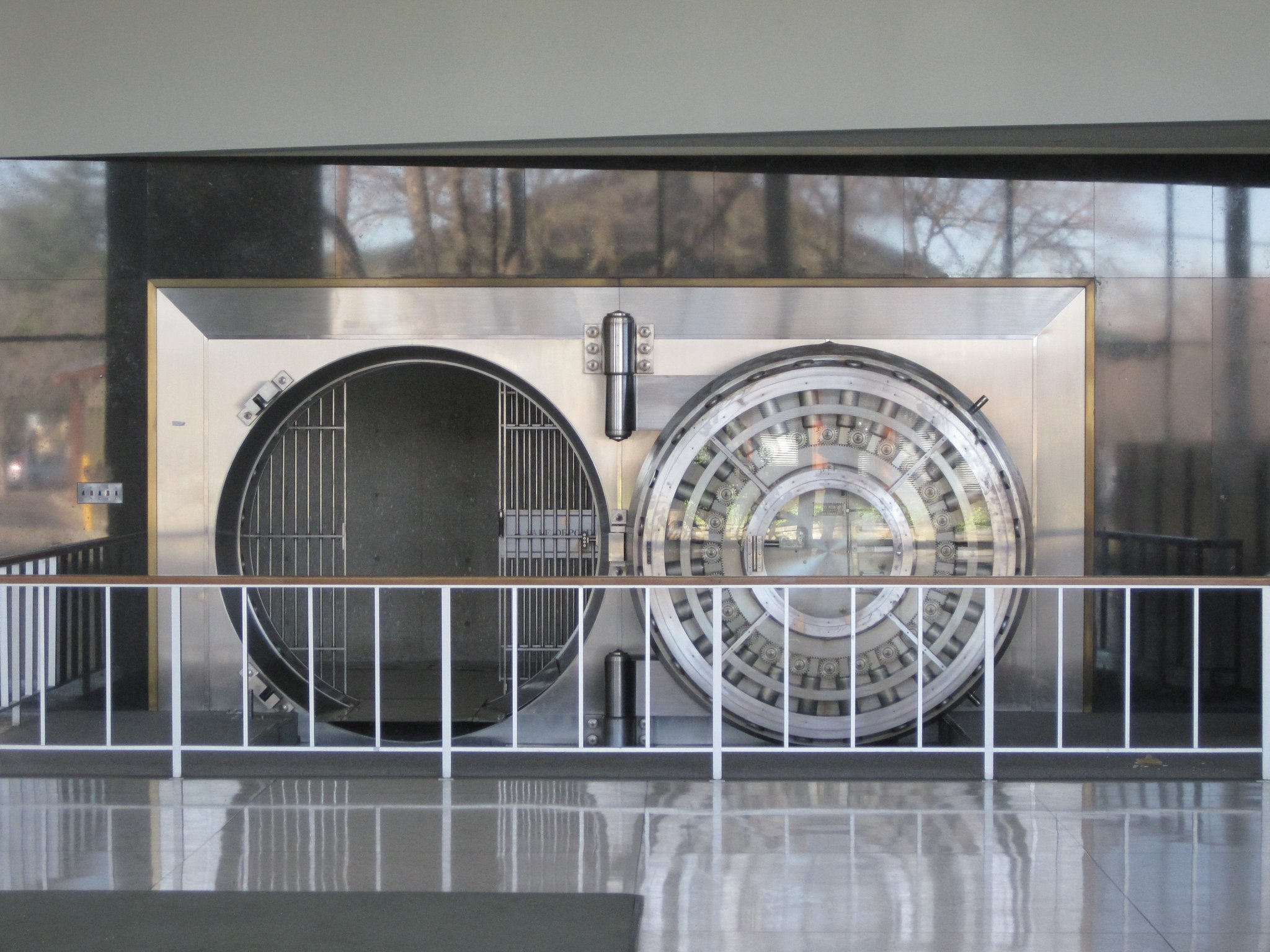
Bank_of_the_West_Los_Altos_branch_vault

(Former) Bank of the West vault in downtown Los Altos, California via WikiMedia Commons (CC0 1.0 Universal Public Domain Dedication)


Two Short Courses in Tartu

#fulbrightspecialist #fulbright #exchangeourworld

In an earlier post, I expressed my appreciation for the opportunity to visit the University of Tartu as a Fulbright Specialist. Among my tasks while there was to teach two short courses. Here I want share the story of those courses and reflect upon how they fit into my visit and into my fall of sabbatical leave.

IMG_5455

The Departments of Ethnology and of Estonian and Comparative Folklore are not only headquartered in the beautiful building on the left, but they are located across from the wonderful, legendary cafe Werner on the right. The cafe itself justifies a trip to Tartu.

As I noted earlier, the University of Tartu has well-established and distinguished degree programs in (1) folklore studies, (2) ethnology, and (3) Estonian craft. My visit was in part prompted by the addition of an English-language MA program in folkloristics and applied heritage studies. This new program is being offered by the three departments in partnership. Given the focus of the new program and the interests of its students, there was a desire in the core faculty to offer an enhanced opportunity related to museums and material culture. That is where I fit it, as I regularly teach graduate courses in museum curatorship and in material culture studies for students of both folkloristics and in ethnology (≈ cultural anthropology). I suspect that my experience working in both museums and academe is also relevant here.

For my Fulbright visit, I was asked to contribute to a course called “Material Culture and the Museum.” Wonderful Tartu colleagues Kirsti Jõesalu, Elo-Hanna Seljamaa, and Ene Kõresaar organized and kicked off the course prior to my arrival and carefully managed its mechanics during and after my visit. I offered four course lectures and then participated with the students in the International Committee for Museums and Collections of Ethnography Conference held during my final week in Estonia at the Estonian National Museum (more on the conference later). The descriptions for my course talks were:

Museum Ethnology and Material Culture Studies: An Introduction

In the first of four sessions, the core concerns of museum-based folkloristics, cultural anthropology, and ethnology (= museum ethnology, hereafter) will be introduced. Material culture studies within these fields is an intertwined but independent endeavor. Concerned especially with the areas in which museum ethnology and the study of objects and built environments intersect, material culture studies as an research area in ethnology will also be introduced.

Theories of Material Culture

In the second of four sessions, the focus will be a survey of theoretical perspectives relevant to the study of material culture within the ethnographically-oriented disciplines. As a prelude to later investigations by course participants, a wide range of perspectives will be introduced briefly. The session will conclude with a somewhat more elaborated account of the primary approach to material culture studies now active in North American folkloristics. This dormant perspective reflects the communication or performance focus characteristic of North American folkloristics more generally.

Practices in Museum Ethnology

The third of the four sessions will characterize the practice of museum ethnology by scholars who are both based in museums and those who, while employed in other kinds of institutions, take museums and their collections as a special focus. What does a museum anthropologist, a museum-minded folklorist, or a museum ethnologist do? Why do they do what they do? What are the broader implications of this kind of work? How do such museum scholars contribute to the larger work of their field(s)? These questions will animate this session.

Contemporary Developments in Museum Ethnology and Material Culture Studies

In the final of the four sessions, the focus will be on emergent trends at the intersection of museum ethnology and material culture studies. These trends will be situated within a broader revitalization of work within these endeavors. Among the developments to be discussed are: (1) the changing role of museums in society, (2) reconfigured relationships with originating or source communities, (3) the impact of new digital technologies, and (4) the rise of new or reconfigured heritage and property regimes. We will also reflect on the relationship between museum/collections-based material culture studies and the now much larger and more diverse realm of material culture studies as a whole.

I was honored and a bit surprised that so many colleagues from around Estonia came to sit in on these four course meetings. There was a large and talented group of students participating in the course from the English-language MA and from other degree programs, but there were also faculty, researchers, and museum curators from around Estonia attending as well. It was exciting to engage with this diverse and interested audience. I am sorry that the size of the group prevented me from connecting personally with everyone.

I am on sabbatical leave this fall. Did I really have any business teaching? Yes. I will not be the first to observe how valuable teaching can be for the advancement of one’s own thinking and research. My Material Culture course at IU has been taught several times already, as has my Curatorship course. They need fresh thinking. Together, these two courses occupy 30 weeks of graduate seminar (75 contact hours). While in a small group, American-style seminar, I might have conversed my way across the topics outlined above, the large audience and tight time window necessitated coming at the material in a new way. Thinking about how to present the big picture in these two intersecting domains in a brief series of lectures was extremely productive for my own thinking. As I re-engage with my own museum-related material culture research, this fresh look is really valuable. One other thing that I can say about it was that–in the doing–I really drew inspiration from the recent work of younger scholars, including the IU graduate students with whom I get to work. The whole undertaking was generative and I appreciate the opportunity to pursue it. Special thanks to my colleagues for organizing it and for all who attended the course meetings.

My other short course was titled “Getting the Most Out of Peer-Review.” One of the advantages of a university with smaller course modules is that there is room for focused courses like this. This is the course that previously mentioned was partially supported by the European Union. It drew students from beyond folkloristics and ethnology and the participants were mostly PhD rather than MA students. It was at a high level from the first moment because a majority of the students came to the course with publishing experience. Most had already published one or more peer-reviewed articles, which meant that our discussions did not focus on the mechanics of submission and publication but focused specifically on peer-review. In this, we explored two phases. How to (1) engage with peer-reviews as an author receiving them and (2) how to be a good citizen and effective as a peer-reviewer. My kind hosts Kirsti Jõesalu and Elo-Hanna Seljamaa handled the kick-off and follow-up and mechanics of this course also and I hosted and led two seminars (one short, one long-but-with excellent snacks!) in which we discussed the broad domain. Unlike the lecture-hall material culture course, the peer-review course could be handled in seminar style and I thus had an increased chance to learn from the participants. I note here my thanks to all of the participants and to my hosts.

I won’t elaborate the peer-review course content further here, but I will note one related issue of particular interest to me.

The students in this course are advanced in their research and advanced in their publishing careers. This is normal for their institutional and disciplinary contexts in Europe and it also articulates with how most of them will meet their dissertation requirement for the PhD. As is true in the hard sciences in the United States but rare in cultural anthropology or folklore studies (or history, art history, etc.) here, these students dissertations will be assembled around a suite of peer-reviewed articles rather than a long-form, book-like manuscript. I hope to write more about this difference in the future, but if you are curious about what such a dissertation looks like, consider the case of Anastasiya Astapova’s dissertation titled Negotiating Belarusianness: Political Folklore Betwixt and Between. I choose this example because it is highly regarded and connects to my own home department.

As you will see if you consult the dissertation online here: https://dspace.ut.ee/handle/10062/49509, this dissertation combines a 69 page contextualizing and framing essay with presentation of five peer-reviewed articles and chapters. The first of these appeared in the journal Humor, the second appeared in the Journal of Folklore Research (published the IU Department of Folklore and Ethnomusicology and IU Press), the third appeared in Ethnologia Europaea, the fourth appeared in the Journal of American Folklore, and the fifth appeared in an edited book titled Contesting Authority: Vernacular Knowledge and Alternative Beliefs. This is a stellar set of high profile publications in leading venues.

If you look at the dissertation online, you will find all of the framing and wrapper material, but not the five articles/chapters themselves. Professor Ülo Valk kindly gave me a paperback edition of the dissertation and it includes reproductions of the five published or then-forthcoming contributions. (All of the current Tartu dissertations are beautifully produced as book-like objects.) I suspect that the University of Tartu withholds these in the open access version for copyright reasons.

IMG_5454

While I mention Anastasiya Astapova’s dissertation in my post, there are plenty to attract our attention. Here is the cover of Jinseok Seo’s dissertation on Korean shamanism.

I hope to reflect more on this model of the dissertation in the future. Here, I mention it to provide context for the peer-review course. This structure definitely gives the peer-review article genre a key place in doctoral training.

In closing, here I want to thank the Fulbright Specialist program again as well as my staff and faculty hosts at the University of Tartu. In connection with the two courses, special thanks go to the students and colleagues who engaged with the efforts described here. (And thanks to the European Union for supporting the peer-review course.)

The University of Tartu, Appreciated

#fulbrightspecialist #fulbright #exchangeourworld

I recently spent an extended time in Tartu, Estonia. I had the wonderful opportunity to be a Fulbright Specialist visiting the Departments of: (1) Estonian and Comparative Folklore, (2) Ethnology, and (3) Estonian Native Craft at the University of Tartu. My visit also provided rich opportunities to learn about the work of the Estonian National Museum, with which these departments collaborate closely. Visiting Estonia was a transformational experience for me and I am very grateful for my generous hosts in Estonia and for the continued work of the [U.S. Department of State’s] Fulbright Program. Here I reflect briefly on the work of my fields at the University of Tartu. In a later post, I will evoke the courses that I taught and the students I met while in Tartu. In a final post, I will touch on the Estonian National Museum and the rich International Committee for Museums and Collections of Ethnography (ICME) conference that it recently hosted.

IMG_5457

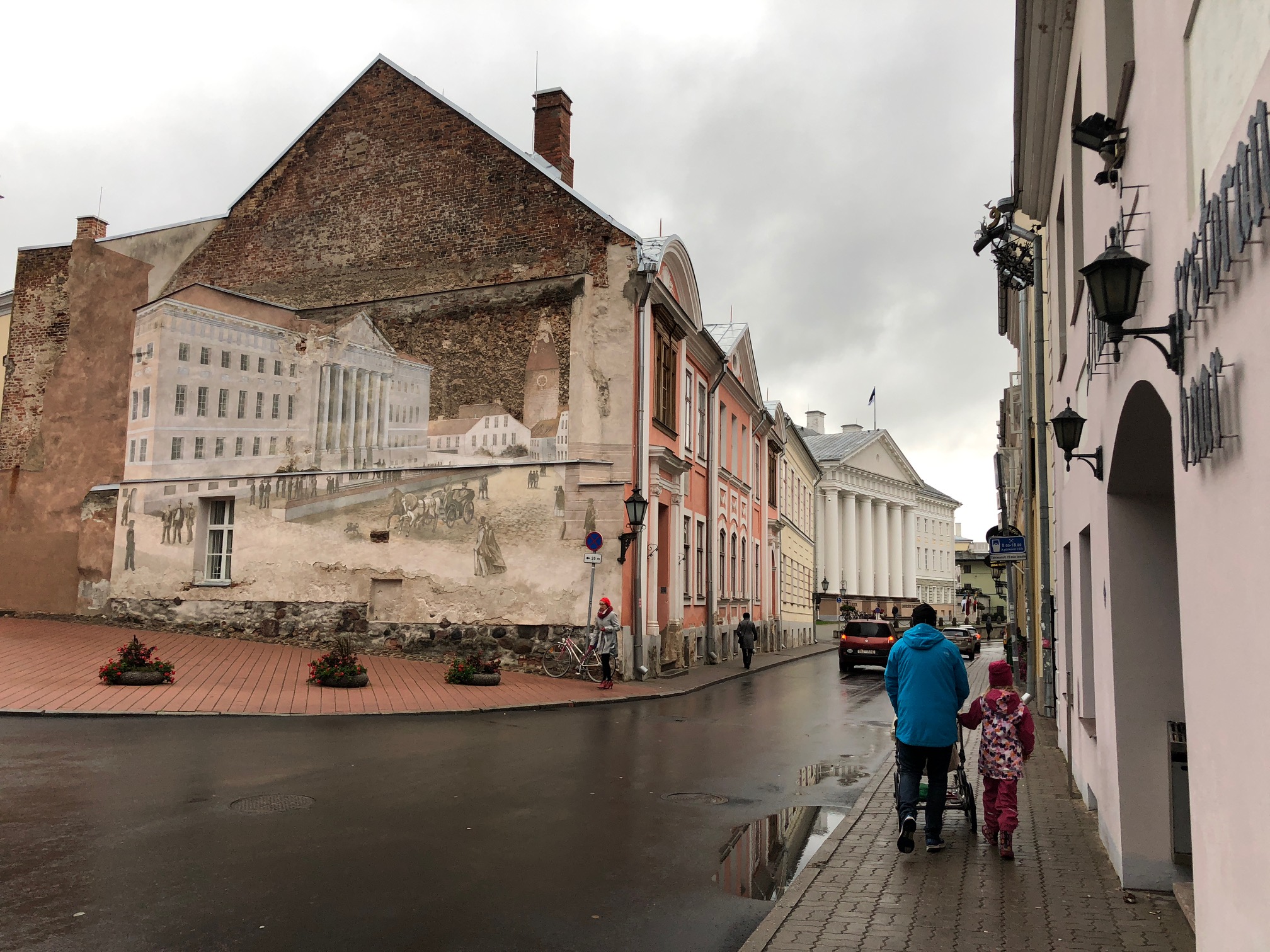
On the left, with the mural on its end, is Ülikooli 16 in Tartu on the University of Tartu campus. It is today home to the Institute for Cultural Research, which includes the Departments of Ethnology and of Estonian and Comparative Folklore.

The twinned disciplines in which I work–folkloristics (folklore studies) and ethnology–have a deep and important history in Estonia. So too do the practice of, and the study of, the nation’s rich craft traditions. For my interests, it would really be difficult to think of a richer and more rewarding place to make an in-depth, scholarly visit. The University of Tartu is almost two centuries older than Indiana University where I work. It was founded in 1632 under the auspices of King Gustavus Adolphus of Sweden. Through Swedish, Russian, and Soviet rule as well as in independent Estonia, the University of Tartu has been a major world academic center. This is reflected in the fame and impact of its academic programs and in the scholars and students who continue to gather there from around the world. (For those interested in Indiana University connections, the university is strong not only in folklore studies and ethnology, but in the neighboring field of semiotics, another field of special interest to Indiana University scholars. Semiotician and IU Distinguished Professor Thomas Sebeok’s library can be found there (See: Thomas A. Sebeok Memorial Library. As noted here, Sebeok was a Fellow of the IU Folklore Institute and a Professor of Anthropology among his many IU roles.)

The Departments that hosted me have longstanding and strong undergraduate and graduate programs, but a new joint MA program was one catalyst for my visit. Having just welcomed its second cohort of students, the Folkloristics and Applied Heritage Studies program is an English-language masters degree program attracting strong students from around the world (including the United States). It is taught and managed in partnership between these units.

I taught two short-term courses while visiting campus (see later post) and met with colleagues and students both in Tartu and in the city of Viljandi, where the Department of Estonian Native Craft is based. It and other arts programs are located in the Viljandi Culture Academy. Viljandi–about an hour east of Tartu–is a strong hub for the arts in general and for Estonian vernacular and folk arts in particular. For example, near Viljandi is a great satellite museum of the Estonian National Museum that is focused on handicraft and rural life (Heimtali Museum of Domestic Life) and Viljandi is home to the major Viljandi Folk Music Festival.

Both in Viljandi and in Tartu, UT faculty were very generous and taught me much about their work and its contexts. As someone who teaches the history (and present status) of folklore studies, anthropology, and ethnology, it was extremely valuable to have a close encounter with the past and present of these fields in a national context that is inflected in both Northern European ways and in the Russian, Soviet, Post-Soviet ways. As throughout the region, issues of nationalism and national identity are a central theme, but colonialisms and their afterlives are also woven throughout the disciplinary histories. Estonia offers much to think about.

This is not just a historical matter, as changes and innovations in Estonia society also offer many lessons. For instance, life at the University of Tartu is now heavily impacted by programs and initiatives of the European Union and technological mediation is a constantly present dynamic in the university’s educational work. While I am quite accustomed now with online and distance education, I was struck by the extensive role that these techniques play not only word-heavy curriculums such as in ethnology and folklore studies, but in the university’s native craft curriculum. Most students in this later department are older students (older, that is, than recent high school graduates) and they are learning advanced textile, metalwork, and building techniques as well as heritage studies methods and theories through a combination of intense-but-brief in-person work on campus and online education activities.

IMG_5437

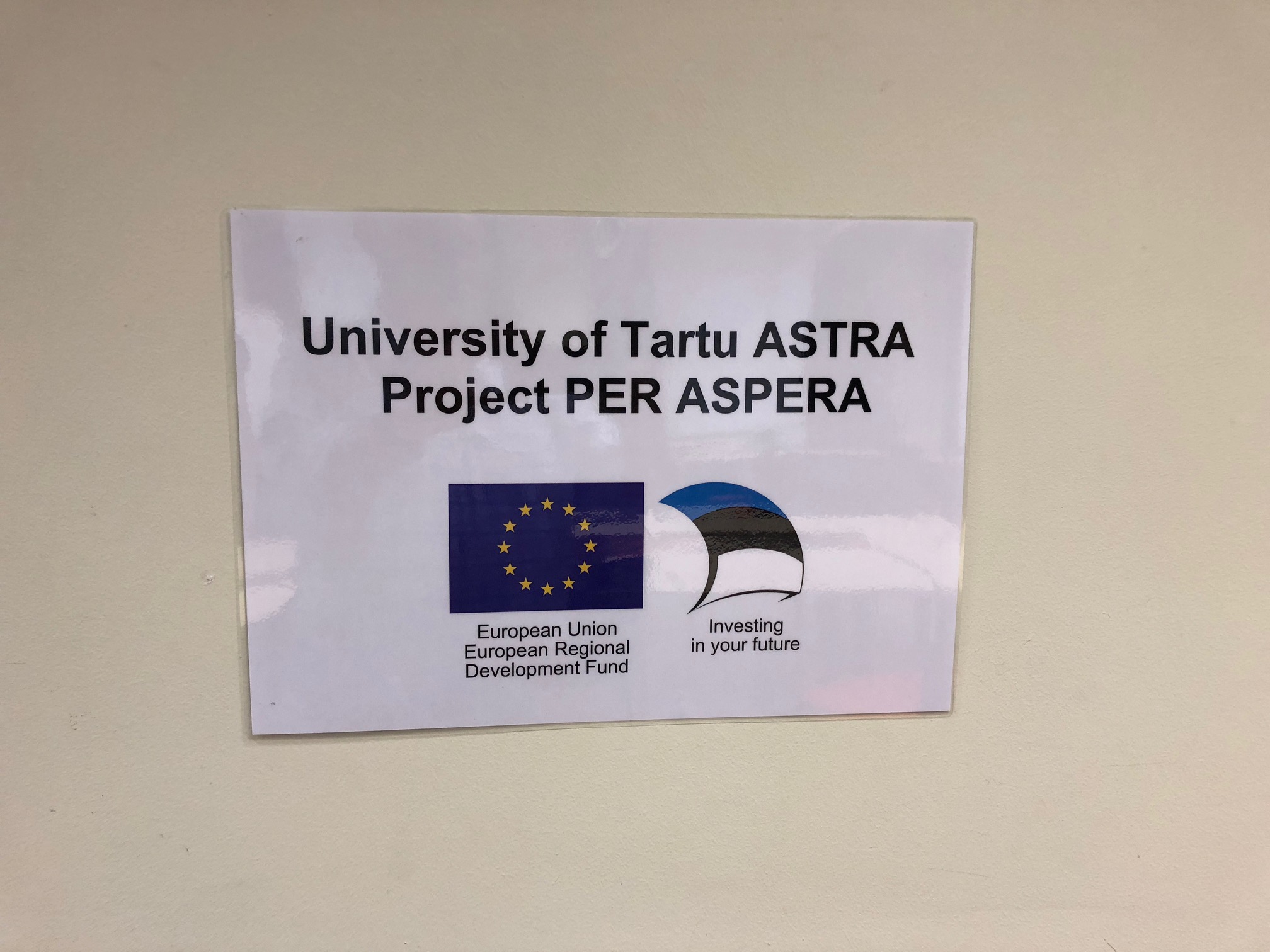
My course on “Getting the Most Out of Peer-Review” was generously supported by the European Union, thus this sign was posted during class sessions.

From colleagues in these departments, I also gained a deeper understanding of their impressive publishing work. Highlights include the Journal of Ethnology and Folkloristics (which I have long admired) and Studia Vernacula and a great diversity of monographs and edited volumes. Publication work in my fields is very advanced in the UT departments. The well-researched and beautiful books being produced related to Estonian craft techniques and histories are a marvel–little work of this quality is found in the United States.

I could continue at near endless length, but this is enough for now. I close for the moment with warm appreciation for all of the staff, faculty, and students who worked hard to make my visit possible and who shared so much of their work and passion with me. Thanks also go to the Fulbright Specialist Program and to the European Union, the University of Tartu, and other funding agencies that supported my activities.

IMG_5448

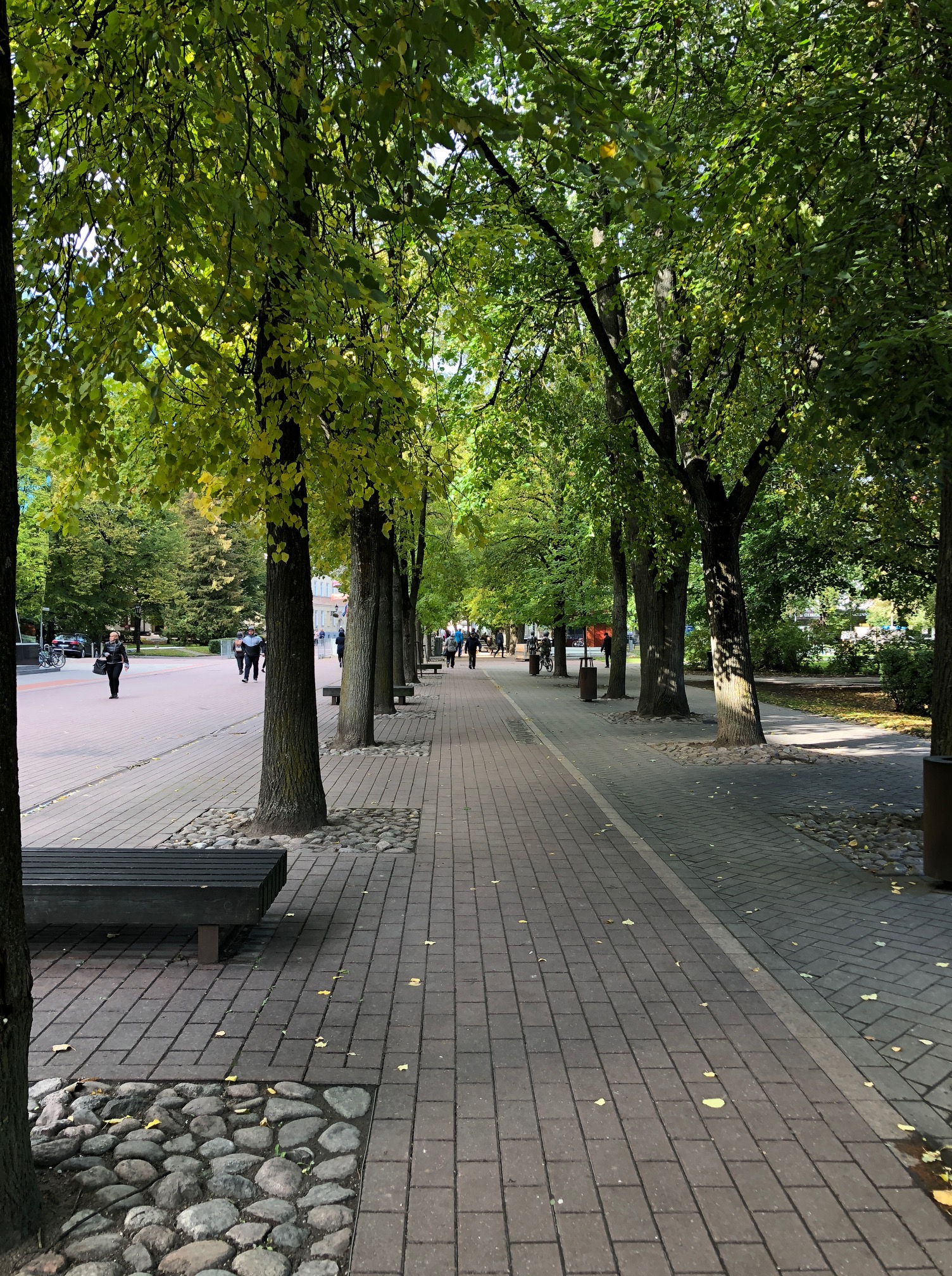
In downtown Tartu.

Material Culture Seminar, Spring 2019

Material Culture Flyer B

What is the Museum Anthropology Review Business (Labor) Model?

Alternate title: How to give away $99,000 worth of articles.

Although it has become normalized in open access/scholarly publication reform discussions to speak in this way, it often seems laughable to use the phrase ‘business model” in the context of many open access projects. Business model implies more modeling and more business that are often found in these efforts. When the eye-rolling or chuckling stops, the business school talk does remind prompt us to try to figure out what we are doing and how we are doing it. This is good even for tiny projects held together (often happily) with just a bit of used string and some tape. (Thank goodness that we do not all want to become the next oversized thing.)

I write the following as founding editor of Museum Anthropology Review, an open access journal supporting scholarly and public-facing work in museum anthropology, museum-based folklore studies, and material culture studies. In an immediate context of painful collective disciplinary assessment, debate, and reflection (#hautalk) on scholarly communication work (and labor practices, and power, and hierarchy, and practices of discrimination, etc.) in the ethnographic disciplines, I thought it might be useful to be more explicit about labor and funding underpinning MAR). While the journal has a complex origin story and has changed alongside other changes (in my career, at Indiana University, in the fields that it serves, etc.), the so-called business model has remained pretty consistent, making this small task easier. It is not the business school way, but it may be easiest and most contextually relevant in MAR and disciplinary context to track labor and money using participant roles. It is hard to do this in a way that will not seem either self-promoting or defensive, but it has to be done. I have stressed throughout my wider engagements with open access that projects such as MAR need to try to be intentional in their experimental work and in reporting back to the field for collective benefit. The need for more of this is more pressing now than ever and I have been relatively silent on open access issues since finishing what I thought of as capstone activities in two pieces written with colleague-collaborators (Jackson and Anderson 2014; Walters et al. 2015 [for this project, see also here]).

MAR Screenshot

Readers: The journal does have readers. I and others involved in the journal know this from digital statistics (like Google Analytics), citations to work published, and word of mouth. Accessing MAR requires internet access but does not cost readers anything. Everyone involved is pleased to know that the work is worth doing, so I say thank you to the readers who have spent their time and attention on MAR. (I invite you to sign up as a reader and get free tables of contents for MAR by email.)

Authors: The journal does have authors. Authors are not paid for their contributions to MAR, but they are also not charged author fees or article processing charges, as is common in some other kinds of open access projects. In MAR we have so-far published 33 peer-reviewed articles. Had the authors of those articles published them in Curator and paid to make them open via Wiley’s Online Open program, the total cost to authors would have been $2500 x 33 = $82,500. Author-pays open publication in Museum Anthropology would have cost $3000 x 33 = $99,000 (See Wiley-Journal-APCs-2018MAY24 (a spreadsheet) via https://authorservices.wiley.com/author-resources/Journal-Authors/licensing-open-access/open-access/onlineopen.html, accessed June 16, 2018). Those of us in other MAR other roles wish, of course, that authors were more aware of these taken-for-granted things. Hopefully this post will help a bit. I am proud that the MAR community has been able to make publication happen for these authors and their readers without ability-to-pay being a factor shaping the publication process. I also thank journal’s authors for sharing their valuable work widely through publication in MAR.

Peer-Reviewers:  The journal definitely has peer-reviewers. They are generous and thoughtful and they are essential. I thank them here for their contributions to MAR. MAR peer-reviewers are not paid for their contributions. This is the current scholarly publishing norm for journals. I track the debate on the ethics of this. We are in a bind. Peer-review is hard, important labor. My opposition to industrial scale commercial scholarly publishing is based in part on the relationship between free labor of some participants and the huge profits that these firms reap (sample rants here and here). If paying peer-reviewers were to become the norm, then small community-based journals such as MAR would not be able to do it and corporate run and co-published journals would have an even bigger slice of the scholarly publishing pie (the enclosure of anthropology was at issue here). It is a conundrum at the heart of scholarly communications reform. For now, know that MAR peer-reviewers are valued and unpaid. The cash/gift economy status of the other roles is probably relevant to their feelings about this. My hope is that one feels relatively less exploited about peer-reviewing for a journal that looks like the one that I am describing here.)

Editorial Board: As is normal, MAR has a valued editorial board. As is common, I have not turned to them for structural, business or governance issues as much as I might have. As in other journals, they often serve as a kind of meta- peer-reviewers. For instance, serving as a source of editorial advice when I need help figuring something out or as a source of recommendations for reviewers. Sometimes editorial board members are called upon to undertake peer-reviews themselves. As with all journals that I know (and this is relevant in the context of the current journal controversies in the ethnographic fields), they also lend their reputations to the journal as a project. This is not inherently bad and it has a function beyond the accumulation of symbolic capital. When a potential author considers making a submission to any journal, they can review the masthead and ask: “Does my work resonate with the work of some of the people identified here?” Editorial Board Members are not paid for their MAR service. I thank them for encouraging and supporting the journal and helping it go.

A special member of the editorial board during the initial years of MAR was Associate Editor Kimberly Christen. As reflected also in her important scholarship (example here) and her own large and innovative projects (example here), Kim was a key interlocutor for me on (then new) questions of open access, helping me make sense of the shifting terrain across which MAR would travel.

Editor: At the most, two people have worked in the editorial office. Quite often, one person works in the editorial office. If there is just one person, then that person has been me. MAR launched in 2007. The story of its birth and its transformation is a different story and I postpone telling it here. A large number of friends and colleagues have helped by occupying the roles that I have noted above and by offering a range of encouragements and words of appreciation. The duties that traditionally fall to an editor are the ones that I have pursued. In the MAR case, this also includes overseeing the journal’s reviews work (book, exhibitions, etc.). This is a smaller setup than is normal even in smaller journals, which typically have a book review editor and other separated roles. There is no doubt that a critic would say that this concatenation of roles represents a concentration of power. I hope that close independent analysis would suggest that no pronounced problems flowed from this fact. For better or worse, it was also a concentration of so-called “service” labor. Understanding the finances of the editorial office can help readers judge the risks and ethics.

The actual production of the journal is also done in the editorial office. Content does not get handed off to a publishing partner for formatting, metadata coding, assignment of DOI numbers, etc. That work happens in-house and it is the editor and (when existing) the editorial assistant that do that work. As described below, Indiana University has created an excellent open access publishing environment that makes this possible.

As I still do, I held a tenured professorship when MAR sprang up into existence. As reflected by my notes above (and the points remaining to be made below), no money comes into MAR and no money goes out of MAR. There is no direct financial benefit to me to work on MAR. I acknowledge that I am paid well by Indiana University in support of the range of teaching, research, and service activities in which I engage and that I am reviewed annually and in the context of promotion decisions. No pressure to stop doing MAR has ever arisen (although my colleagues may privately question my judgement vis-à-vis excess editorial activity) and no special reward for doing it has been provided. My departments are home to a lot of editorial activity and mine just conforms to this local norm. This is a longstanding tradition, with many journals previously edited in them (Museum Anthropology, International Journal of American Linguistics, American Ethnologist, etc.) and many founded in them (Ethnohistory, Anthropological Linguistics, Journal of Folklore Research, etc.). If I did not do work on MAR I would be working on other things and my salary would not, I think, be any different. [I am mindful of the luxuries of choice available to me in my position.) MAR keeps me connected to my scholarly community and has brought a huge range of valuable experiences and relationships into my life. But there is no money to follow. Before 2013, MAR had only a kind of informal social base. It was produced by me and my friends with help from the IUScholarWorks program at the Indiana University libraries (see below). After 2013, MAR became the journal of the the Mathers Museum of World Cultures (MMWC). This was a positive byproduct of my becoming the MMWC’s Director. When my Directorship ends, MAR will remain at the museum and will be the responsibility of its next Director to continue, expand, shrink, change, or shutter. (Note: If the journal were to end next month or next year or next decade, the robust preservation and continued public accessibility of its backfiles is one of the durable commitments that IU Libraries have made to the project. See IU ScholarWorks below).

Editorial Assistant: When I was help in the work of the Editorial Office, it was by a graduate student from the Department of Folklore and Ethnomusicology or Department of Anthropology at Indiana University holding an .5 FTE (half of fulltime) graduate assistantship. Whereas the College of Arts and Sciences at Indiana University specifically funded a .5 FTE graduate assistantship for the work of supporting my previous editorship (2005-2009) of Museum Anthropology (the journal of the Council for Museum of Anthropology), MAR was never directly supported in this way. During a year serving as a department chair (2009-2010), a graduate assistant was assigned to support me in my scholarly activities. Helping with MAR became this colleague’s key duty. Between becoming Director of the MMWC in 2013 and the end of Spring 2017, the primary duty of a graduate student similarly appointed has also been to help with the journal. During fall 2017 and spring 2018, the work of the MMWC Director’s Office graduate assistantship has broadened to other projects, but the incumbent did do some MAR work. When a graduate student was working primarily on the journal, they held the title Editorial Assistant and appeared thus on the MAR masthead.

When filled, this Editorial Assistant role was a 20 hour per week position held during the fall and spring semesters. Those holding it have had the same stipends as their classmates holding similar appointments in the Department of Folklore and Ethnomusicology. They also hold fee waivers that pay for a significant portion of their course work for the full year (including summer courses) and they have a university health insurance plan. I wish that all of the assistantships held by students in my home departments (Folklore and Ethnomusicology, Anthropology) were better paid and offered better benefits, but I am happy that those student colleagues who worked with me on MAR had as good of a deal as any of their classmates. They can speak for themselves, but I think that they appreciated the experiences that they had while working on the journal. The rich range of publishing opportunities provided to graduate students in my departments have, over time, made (what I perceive to be) a significant difference in the career outcomes of the graduate students with whom my faculty colleagues and I have thus worked.

The key thing to note here vis-à-vis broader debates in anthropology publishing right now is that MAR’s basic editorial office work (correspondence, copyediting, layout and formatting, social media stuff, etc.) was either done by me or by a graduate student being paid to work with me.* Given its small scale and lack of cash in and cash out practices, MAR could have been done with a wider pool of volunteer laborers. I actually support this model and have spoken up for it often, but in the actual doing, the mix of roles described here made sense to me for MAR. In part, this stemmed from MAR being an off-shoot of Museum Anthropology which, for a time, was run with as many variables as possible being held constant so as to provide a kind of natural experiment to contrast open access and conventional publishing in the sub-field that both journals served. The mode of editor (or pair of editors) plus assistant has been constant with Museum Anthropology from the time of my editorship and thus through the period of MAR’s history at issue here. Creating opportunities to support the work of graduate students interested in museum ethnography was always a key concern of mine in this work. It motivated my seeking the Museum Anthropology editorship in 2005 and it has remained a prominent goal throughout. I thank the College of Arts and Sciences and the Office of the Vice Provost for Research for supporting the assistantship positions that have at various points helped MAR prosper. I thank Janice Frisch (2019-2010), Teri Klassen (2014), and Emily Buhrow Rogers (2014-2017) for their hard work as editorial assistants with MAR.

IUScholarWorks:  MAR would not be possible without the extraordinary vision, investment, and labor gathered in the IUScholarWorks program of the Indiana University Libraries. Focused on supporting open access scholarly communications efforts, IUScholarWorks (IUSW) has a number of signature projects, including Indiana University’s institutional repository and the IUScholarWorks Journals program. MAR was the first of the IUSW supported journals. This program has grown to include more than forty open access journal titles, including others of relevance to the ethnographic disciplines (Anthropology of East Europe Review, Ethnomusicology Translations, Studies in Digital Heritage, etc.).

I am not able to quantify the financial investments that the IU Libraries have made in MAR via the IUSW program, but the investment is significant and important. Most crucially, it is via IUSW that MAR has access to the incredible open access journal hosting and workflow software known as Open Journal Systems (OJS). OJS makes MAR possible and the IUSW librarians and staff make MAR on OJS possible. I want to express appreciation for the investment and incredible support that the IU Libraries have provided to me and to the MAR project. I hope to say more about the details of this support in the future and to quantify the technical and staff costs underlying it. For now, it may be enough to know that just as MAR tries to serve the field without charging fees for that service, IUSW tries to serve projects like MAR without charging fees for that service. It is certainly the case that economies of scale have been realized by having library-based publishing support services that can concurrently help a wide range of (mostly small) journal projects.

Indiana University Press: Technically, I could speak of the IU Press alongside IUScholarWorks. At Indiana University, our wonderful press is now a unit inside the IU Libraries. In this position, there is significant overlap and interdigitation between the open access publishing support work of IUScholarWorks and the general publishing work of the IU Press. But the two efforts also preserve some distinction. One way that MAR is increasingly being served by the IU Press is through promotion. As an outgrowth of the Press’ own commitment to fostering open access publishing, the Press has generously promoted MAR alongside its full suite of scholarly journals. As with the libraries as a whole and IUSW in particular, I cannot say enough good things about our press. The open access-fostering work of the Press, IUSW and the libraries in general are an outgrowth of a larger campus-wide and university-wide commitment that has been a key factor in the success of MAR and other OA (related) projects (JFRR, Material Vernaculars, Open Folklore) in which I have participated. I am appreciative of this support even as I cannot put a dollar figure on it. The key thing here is that MAR had not had to pay the IU Press to promote the journal (through print and web ads) just as it has not had to pay the libraries for IUSW services.

Conclusion: Responding to current calls for transparency in the work of open access journals is important. When I edited Museum Anthropology for the Council for Museum Anthropology Review, I was required to prepare and present annual editor’s reports that provided the board, the membership, and the AAA an auditable record of the journal’s editorial work and the financial realities of the journal in relation to the finances of AAA vis-à-vis its (then) publishing partners (University of California Press –> Blackwell/Wiley-Blackwell). By their nature, more emergent and grassroots projects (like MAR) lack formal institutional structures and thus they lack baked-in prompts for recording and reporting the facts of their existence. I hope that the accounting that I have provided here shows how one such project has functioned, particularly in terms of the flow of in-kind services. If cognate projects to MAR can also respond to calls for more public sharing of their underlying circumstances, the larger project of building a more equitable and sustainable system of scholarly communication can be advanced. I regret now not putting the facts noted above into written form sooner. Rather than end though on regret, let me close with a final word of appreciation to all of those who have provided the in-kind labor or financial support or technical infrastructure that has made MAR possible. See what you think of the results at: https://scholarworks.iu.edu/journals/index.php/mar/issue/archive.


Note

*For the first time in MAR’s history, I paid a freelance copyeditor to edit three article manuscripts last month. Other duties prevented me from doing this work in a timely way and the assistantship role is not filled during the summer months. I paid for these edits out of discretionary funds raised through my involvement in other non-journal projects. Noting this fact allows me to record the value I place on the contributions that publishing professionals make in scholarly communication work. The DIY nature of MAR is an outgrowth of its nature and scale and is not a repudiation of professionalism in publishing work. Opposition to large corporate publishers is not the same thing as opposition to all publishers. I have devoted significant effort to supporting university presses and I try to be an ally to university press colleagues.

[Jason Baird Jackson is the author of this post. It was initially written on June 16-17, 2018 and published on Shreds and Patches on June 17, 2018. It is released under a CC BY-NC-SA 3.0 license. At the time of its publication, his twitter account “handle” is @jasonjackson116]
What is the current status of confidentiality and non-disclosure policies at HAU?

UPDATE 1: On Facebook (June 13, 2018) someone from the HAU social media team stated that no one now involved in HAU is bound by a confidentiality agreement (beyond norms of editorial confidentiality that are customary in scholarly publishing). (Update created early EST on June 13, 2018)

UPDATE 2: Anyone reading this as part of a larger effort to make sense of the much wider set of issues being discussed in the field should be aware that it was written prior to the release of additional documents (including the open letter of June 13) and great deal of public discussion. (Update created late EST on June 13, 2018)

UPDATE 3: Discussions of HAU have continued, with many relevant documents and position statements appearing and a lot of commentary on social media. I cannot account for all of this here. I hope that the unfolding of the discussion reveals more clearly the logic behind my querying the more general status of non-disclosure strategies at HAU. Even if this approach was only taken for a period (the period in which I was asked to join the advisory board) and only with the advisory board and not the various editorial boards or with various staff and volunteers, the existence of policies or practices related to confidentiality would be a major factor in the wider range of issues (of power and silencing) that are now being discussed. While I cannot provide coverage of all of the discussion, two essays from today speak rather directly to what I was getting at in the post below. These are the essay by former HAU treasurer Rodolfo Maggio and the essay by former HAU editorial team participant Ilana Gershon. (Update created afternoon EST on June 19, 2018)

What is the current status of confidentiality and non-disclosure policies at HAU? Why can’t the policies be published?

Those are my questions. This is my context.

Alex Golub has noted previously that I tend to bury my lede. Other stuff will follow, but here is my main note, first. My email records on the following matter are incomplete, but I possess one key message that lends certainty to my account. I was invited to serve on what was then (to be) called the External Advisory Board for the journal HAU sometime in spring of 2013. My understanding of this at the time was that the invitation was an outgrowth of my work prior to that point on scholarly communications in general and on open access issues in particular. While then new to the work of directing the Mathers Museum of World Cultures and at the time serving as Interim Editor of the Journal of Folklore Research as well as continuing as Editor of Museum Anthropology Review, I was earnest in considering this opportunity closely. With several substantive issues already published and numerous scholars joining the cause, it was already clear that HAU was emerging as a significant undertaking. Why did I not follow through and join the External Advisory Board? Whatever it was, why to do I bring it up now?

I bring it up now because in all of the conversation now underway (from a great many perspectives and points of view—the current HAU discussion is not a binary one), no one else has flagged it and it seems more germane to me now than it did then—and at the time it was a big deal for me. When I was asked to join the External Advisory Board, I was asked to agree to what in legal parlance is a non-disclosure agreement. In the English speaking world right now, these are very much in the news in a #MeToo context. In that context, they are seen by some as tools by which to silence victims and shield serial predators. None of that was on my mind at the time I was asked to help HAU. But I was bothered by the confidentiality language I was asked to embrace, understanding it at the time as the kind of language used in industry to try to protect trade secrets and business processes. Why did this bother me? I was being asked, as I understood it, to help with HAU because of my experience with open access and with publishing more broadly. In essence, I was being asked to bring knowledge gained from other publishing projects into the HAU context, but was being explicitly bared from taking knowledge gained in the HAU context into other publishing contexts and also being bared from reflecting in my scholarly writing and speaking (etc.) on that which I would learn as a HAU volunteer.

In the face of my concerns, there was an effort led by Sarah Green (Manchester) to weaken the confidentiality language in the HAU governing documents, but the basic approach remained in place and none of the others then serving, or being approached, to my knowledge, were particularly concerned about this issue. I said no, and HAU went on without me. In itself, that is o.k. I hardly needed more publishing endeavors in my life and I am not confident that I could have made an particularly important contributions to HAU. But, on this point, I will just say that, especially, in anthropological contexts, all open access projects (perhaps to too great a degree) have drawn upon our (probably over-extended) disciplinary concern with gift economies, Maussian exchange, communal labor, etc. From its name on down, from its first moment of existence, HAU struck this note at a greater volume and with greater frequency than any of the rest. It seemed ironic then and, with the hindsight that comes with more recent developments (they are out there, you can find them), it seems even more unbelievable that a (formerly) open access journal would play the gift economy card so vigorously while adopting, from the earliest possible moment, one of the most draconian tactics in the corporate tool box. My partners and friends in working on open access in folklore studies and in anthropology have generally spoken of our efforts as provisional, emergent, experimental, contingent, practical, cooperative…. When we figure out how to accomplish X or Y, we (as scholars and community members) try to share what we have learned and to help other efforts thrive. My involvement, such as it was, in helping Cultural Anthropology’s move towards open access had this character and the same is true for many other people who joined in that effort. In a campus context, the work of Museum Anthropology Review has provided lessons for the forty or so other open access journals that have followed it in the IUScholarWorks Journals program. The approach has also characterized the Open Folklore project and the move of numerous folklore studies journals to sustainable open access publishing frameworks. When open access advocates speak of sharing, they have generally really meant it and lived that value. Confidentiality and non-disclosure agreements, and the the values with which they so often co-occur, are incompatible with open access as a community-centered approach to scholarly publishing. (I am well aware of the alternative forms that open access has also taken–green, corporate, predatory, etc.)

I do not touch here on the accusations that have been made regarding the work of HAU. I have no special insight into that. But I do observe in a general way that a culture of confidentiality and the use of confidentiality-enforcing agreements is a proven breeding ground for a wide range of abuses and a partial explanation for why unhealthy relationships and structural arrangements so often go unaddressed until things are way out of hand (if then). I do not presume to know what has gone on behind the scenes in a journal that I have no role in, but I know with certainty that I was right in not agreeing to join any volunteer, scholarly effort that demanded a formalized, all-purpose pledge of confidentiality of me.

The non lede…. Am I hostile to HAU? No. I am stunned (in a good way) by the amount of first rate scholarly activity the HAU community has been able to assemble and share. Many colleagues whom I respect are active in HAU, have published in HAU, and have devoted great effort to the advancement of HAU. I think that I have only spoken or written about HAU positively in public contexts (Jackson and Anderson 2014 provides an example). (And yes, I am very much listening to the critiques of HAU that are about issues other than open access. More articulate voices than mine are saying important things on that front.)

Have I helped HAU in anyway despite my not joining the effort formally? I think so. Despite my private reservations, I advocated on HAU’s behalf with the leadership of the Indiana University Libraries, thereby positioning IU to become a HAU-N.E.T institution. This was an easy sell on a campus and with a library that is passionate about open access, but it was the quantity and quality of the work that HAU was publishing that made this a certain thing. The transformation of HAU into a non-OA publication certainly changes this dynamic on our campus.

It is another small thing (although it involves significant technical work by my IU Library colleagues), but I advocated for inclusion of HAU content in the Open Folklore project’s  search corpus.

I wanted HAU to succeed. I still want HAU to succeed.

Do I have any comment on David Graeber’s published apology of June 11, 2018 or the “new” HAU Trustee’s statement of June 12, 2018? No, with one exception. I appreciate part of what Graeber has indicated that he is trying to do. I am filled with dread reading so many social media posters linking HAU’s moment to failures (deemed by them) in open access. As Graeber notes, the story of HAU, whatever it is, is not the story of open access failing. Here is not the place to argue that point further, but open access is not the problem. Open access is hard, complex, partial, and human. Open access is also succeeding on a great many fronts. I could recount them all day and not be done. The move to Chicago was hardly the only future HAU could have had and the current controversies are surely not about open access, they surely are about humans and human relationships in a much more complex sense.

Early Career Jobs for IU Folklore and Ethnomusicology Ph.D.s in 2014

In order to answer a question that was posed during the recent Future of American Folkloristics conference, I took a few moments recently to crunch some placement data for Ph.D. graduates in the Department of Folklore and Ethnomusicology at Indiana University. The data was collected for the department’s most recent external review. More could be done with it, but here is some simple and quick analysis.

At the time of the external review, the department gathered then-current employment circumstances for Ph.D. graduates for the period 2008 to 2014. That list of alumni comprises fifty-five colleagues in the fields of folklore studies and ethnomusicology.* I have not checked to see if there are Ph.D. graduates from 2008-2014 missing from this list (but I doubt there are). In the following discussion, I do not separate folklorists from ethnomusicologists. I acknowledge that this could be done with a bit more effort, but I was trying to do what I could do quickly.

PhD Placement

What came out in the work that I did do? I do not privilege academic jobs over those pursued away from university or college campuses, but I will begin here with those in academic roles. (My own biases would probably have me emphasize the museum workers…) The admirable diversity of roles filled by scholars in our fields means that different approaches to coding the same data are probably inevitable. While I do not describe my approach, it should be relatively transparent from the categories that I use below.

I do not support the regrettable professor-centrism of most research university faculties and deans, but I do worry a lot about precarity and contingency in the U.S. professoriate. I start then with those in the 2008-2014 cohort who were in tenure-track (TT) positions in 2014. Nineteen of fifty-five Ph.D. graduates were in such roles at the time of the snapshot (19/55 or 34%). I will comment more on skewing in this number below.

At the time of the snapshot, eight of fifty-five cohort members were in non-tenure track (NTT) roles (8/55 or 15%). As anyone in academe knows, this NTT category is itself heterogeneous, containing colleagues teaching by the course under very difficult conditions as well as those teaching relatively comfortably with full-time, multiyear contracts. I do not parse the list in a granular way to address this distinction. A more careful analysis would.

By my calculation, two more cohort members were in post-doctoral fellowships at the time of the snapshot. To the best of my knowledge, these were university-based and included teaching, thus I will gather them together with other university teaching roles (2/55 or 4%). Together, we can speculate that the NTT and Post-docs may have then aspired to be TT faculty. While I will do the math for this, I do not want to believe it categorically. A person could be in a NTT teaching role while busily seeking a research curatorship, an archivist role, or some other appropriate position. But, lumping the the TT, NTT, and post-docs together, we find 53% of the 2008-2014 cohort working in greater professordom as of 2014.

Twenty-six out of the fifty-five (26/55 or 47%) were then in some other academic support role, university-based researcher role, or public sector or applied job. Others would code the list differently, but my break down is as follows.

  • Academic support (not including librarians, but including academic advisors): N=7
  • Business roles: N=1
  • Librarians and archivists: N=2
  • Public folklorists and public ethnomusicologists (not including museum work): N=3
  • Museum roles: N=6
  • Independent research organization staff: N=1
  • Soft money (grant-funded) research posts: N=2
  • NGO work (outside the conventional public folklore/ethnomusicology sector): N=1
  • Scholarly publishing roles: N=2
  • K-12 education roles: N=1

If I slice this 47% (/non-faculty) group differently, sixteen work in college/university contexts and ten do not. Thus 82% (45/55) (including the citizens of professordom) of the Ph.D. cohort for 2008-2014 are working on campus and 18% of this particular group work off campus. This sort of surprises me, but as I think of it, it makes more sense. Our department trains a greater percentage of public and applied workers for off-campus roles but the analysis would have to add in M.A. graduates to more meaningfully capture this fact.

There are other complexities not addressed here, such as when public folklore jobs are based on university campuses or in museums or when an academic advisor role is based in a relevant academic department and includes an instructional component. The real world is more complex than any simple quantitative analysis can capture. With such caveats in mind, it is noteworthy to me that a significant number of Ph.D. graduates at the time of this snapshot were working as academic advisors. I do not think that this is a bad thing. More and more anecdotal evidence suggests to me that our training makes for excellent advising because we know academic structures, the diverse worlds from which students come, and the complex informal cultures of the university. I would also note that academic advising has proved, in at least one case that I know, to have provided a reasonable home base from which to mount a successful push for a TT professorship. In my observations at IU, an academic advisor role (in contrast to a vexing adjunct situation) would provide more of the much-needed spare time and job stability required to maintain or establish a publication program on the side and to pursue the hard work of applying to a range of professor positions.

While I have not parsed the data or done the math, it seems evident from the listing that the international scholars who secured tenure track jobs in their homelands skew the data for TT appointments in a more positive direction. For Americans seeking TT professorships in the United States, the task is simply harder than the aggregate 34% TT versus 15% NTT numbers would suggest.

Since I am the teacher of our graduate Curatorship class and the director of our campus museum of ethnography, I have a special interest in museum placements and I feel pretty good about the 11% represented here. This cohort, graduating between 2008 and 2014 was the first to benefit from expanded museum training opportunities. I expect our placements in this area to continue gaining strength.

I do not feel overwhelmingly good or bad about these numbers, even as I worry about the state of social science and humanities doctoral training overall. I think that they are a reasonable snapshot of the early career career paths of an impressive group of Ph.D.s in folklore studies and ethnomusicology. Reviewing 2014 data in 2017, I know that many of those represented here have moved on to even better (for them) roles. Post-docs, NTT professors, and academic support staff now hold TT posts, press editors have been promoted, museum people have migrated to jobs that they like even better…. But not everyone is employed as they aspire to be. As the higher education press makes clear every day, the career worlds inhabited by those holding the Ph.D. are not easy and excellent people can struggle under the weight of significant structural challenges. I believe that those challenges require us—especially those of us working in graduate degree granting programs—to try to study current realities and to communicate clearly with those who want to gather data on the graduate programs that they might join or that they are already a part of.

I hope that these notes are useful to someone.

*The set of lists that I am discussing here also include a separate listing of full-time placements among those then-still the Ph.D. program and a list of M.A. graduates for 2007-2014. I do not touch on either of these groups here.


Reflections on The Mind is a Collection

On September 22, 2016 Indiana University’s Center for Eighteenth Century Studies held the 2016 Kenshur Prize celebration at the Mathers Museum of World Cultures. The museum was an especially appropriate setting because the prize winning book was The Mind is a Collection: Case Studies in Eighteenth Century Thought (University of Pennsylvania Press, 2015) by Sean Silver (English, University of Michigan). It was an honor to be asked by Center Director Rebecca Spang to join a panel of discussants of Silver’s book. What follows here are the remarks that I prepared for this occasion. Those paragraphs preceded by XX were not read in oral presentation but are noted here. Silver’s book, and companion digital exhibition, are an important contribution to material culture and museum studies, in addition to being significant in the fields of Eighteenth Century Studies and the history of ideas. My notes here presume a context present at the event but absent here–a general introduction to the author’s work and project, relevant commentary by the author, and commentary by my colleagues on the panel (who were chosen to represent a diversity of relevant perspectives on the book and project). I preceded my own remarks by welcoming the students and faculty of the Center to the museum and congratulating Sean on this important recognition for his book and exhibition.

***

I lack sufficient knowledge of the science, history, culture, and literature of this period, as well as of the relevant parts of cognitive science, to knowledgeably engage the heart of Sean’s remarkable work. Reflecting it central organizing device and thematic concern though, the project’s literal and conceptual organization as a museum-minded exhibition of museum mindedness does offer me a way in. I fear though that I have proven to be one of those rushed museum visitors trying to squeeze in a stop at the big city museum while in route to the airport, roller bag in tow. Passionately interested and markedly impressed, but also nervous and feeling pressed for time, here are a few reflections on my hurried visit. They address smaller vitrines and displays around the edges rather than the main exhibition hall with the core of the story. In the end, such sites of engagement are, of course, a specialty of my own field of folklore studies.

I was struck by the degree to which this is a book and digital exhibition (among the most sophisticated that I have encountered) of our moment. This is not in itself a complete surprise, of course (all of our writings would similarly qualify in degrees), but it does warrant closer acknowledgement. Those who work in museums have a love/not-love relationship with the museum-ification of everything that western societies (and others as well) are in the midst of right now. This is easiest to see in the proliferation of settings in which the word curator is made to apply. TED talks are curated as are meals, fashion shows, and car insurance options. What Barbara Kishenblatt-Gimblett speaks of as the curation of the life world is manifest in the extreme when we speak of curating’s one’s own person brand through, for instance, one’s social media engagements. When it comes to more-than-just-museums curating, there are many very cool things happening on this front in The Mind is a Collection—both the book and the digital exhibition. Like I am, Sean is a part of the zeitgeist. He has interests and passions that are socio-culturally and historically conditioned and he knows the mood of the present so as to anticipate the interests of his readers; but at the same time, his book is fundamentally about the curation of the life world and is a valuable reminder that there is much more to this than a present-day sensibility. I loved learning about the degree to which the curatorial style was a past-day sensibility for learned London, if not for the mass of the city’s residents. Something special happens when a well conceived, well executed project is perfectly calibrated between the ethos of its present and the ethos of the other time or place or context with which it is concerned.  Such dynamics could be investigated in any scholarly project, but here they just ring clear as a bell for me.

XX Another instance of this calibration of then and now ethoses concerns what here at IU we call—as reflected in our strategic plan, for instance—“a culture of making.” Even when Sean is discussing unfamiliar matters, I sense that nearly any practicing museum curator would swoon in response to his manifest love of objects, particularly in their status as manifestations of craft. This is a book and digital exhibition for material culture specialists, even if it deals with materials and concerns not uniformly familiar to the most established material culture disciplines. But outside the scholarly realm, ours is a moment of craft in countless guises, from molecular baskets concocted in materials engineering laboratories to yarn bombing on the streets of Bloomington. I have a friend who crafts artisanal reproductions of the earliest telescopes—the kinds of objects that would seemingly belong in the cabinets of Sean’s subjects. As my own students are documenting ethnographically in a wide range of domains and as the programs of the Mathers Museum reveal, a significant portion of our fellows of the present are in love with the hand made thing and, sometimes, with making things by hand. Such enthusiasms surely persist in a core of actors in each period and place, but they also go in and out of wider fashion. Ours is a maker-minded moment and this is an engaging book and digital exhibition written about the maker-minded living in another maker minded-moment by a maker-minded author. My pleasure again arises in part from the parallelisms found here. I also look forward to learning more about Sean’s in-progress work The Crafts of Enlightenment.

website

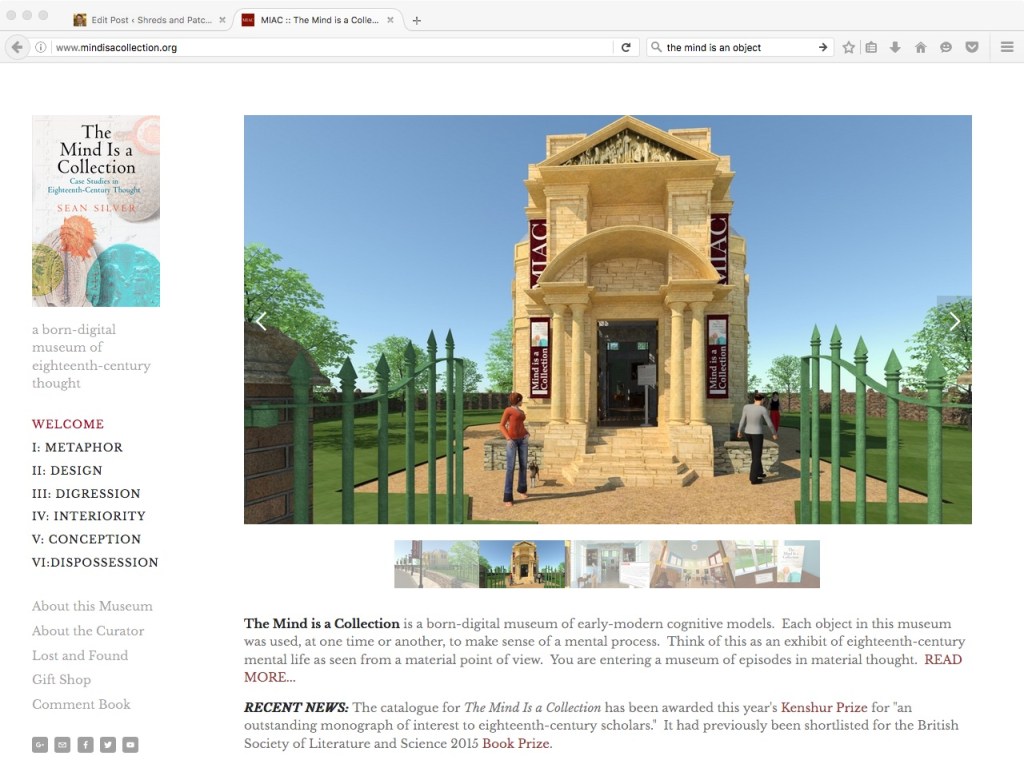
Figure: The landing page for Silver’s digital exhibition The Mind is a Collection.


XX For the social scientific reader, I also think that this book and digital exhibition participates in the contemporary conversation in the human sciences in a novel and interesting way. Like other particularly noteworthy works of our moment, it is a book about the recursive entanglement and co-constitution of humans (as individuals and in groups), objects, and ideas occurring together in particular environments. (For instance, consider Anna Tsing’s The Mushroom at the End of the World.) Its central concepts are shared keywords of our moment: design, complexity, network, embodiment, scale… Such matters interest many of us broadly, but in Sean’s project I find that they are being approached in fresh and new ways that I can happily begin carrying back into my own disciplinary conversations. His website and book are just the kinds of works that I could recommend to the graduate students with whom I work, as an anecdote to conventional approaches to conventional topics addressed with the help of canonical works. Put another way, the book and website engage shared interests in fresh ways. I say this from the perspective of someone who teaches a graduate course on Theories of Material Culture. I would welcome the challenge of working with students in that course in study of The Mind is a Collection.

XX The term material culture arose in the disciplinary context of anthropology. It fits and doesn’t fit in that field in a number of different ways in different times and places. In one now moribund American formulation, material culture was part of a triumvirate that also included mental culture and social culture. The phrase material culture persists despite our shedding of these two companion terms.  During the height of ideas and symbols-centric anthropology, material culture studies faced hard times in social and cultural anthropology. Folklore studies became a key contributor to the study of material culture during the time of its neglect in cultural anthropology.  Today, matters have changed again and material culture is front and center in anthropology and anthropologists face a changed landscape outside their field. The English Department at the University of Michigan has a nice website. When looking at the department’s faculty, one can sort them easily by research interests. In the past, but even today, many cultural anthropologists would be surprised to see that material culture is one of these departmental research foci. They would be even more surprised to see that twelve core faculty members in English—Sean among them—identify with this interest. The same dynamic is now active in many fields lacking deep histories of work in this area. Those who long studied material culture alone in a tiny disciplinary node now operate in a field that is broad and deep. Sean’s book arrives in this new context, one that is driven home each day when my editorial assistant and I open envelopes containing books sent to Museum Anthropology Review for review. If a skeptic asked me for an illustration of what a scholar of English could contribute to the material culture studies commons, The Mind is a Collection offers an incredible answer. But it also reveals the newer challenge for anyone working in material culture studies—this interdisciplinary field is now vast and sophisticated beyond the practical ability of most practitioners to keep up. Material culture studies has entered a new era.

15446

Figure: The cover of The Mind is a Collection (Penn Press, 2015).

Let me close with a reflection on “thinkering” this is a great word prominent in a great project. In the contexts in which it comes up here, this neologism caused me to think of a pronouncement that I always make when discussing the pleasures of being a curator. It comes up sometimes when I am discussing careers with graduate students. It always comes up in my graduate course in Curatorship, and it certainly has popped out when a non-museum friend or colleague finds me at work cleaning a vitrine with Windex or measuring a gallery wall with a tape measure. What I have said countless times is that the special pleasure of being a curator is that it is the perfect mix of brain work and of hand work—hammering one minute, studying in next. Now this dualism participates in exactly the problematic conceptualizations that are at issue in Sean’s study, but he is generous and, in my reading, he gives our folk psychology back to us and lets us get on with the work. While he holds a professorship and not, to my knowledge, a curatorship, it is a pleasure to have engaged with the work of someone whose brain work and hand work are so well integrated and so well executed. I hope that soon Sean will get the chance to build a physical exhibition to go along with his book-as-catalogue and his digital exhibition.

Improving Access to Scholarship: Material Vernaculars as Milestone and Experiment

First the take away, then the story. While produced in very nice and reasonably priced hardback, paperback, and ebook editions, works in the new Material Vernaculars series are also being made available in free-to-the-reader PDF versions. This is a great thing and, if you agree with me about that, and can afford to do so, I really hope that you will purchase the edition of your choice, thereby signaling your support for making such works freely accessible to those who cannot afford to purchase them. If this seems strange to you, its a lot like community and public radio in the United States. Those who can support these services help make them accessible to those who cannot afford to make their own donations. We all gently nudge those who use them and could, but don’t, support them. (Called free riders.) Its not utopia, but its what we have and its better than the vast majority of people being locked out of non-commercial arts and education programming (and scholarly books). Now you can skip to the end for the link if you are in a rush.

Slide1

Those who know about my work know that I have been focused on promoting free and open access to scholarly work for a relatively long time. My advocacy efforts followed soon after I began work as a scholarly journal editor. At that time, I was drawn into a diverse range of problems, opportunities, and paradoxes that the transformation of scholarly communication was (and is still) engendering. Probably the best place to find the things that I have written on this theme is to look at the interview that I did with Ryan Anderson (published in Cultural Anthropology in 2014)

In 2015, my focus in this work shifted to books when I was a participant in a project funded by the Mellon Foundation. The results of that project were reported in: A Study of Direct Author Subvention for Publishing Humanities Books at Two Universities: A Report to the Andrew W. Mellon Foundation by Indiana University and University of Michigan.

Concurrent with such advocacy work, I have tried to build real-world projects that could advance scholarship while testing strategies for increasing public access to research. Now in its tenth year, Museum Anthropology Review (now the journal of the Mathers Museum of World Cultures) is the best example of this. On the book side, there is now the Material Vernaculars series co-published by the museum and the Indiana University Press. In my previous post, I highlighted the series first title—Folk Art and Aging: Life-Story Objects and their Makers by Jon Kay and the series’ scholarly mandate. Here I am flagging the series’ relationship to free and open access movements.

Books cost a lot of money to make. In a peer-reviewed article, based on our humanities book research studying publishing work of the Indiana University Press and University of Michigan Press, my colleagues report that the zero copy cost for a typical humanities book is about $27,000. Efforts to increase access to scholarship have to find ways to confront these costs from all sides—finding ways to lower prices but also new ways of funding the professional work that it takes to make a quality book.

For me, for the museum, and especially for the IU Press, the Material Vernaculars series is an experiment. If we get past talking about it and actually begin doing it, what can we learn that will, we hope, help us learn to do it more and better? This is part of what is at stake for IU Press and for the whole world of university press humanities book publishing. I am thrilled to be a part of a new series that has a secondary role (beyond its primarily scholarly one) of finding ways to make scholarly books more widely and openly accessible.

So paradoxically, if you believe (for example) that the communities about whom ethnographers write should have access to what they write, then I call on you, paradoxically, to purchase a copy of Folk Art and Aging and the other other books that are in the pipeline. Your purchase helps support the goals of the series and it demonstrates that paid-for print editions or e-book editions are not mutually exclusive of free-to-readers electronic editions. If it helps, think of the print edition as a thank you gift for your donation to this cause rather than as a commodity that you are purchasing in the marketplace. You can feel particularly good about it if you purchase it directly from the Indiana University Press, thereby cutting out one or more commercial intermediaries.

It (PDF) won’t always be the file format of choice, but for now the free editions of Material Vernaculars titles will be circulated in PDF form via the IUScholarWorks Repository. When people download the books from IUScholarWorks, there is a download count, which helps us learn how many people, over what time period, showed interest in the book(s). (So, send your friends to the link rather than passing around the PDF…)

If you are wondering how to download the book, see the picture above for the place to click.

Here is the link. Two actually. The first is durable but enigmatic. The second is more human readable, but potentially less permanent.

http://hdl.handle.net/2022/20906
https://scholarworks.iu.edu/dspace/handle/2022/20906

Happy reading.

An Interview with Curator and American Music Specialist Levon Williams

Levon Williams will return to Indiana University in the fall of 2016 to pursue a MA degree in Non-Profit Management in the School of Public and Environmental Affairs. He holds a BA in Interpersonal Communications from Purdue University and studied Library and Information Science at IU. He has previously worked as Curator of Collections and Registrar at the STAX Museum of American Soul Music in Memphis and as Curator of the National Museum of African American Music in Nashville.

Jason Jackson (JJ): Thank you Levon for taking time for this interview. You are looking ahead to your new graduate program, but I am sure that you have also been reflecting on your recent years working as a curator and interpreter of American musical culture. What have been some highlights of your work as a museum professional so far?

Levon Williams (LW):  Well there have been many, but here are two that really standout. During my time at the Stax Museum, I had the opportunity to work collaboratively with the non-profit organization Facing History and Ourselves (FHAO). Facing History and Ourselves’ work focuses on empowering young people to be “upstanders” (as opposed to bystanders) by strengthening their capacity for empathy and understanding. Our goal was to create an educational curriculum for middle school and high school aged students centered around the development and music of Stax Records as well as the history of the Civil Rights movement of the 1960s and 1970s.

The opportunity to use the history of Stax Records as a lens through which to explore broader concepts such as Civil Rights history in this manner spoke directly to both my professional and personal goals. Using music as an entry point, we were able to help students frame their own history and related it directly to the lives they live everyday. FHAO were absolutely wonderful to work with on this project and I am very proud of the result. This curriculum includes text, images, as well as several audio/visual elements. It can be viewed here: Sounds of Change.

A second major highlight, was the opportunity to work collaboratively with the Curatorial Team at the National Museum of African American Music (NMAAM) to create what will become the interpretive program for the museums galleries. The NMAAM set open in Nashville, TN in 2018 will house 5 main galleries, a changing gallery and a large area for shared visitor experiences called Rivers of Rhythm. It is shaping up to be something that will be extremely engaging for visitors from various interests and walks of life.

It is not often that one has the opportunity to have input on how a story of this magnitude (the history of American music) will be told on this scale (roughly 1600 sq ft.)  Learning about the process of undertaking such a task, as well as working collaboratively to contribute to how the history and music will be contextualized in the story the museum will tell has definitely been another professional highlight.

JJ: Those are incredible experiences. In the case of the FHAO project, an exciting museum effort is closely aligned with positive social change. In the NMAAM, the creation of a new museum is itself a huge change, one that will surely create an important platform for doing good on a national level. How did your previous work in the field and your studies at Purdue and Indiana prepare you to contribute to those endeavors?

LW: I’d definitely suggest that in a way all of your previous experiences contribute to how you approach any given project in one way or another. However, specifically in regards to my undergraduate and graduate experiences, I would lean heavily on my graduate experience having a significantly strong impact.

Over my two years at Indiana University, I worked, volunteered and/or interned at Wells Library, Monroe County Public Library, IU GLBT Library, Kinsey Library and Special Collections, Archives of African American Music and Culture, Archives of Traditional Music, Mathers Museum of World Cultures and the Monroe County History Center. My understanding of how libraries, archives and museums worked increased exponentially. My association with these different organizations offered a wealth of opportunity to gain experience in all three disciplines, and was immeasurable in terms of exposing me to the inner workings of different organizations. I’d definitely say it did much to prepare me for my first steps into professional life. The opportunity to gain a deeper understanding of departments were set up, how workflows were managed as well as the seemingly inescapable politics of work were just a peak into what what I would encounter in the field, but I am beyond grateful for those opportunities.

I was also able to utilize these positions as a platform to build a strong professional network. I established relationships with several people I would come to call mentors. It has been tremendously helpful to be able to call on them during my time in the field. I am eternally grateful to all of them for the support they’ve offered over the years. Their collective impact on my career path cannot be understated.

JJ: I like how you stress the ways that skills development and networking are both part of the practicum/internship/volunteering experience. I also note that you treated libraries, archives, and museums as a diverse but unified sector—what, with the inclusion of galleries, we sometimes call the GLAM (galleries, libraries, archives, and museums) fields. You have finished up your work at NMAAM and are soon to return to IU as a student. What will you be studying and what are your goals for your program?

This fall I am returning to IU to pursue a Master of Public Affairs degree in the of the School of Public and Environmental Affairs. My focus will be Nonprofit Management. After spending close to 5 years in the field I felt this area might be one where I could make an impact of significance. I am a strong believer in the importance of a strong and supportive organizational culture. I feel that strong support and sustained investment (financial and otherwise) in creating and empowering strong leaders is especially pronounced in the Nonprofit sphere as organizations are often understaffed and may not have salaries that reflect the impact of the work they do. I feel an environment that is energizing and offers the potential for professional and personal growth goes a long way to keep staff passionate about the mission they serve.

On a personal note, my hope is to broaden my Administrative skill set and to return to the field with a strong foundation in best practices for operating healthy Nonprofit organizations as well as some practical experience as well. The SPEA Nonprofit Management program stands to significantly deepen my understanding of many of the Administrative elements of leadership in Nonprofit organization such as budgets and philanthropy in general. I strongly believe a better understanding of how these concepts all work together will prove invaluable as I continue my career. The program also offers a Capstone project that I am very excited about, as it will afford me the opportunity to apply the concepts I will be learning in class to real world scenarios. I look forward to possibly returning to museums or working with other organizations in the Nonprofit sphere once I have completed my degree.

JJ: The leadership needs that you’ve identified for the non-profit sector are certainly pressing. I am excited for you that you have this new opportunity to return to SPEA and secure this additional training. I look forward to keeping up with your work, both in the nonprofit management program and throughout your career. Thank you for sharing your experiences with me. Good luck with your new round of studies.