Not long after the publication of Linguistic Diversity in the South: Changing Codes, Practices, and Ideology, I was asked by an anthropology journal to review the book. The subject interested me greatly and I was acquainted with the work of the editor and several of the volume’s contributors. In a relatively timely fashion, I submitted the brief review that follows here. At the time, the journal’s editors asked that I expand the review to focus on the contents of the volume in greater detail, thereby bulking what amounts to a book note up to the scale of a full scholarly review. I fully intended to give this a try, but in the constant flow of new tasks, the matter was delayed so long that it was lost sight of. Rediscovering the review today, in the course of organizing my writing-related files, I experienced regret that I did not follow through and see the review through to publication. Rather that attempt to expand it at this stage and secure journal publication for it, I offer it here for those who know my interest in Southern cultural studies and linguistic anthropology and for those web searching researchers whose queries may lead them to the book or my comments on it. I apologize to the volume’s editor, contributors, and publisher for my lack of follow through. Thanks go to all involved for assembling a valuable contribution to the literatures in these fields. The actual review follows.
Linguistic Diversity in the South: Changing Codes, Practices, and Ideology. Southern Anthropological Society Proceedings, No. 37. MARGARET BENDER, editor. Athens: University of Georgia Press, 2004. Pp. 141. $19.95 (paper).
Reviewed by Jason Baird Jackson, Indiana University
Linguistic Diversity in the South is comprised of eight fine essays and a solid introduction contextualizing the volume’s contents and its place in contemporary sociolinguistics and linguistic anthropology. The papers gathered in the volume were originally delivered at the Southern Anthropological Society’s 2002 keynote symposium, which was organized by the volume’s editor, Margaret Bender. Contributors range from enterprising graduate student researchers to distinguished senior scholars. All offer brief, nuanced ethnographic or sociolinguistic treatments of language use in the southern United States.
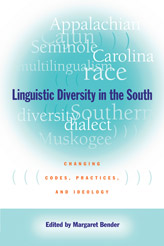 A great strength of the volume is the manner in which it, without attempting to be a comprehensive survey, offers a rich sampling of Southern speech-communities, ways of speaking, and language ideologies. The papers explore language in Native American [Lumbee (Walt Wolfram), Muscogee/Creek (Pamela Innes), Seminole (Susan E. Stans and Louise Gopher)], Mulungeon (Anita Puckett), Scotch Irish (Puckett), Cajun (Shana Walton), Appalachian (Kirk Hazen and Ellen Fluharty), Outer Banks (Wolfram), and North Carolina African American communities (Christine Mallinson). Blair Rudes contributes a paper historically surveying multilingualism, linguistic complexity and change in the Carolinas since contact. Bender’s introduction reflects experiences gained in her own work among the North Carolina Cherokee and links the volume’s contributions to contemporary theoretical concerns in linguistic anthropology, especially research on discourse, contact, maintenance, shift, and ideology.
It is exciting that the volume provides evidence that a critical mass of contextual research on language use in the Southern United States has been reached. Because of the conference proceedings format shared by all Southern Anthropological Society volumes, the papers contained within Linguistic Diversity in the South represent short, accessible samplings of broader, more detailed research programs. In this instance, this is a virtue, as, for instance, scholars consulting the book for its studies of language in Native American communities, easily also gain concise accounts of other Southern peoples and varieties. While many interesting and important communities are not treated in the volume, as Bender is quick to note, it does offer a clear picture of how linguistically and cultural complex the contemporary South is. The book thus counters conventional assumptions of Southern linguistic homogeneity at the same time that it proves to the fields of linguistics and linguistic anthropology that key general issues can be very productively examined from the perspective of the region’s ethnography.


 Shreds and Patches